
YMCA Bench Press Test
Absolute Upper-Body Muscular Endurance · Fixed Weight & Cadence
Lie flat with feet on the floor and a spotter at the head of the bench. Lower the bar to the chest on one beat and press to full lockout on the next. The test ends when you can no longer keep pace with the metronome or reach full range. No bouncing, and keep your hips and head on the bench.
Based on the YMCA’s published bench press norms (2000). The YMCA did not describe who was tested, and the norms are decades old, so treat your rating as a guide.
Retest every 4–6 weeks with the same weight, cadence and spotter, and compare against your own previous rep count. That comparison is the most reliable result on this page.
Based on the YMCA’s typical (50th percentile) count for each age group, from 18–25 to over 65.
Read from the YMCA’s percentile table (5th, 25th, 50th, 75th and 95th) for your age and sex, interpolated between rows and age groups.
YMCA Bench Press Standards by Age
Standards Across Age
Where You Fall in Your Age Group
The YMCA Bench Press Test
As many presses as you can with a fixed barbell (80 lb for men, 35 lb for women) in time with a metronome at 60 bpm: down on one beat, up on the next, for 30 reps per minute. The images below show the top, the bottom of each rep, and a rep that doesn’t count.
All three positions are shown from the side.
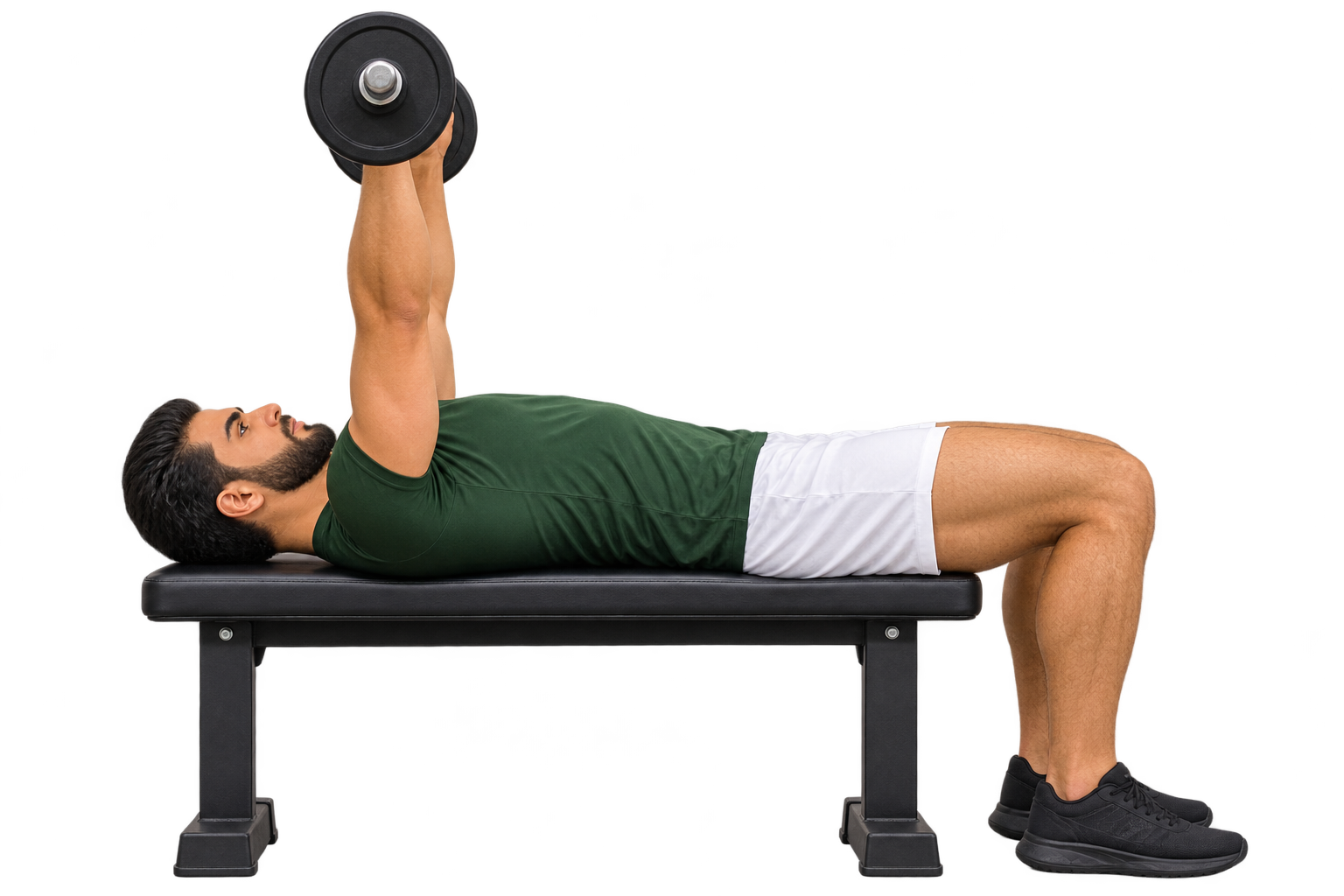
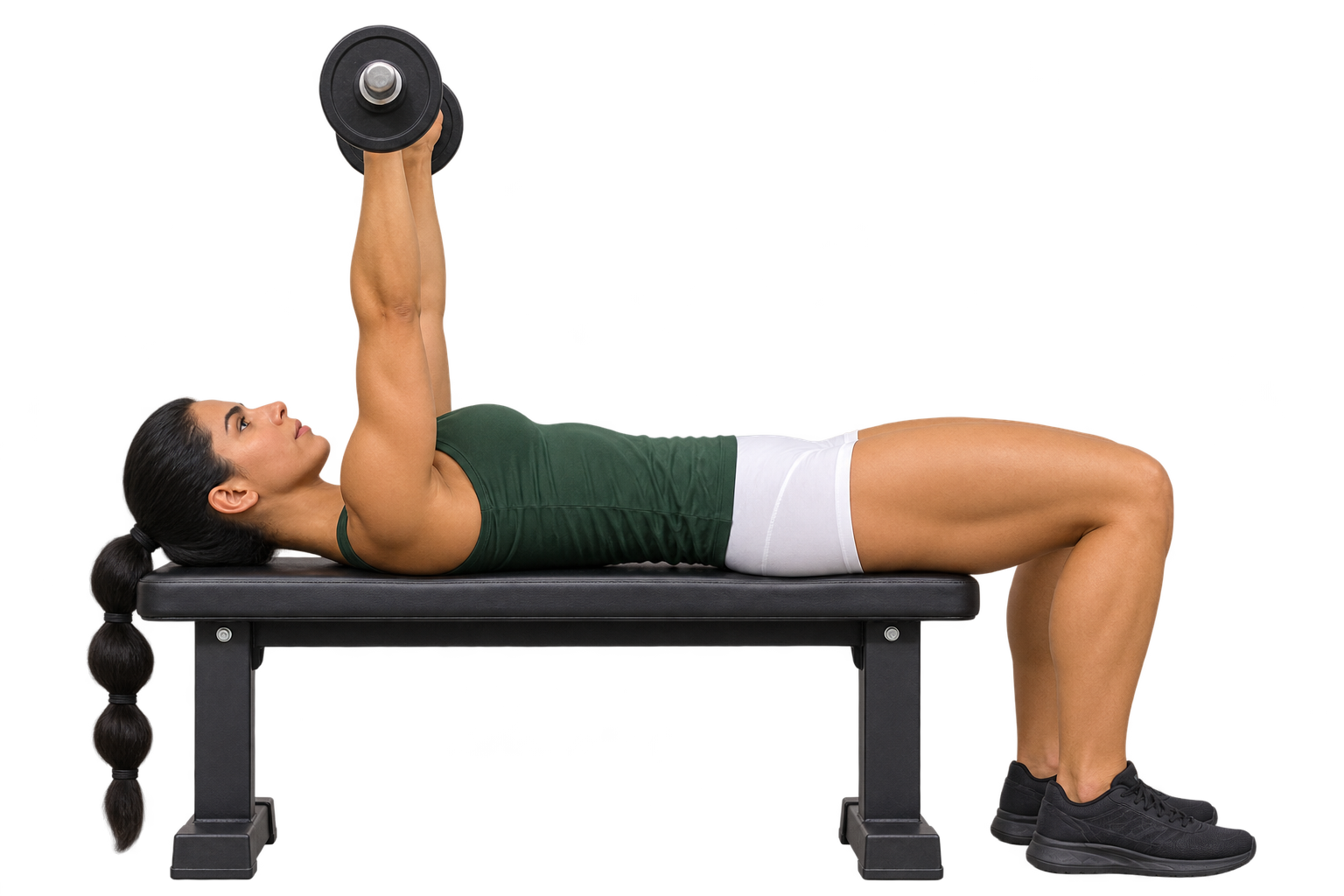
Arms Locked Out
Lie flat with your head, upper back and hips on the bench and feet flat on the floor. Grip the bar a little wider than your shoulders and start with your arms fully straight, the bar over your shoulders. Each rep finishes back here, at full lockout.
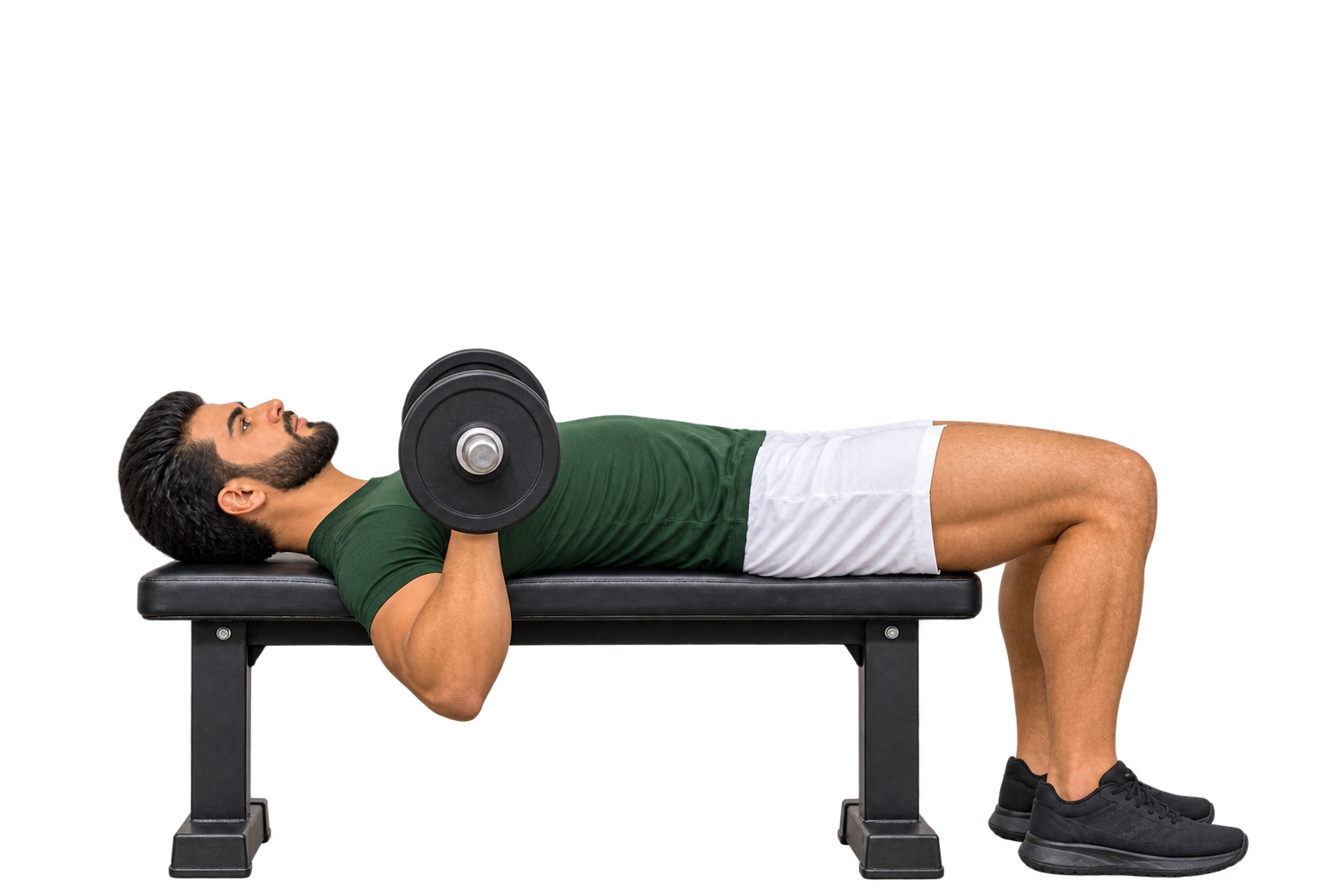
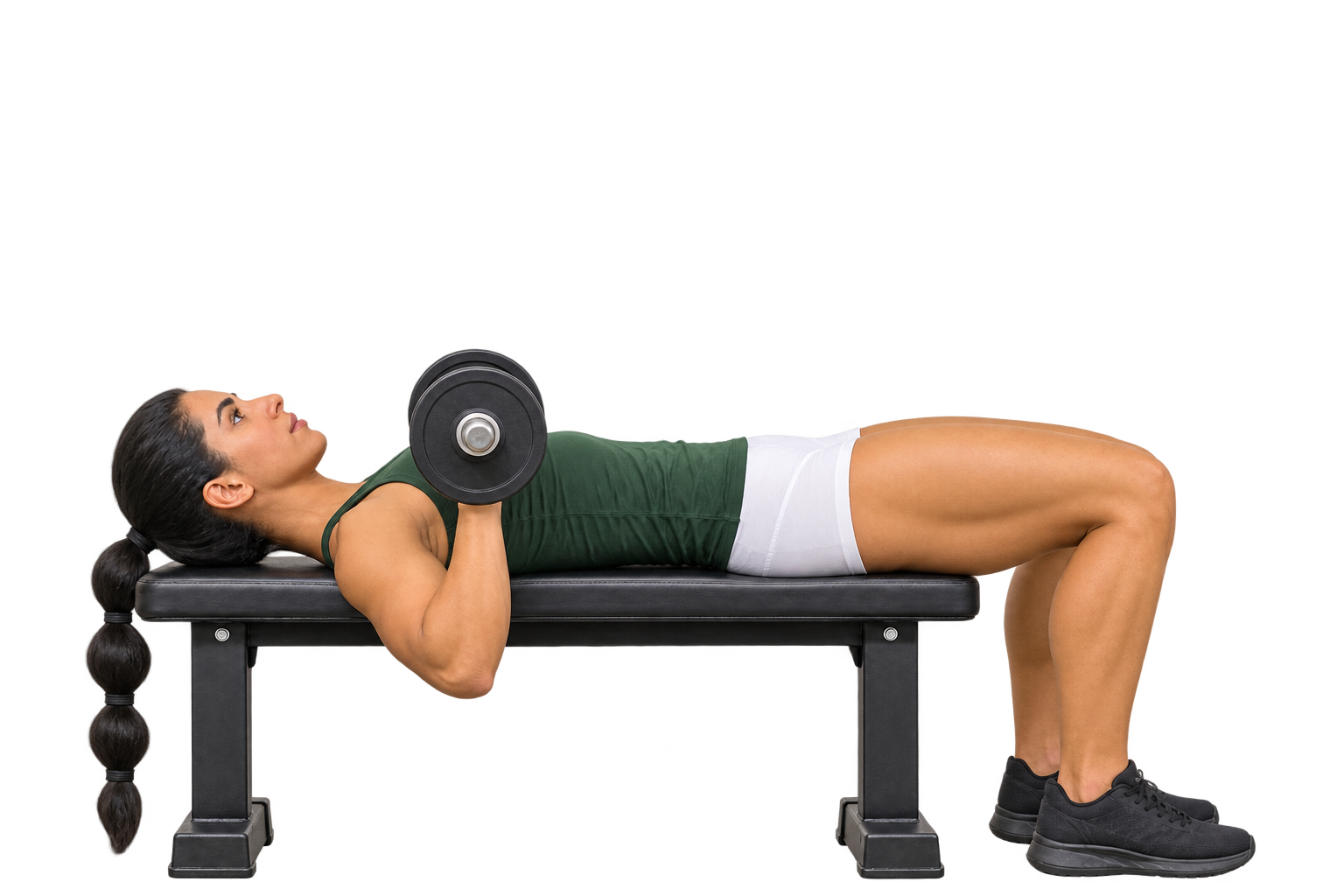
Bar to the Chest
On one beat, lower the bar under control until it touches your lower chest, forearms vertical under the bar. On the next beat, press it back to full lockout. That is one rep, and two beats.
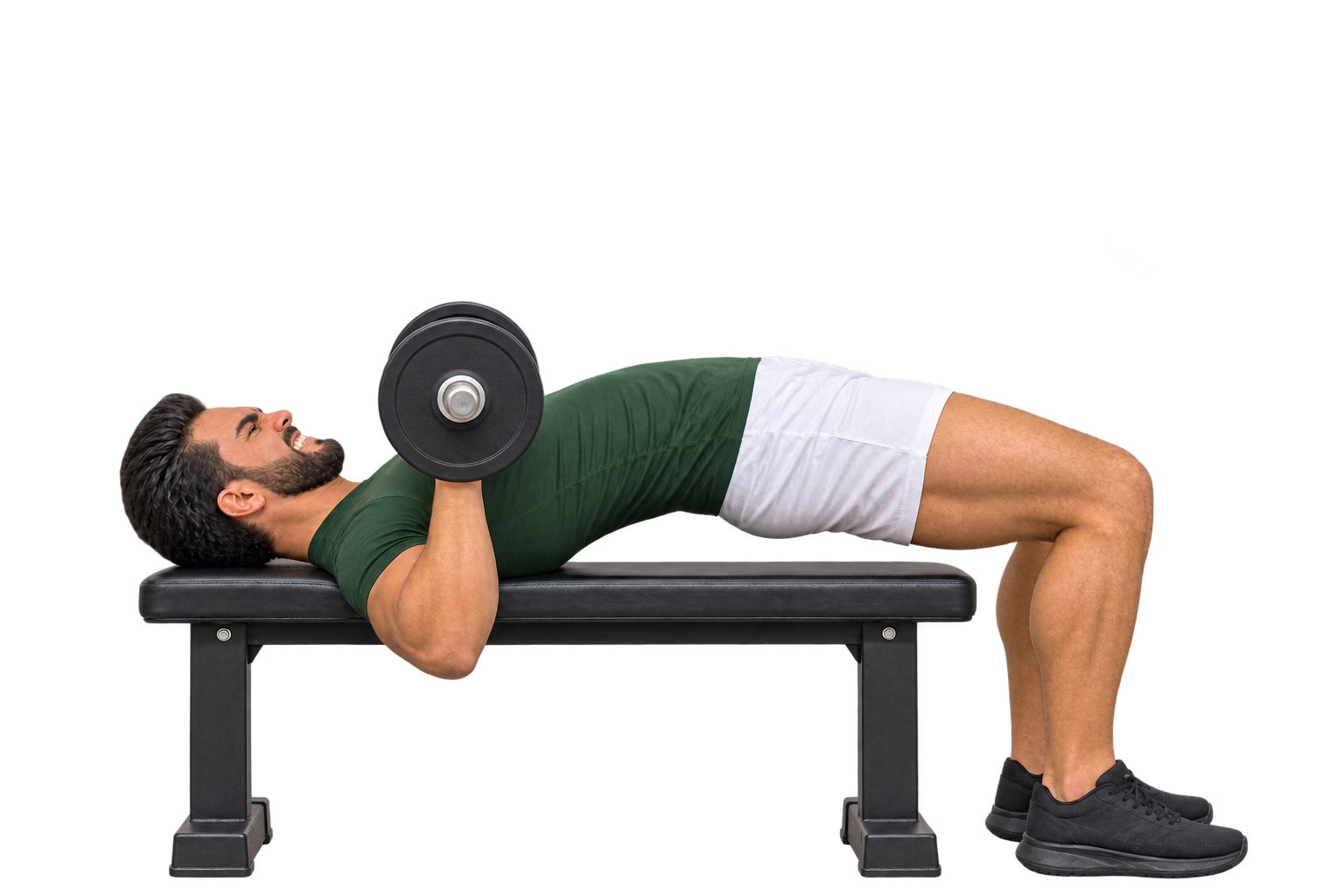
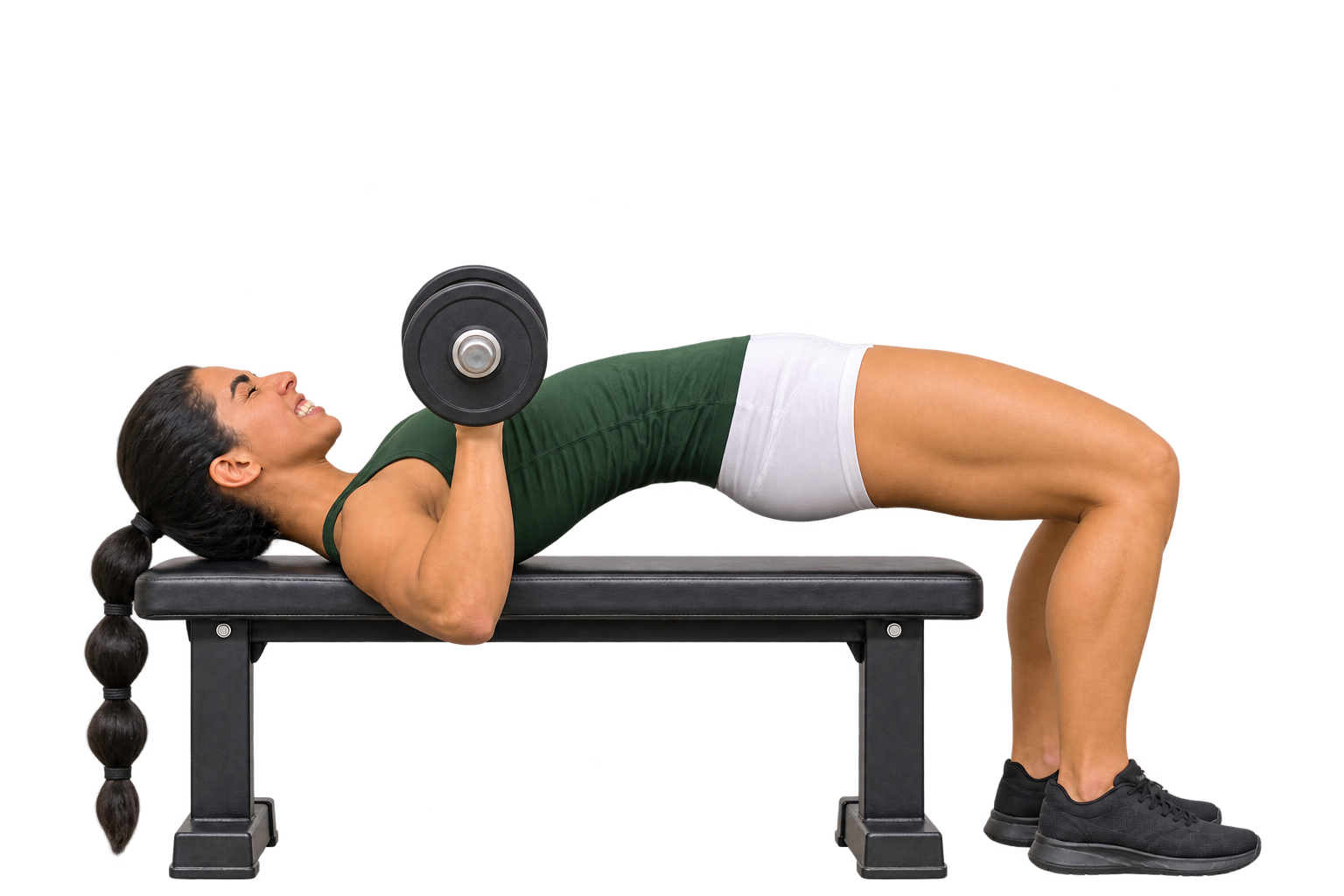
Hips Off the Bench
Lifting your hips or head, bouncing the bar off your chest, or stopping short of the chest or lockout means the rep doesn’t count. The test ends when you can no longer keep pace with the metronome or reach full range.
Use a spotter standing at the head of the bench, warm up first, and stop right away if you feel shoulder, elbow or chest pain. The weights are totals, including the bar. The calculator’s standards apply only to this fixed weight and 60 bpm cadence.
YMCA Bench Press Test Video
A walkthrough of the YMCA bench press test: the fixed barbell weight, pressing in time with a metronome, full range on every rep, and when the test ends.
For the test: use 80 lb for men or 35 lb for women in total, including the bar, and set a metronome to 60 bpm: the bar goes down on one beat and up on the next, for 30 reps per minute. Every rep touches the chest and finishes at full lockout, with hips and head on the bench. The test ends when you can no longer keep pace or reach full range. Always use a spotter.
This video is from an external YouTube channel and is not produced or endorsed by Amatal. It is shown for general technique reference only and is not medical or training advice. Any products or programs mentioned in the video or its description are the creator’s own.
How This Calculator Works
This calculator measures your absolute upper-body muscular endurance using the YMCA Bench Press Test, a long-standing field assessment in which you press a fixed-weight barbell in time with a metronome for as many reps as you can. You enter how many reps you complete, and the calculator classifies your result against Amatal’s five-tier scale for your age and sex, then computes your category, your Bench Age, an estimated percentile, and where you fall on a bell curve.
How These Standards Were Set
The YMCA publishes bench press rep counts at the 5th, 25th, 50th, 75th and 95th percentilesThe counts that beat 5%, 25%, 50%, 75% and 95% of people of the same age group and sex in the YMCA data. for six age groups (18–25, 26–35, 36–45, 46–55, 56–65 and over 65), separately for men and women. Amatal’s tier cutoffs are set from those rows:
The Elite cutoff is the YMCA’s own 95th-percentile value. The YMCA table has no 35th, 65th or 85th row, so those three cutoffs are placed between its rowsThe 35th sits between the 25th and 50th rows, the 65th between the 50th and 75th, and the 85th between the 75th and 95th, positioned on a normal-curve (z-score) scale rather than a straight line. on a normal-curve scale, the same method Amatal uses on other pages with sparse percentile tables.
Each age group is anchored at its midpoint (about 22, 31, 41, 51 and 61, with over 65 treated as 70), and values for the ages in between are interpolated in a straight line, so your exact age gets its own standards rather than jumping at a birthday. Ages 18 to 21 use the 18–25 values. Each result is rounded up to a whole rep once, and those same whole numbers drive your category, the table and the chart.
The calculator covers ages 18 to 70 and does not extrapolate. The YMCA’s oldest group is open-ended (“over 65”), so it is treated as representing about age 70.
Step 1: Enter Your Details
The calculator needs three inputs: your sex, your age, and the number of reps completed.
- SexThe norms are reported separately for men and women, partly because the test uses a different fixed load for each (80 lb vs. 35 lb). — selects which YMCA table and which barbell weight apply.
- Age — determines the standards for your stage of life. Ages 18 to 70 are supported.
- Reps Completed — the number of full presses you complete in time with the metronome before you can no longer keep pace or reach full range.
The Test Protocol
For results that match the norms, do the test the way the YMCA protocol describes:
- Equipment: A barbell loaded to 80 lb (36 kg) total for men or 35 lb (16 kg) total for women, including the bar and collars, a flat bench, and a metronome set to 60 beats per minute.
- Position: Lie face-up on the bench with your feet flat on the floor and a spotter standing at the head of the bench. Grip the bar about shoulder-width apart and start with your arms extended.
- Cadence:At 60 bpm the bar moves on every beat: down on one beat, up on the next. One complete rep takes two beats, which gives 30 reps per minute. Lower the bar to your chest on one beat and press it to full lockout on the next, for a steady 30 reps per minute. Holding the pace is what makes the test standardized.
- Each repetition: The bar touches the chest and the elbows fully extend at the top. Don’t bounce the bar, and keep your hips and head on the bench.
- When it ends: Keep going until you can no longer keep pace with the metronome or can no longer reach full range. Your score is the number of completed reps. Breathe steadily throughout; don’t hold your breath.
How Your Category Is Determined
Your result is placed on the same five-tier scale used across this platform, so the bench press test reads consistently alongside the other assessments:
Low · Intermediate (35th percentile) · Advanced (65th) · Superior (85th) · Elite (95th)
Your rep count is compared against the minimum reps required for each tier at your age and sex, and you are placed in the highest tier you qualify for:
- Low — below the 35th percentile for your group. A clear starting point with room for improvement.
- Intermediate — around the middle of the data (35th to 65th percentile). Typical of the adults in the YMCA data.
- Advanced — 65th to 85th percentile. Reflects consistent upper-body training.
- Superior — 85th to 95th percentile. Characteristic of well-conditioned individuals.
- Elite — 95th percentile and above for your age and sex. Among the highest rep counts in the YMCA data.
How to Read the Standards Table
The standards table lists one row for every five years of age from 20 to 70, plus age 18 and an extra row for your exact age, and one column for each of the five levels. The header labels are color-coded to match the chart bands — on a phone the headers shorten to single letters (L · I · A · S · E); tap any header to see its full name.
- Each cell is a single number — the minimum. It shows the fewest reps needed to reach that level at that age. If your result equals or exceeds it, you’ve reached that level.
- The Low column is the exception.Low has no minimum: it runs from zero up to one rep below the Intermediate cutoff. The number shown is the middle of that range. Because Low runs from zero up to the Intermediate cutoff, the number shown there is a midpoint for display only, not a threshold you need to hit.
- Your row and level are highlighted. The row for your exact age is shaded, and within it, the cell for your achieved level is filled with that tier’s color.
Bench Age
Your Bench AgeThe age at which your rep count would be considered typical (median) performance. Conceptually similar to "fitness age" used in cardiovascular testing. is the age at which your result would be average. If you complete more reps than the typical person of your actual age, your Bench Age is younger; if fewer, it is older.
The typical count at each age is the YMCA’s 50th percentile. For men it is highest in the 18–25 group and declines from there; for women it holds level through the 26–35 group, then declines. A result at or above that peak shows as ≤21 for men or ≤30 for women, and a result below the typical over-65 count shows as 70+. If you are at or above the typical count for your own age, the calculator says so rather than giving you an older Bench Age.
Percentile Estimate
The percentile estimates the share of people of your age and sex in the YMCA data who complete fewer reps than you. Your count is placed between the YMCA’s percentile rows for your exact age (5th, 25th, 50th, 75th and 95th) on a normal-curve scale, so the percentile always agrees with your category:
Beyond the data’s range the calculator doesn’t guess: above the 95th row it shows >95th, and below the 5th row it shows <5th (or ≤5th where the 5th-percentile count is zero, as for older adults).
The Bell Curve
The “Where You Fall in Your Age Group” chart draws a normal curveA bell-shaped curve that describes how results spread around an average: most people near the middle, fewer at either end. fitted to the YMCA’s percentile points for your age and sex, cut off at zero reps. The colored bands are the five tiers, and the dashed line marks your result.
Real rep counts are whole numbers and not perfectly symmetric. The top of the YMCA table is stretched out (the jump from the 75th to the 95th percentile is large), and some older adults can’t complete a single rep with the test weight. A smooth bell can’t show that exactly, so the curve is a positioning aid. Your category and percentile come from the YMCA table, not from the curve.
How Age and Sex Change Your Score
These two inputs do not just describe you — each one directly changes the numbers your result is measured against:
- Age changes the thresholds. The calculator recomputes the rep requirement for every tier at your exact age. In the YMCA data, rep counts decline with age, most steeply after 40, so the same count is judged against lower requirements as you get older — an identical number of reps can place you in a higher tier at 55 than it would at 25.
- Sex selects a different table and a different weight.Women press 35 lb and men press 80 lb, so similar rep counts in the two tables do not mean similar strength. Choosing male or female swaps in the YMCA’s separate men’s or women’s norms, and the test itself uses a different fixed load. The two tables have similar rep counts because the women’s weight is much lighter, so a man’s and a woman’s results are not directly comparable.
Why Upper-Body Endurance Matters
Because the test uses a fixed external load rather than your own body weight, it measures absolute upper-body endurance: how many times your chest, shoulders and triceps can move a set weight at a steady pace. That kind of endurance supports everyday pushing tasks and many jobs and sports that involve handling fixed loads.
The rep count also tracks maximal strength. In a study of 58 untrained medical students, YMCA reps at the standard cadence predicted one-rep-max bench press well (r ≈ 0.87 for both men and women). That makes the test a practical, lower-risk way to estimate strength without lifting a maximal load. As with any single field test, it is one useful marker among many, not a complete picture of health.
Data Sources and Verification
The bench press standards come from the YMCA’s norms. The other references support the protocol, validity and context:
- YMCA of the USA (2000). YMCA Fitness Testing and Assessment Manual (4th ed.). Champaign, IL: Human Kinetics — bench press percentile norms by age group and sex (5th, 25th, 50th, 75th and 95th percentiles) and the standardized protocol. Source of all thresholds, the percentile estimate, Bench Age and the bell curve on this page. The table values were taken from a reproduction in Heyward’s textbook (below) and cross-checked against a second copy.
- Heyward, V.H., & Gibson, A.L. (2014). Advanced Fitness Assessment and Exercise Prescription (7th ed.). Human Kinetics — reproduces the YMCA bench press norms; muscular-endurance testing methodology.
- Kim, P.S., Mayhew, J.L., & Peterson, D.F. (2002). A modified YMCA bench press test as a predictor of 1 repetition maximum bench press strength. Journal of Strength and Conditioning Research, 16(3), 440–445 — validation of the test as a one-rep-max predictor (r² = 0.757 for men and 0.754 for women at the standard cadence).
- Kushnick, M.R., Cunningham, D., Bullard, S., & McGlynn, M.L. (2020). Normative Values of College-Aged Men and Women for the YMCA Bench Press Test for Muscular Endurance. Journal of Physical Activity Research, 5(1) — newer norms from 100 men and 100 women aged 18–25, who averaged about 34 and 25 reps. Notes that the original YMCA norms were published without details on the people tested. Not used for scoring.
- Ronai, P. (2020). The YMCA Bench Press Test. ACSM’s Health & Fitness Journal, 24(6), 33–36 — protocol, spotting and common errors.
Limitations and Important Caveats
This calculator provides an estimate, not a clinical measurement. Several factors affect how precisely it reflects your true upper-body endurance:
- Who was measured. The YMCA did not report the size or makeup of its sample, and the norms date back to the late 1980s. A 2020 college sample scored well above the YMCA’s 18–25 values, so younger adults may rate higher here than against today’s peers.
- Secondary copies of the table. Amatal took the YMCA’s values from a textbook reproduction, not from the YMCA manual itself. Two copies were cross-checked and agree.
- Modeled steps. The YMCA reports only five percentiles in six age groups, so the Intermediate, Advanced and Superior cutoffs are placed between rows, values between group midpoints are interpolated, and over 65 is treated as about 70. Ratings cover ages 18 to 70 only.
- Absolute load favors bigger lifters. Everyone of the same sex presses the same 80 or 35 lb, so larger, stronger people have an advantage, and the score isn’t adjusted for body size. Smaller and older, less-conditioned adults may find the weight close to their maximum.
- Cadence and range of motion. Drifting off the metronome, stopping short of the chest or lockout, and bouncing the bar are the largest sources of error in a self-administered test.
- Single-test snapshot. Fatigue, sleep, time of day, grip, and recent training all affect a single test. For tracking progress, retest under the same conditions every few weeks.
Disclaimer:
This calculator provides an estimate based on the YMCA’s bench press norms, with three tier cutoffs placed between the published percentile rows. Real upper-body endurance depends on training history, technique, body size, recovery, and individual variation. Always warm up before any fitness test, use a spotter, and stop immediately if you experience pain, dizziness, or unusual discomfort. This tool is for general informational purposes only and should not be considered medical, fitness, or training advice. Consult a healthcare provider before beginning a new exercise program, especially if you have a pre-existing condition, are over the age of 45, or have been sedentary for an extended period.