
McGill Endurance Battery
Trunk Flexor · Extensor · Side Bridge (Right & Left)
McGill's clinical targets — the most important part of the test.
Reference Standards
You vs Population Mean
How to Perform the Four Holds
Each hold is timed to failure. Rest fully between them, and record all four times.
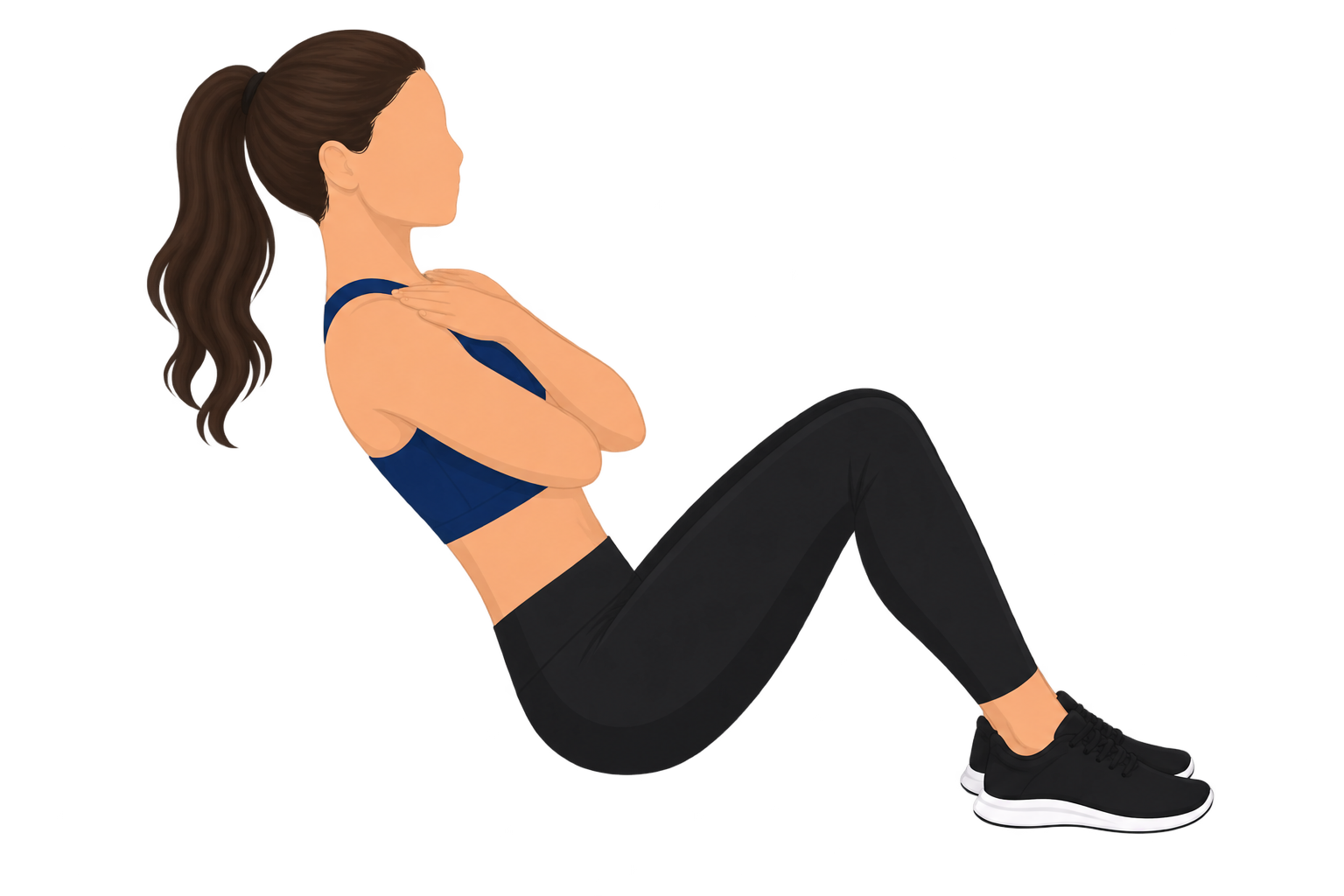
Trunk Flexor
Sit with your torso reclined 60° from the floor, hips and knees at 90°, feet flat and anchored, arms folded across your chest. A support is pulled back a few inches and timing begins.
Ends when any part of your upper back touches the support.
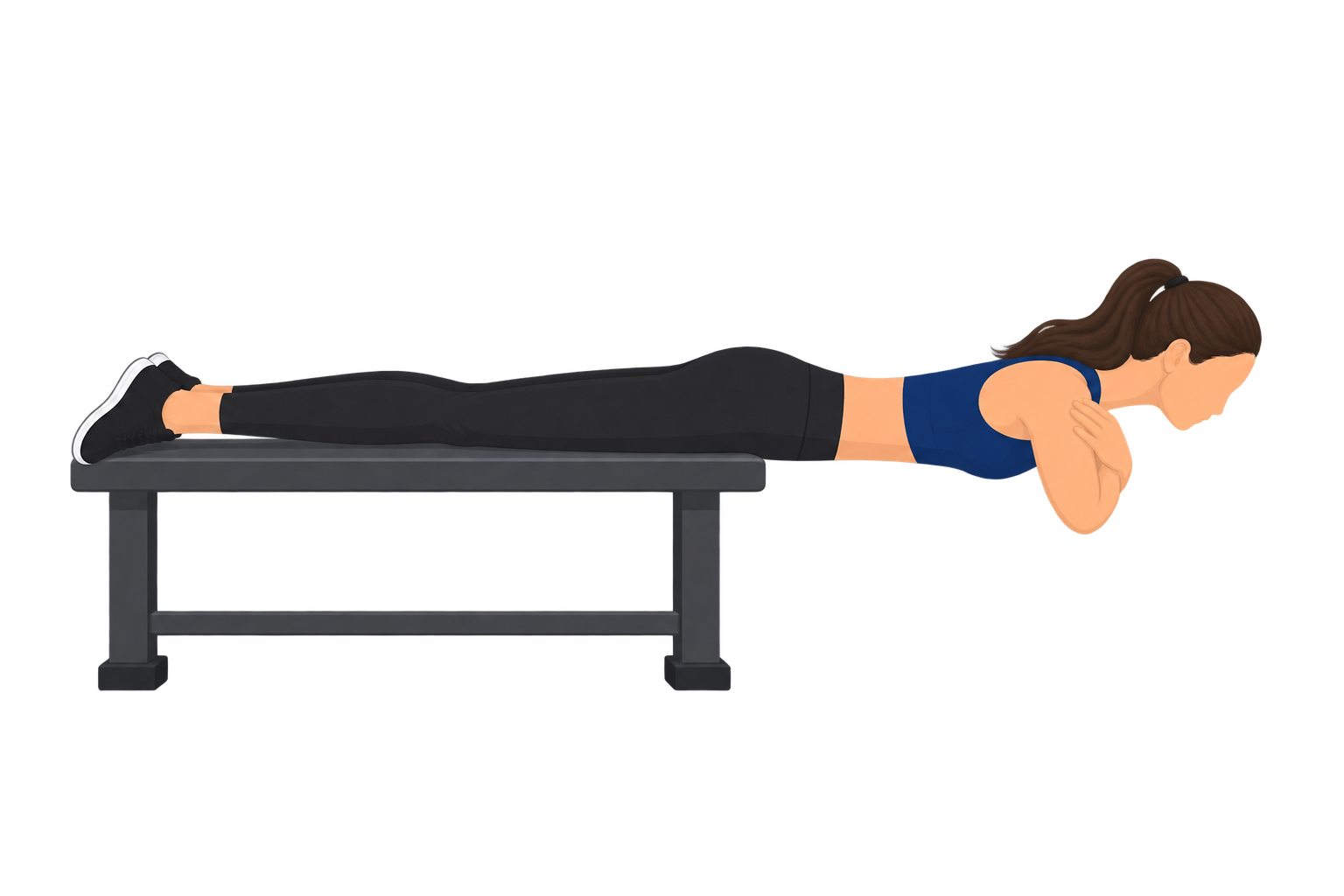
Trunk Extensor
Lie face down with the bench edge at your hips, upper body unsupported off the end. Ankles and pelvis are strapped, arms folded across your chest. Hold your torso level with the floor.
Ends when your upper body drops below horizontal.
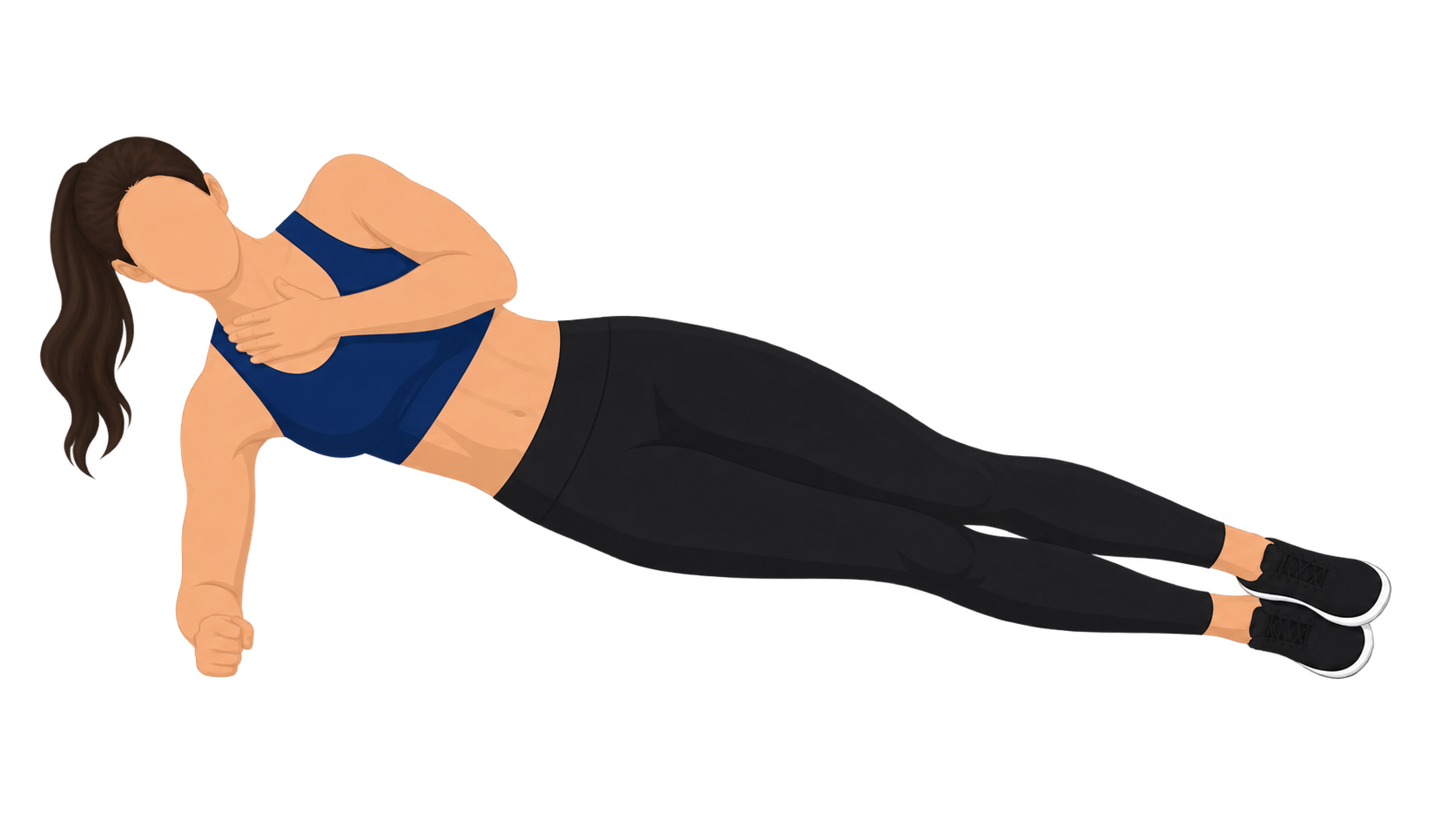
Right Side Bridge
Lie on your right side on your right forearm, top foot ahead of the bottom one. Lift your hips so your body forms a straight line from head to feet, free arm across your chest.
Ends when your hip drops from that line.
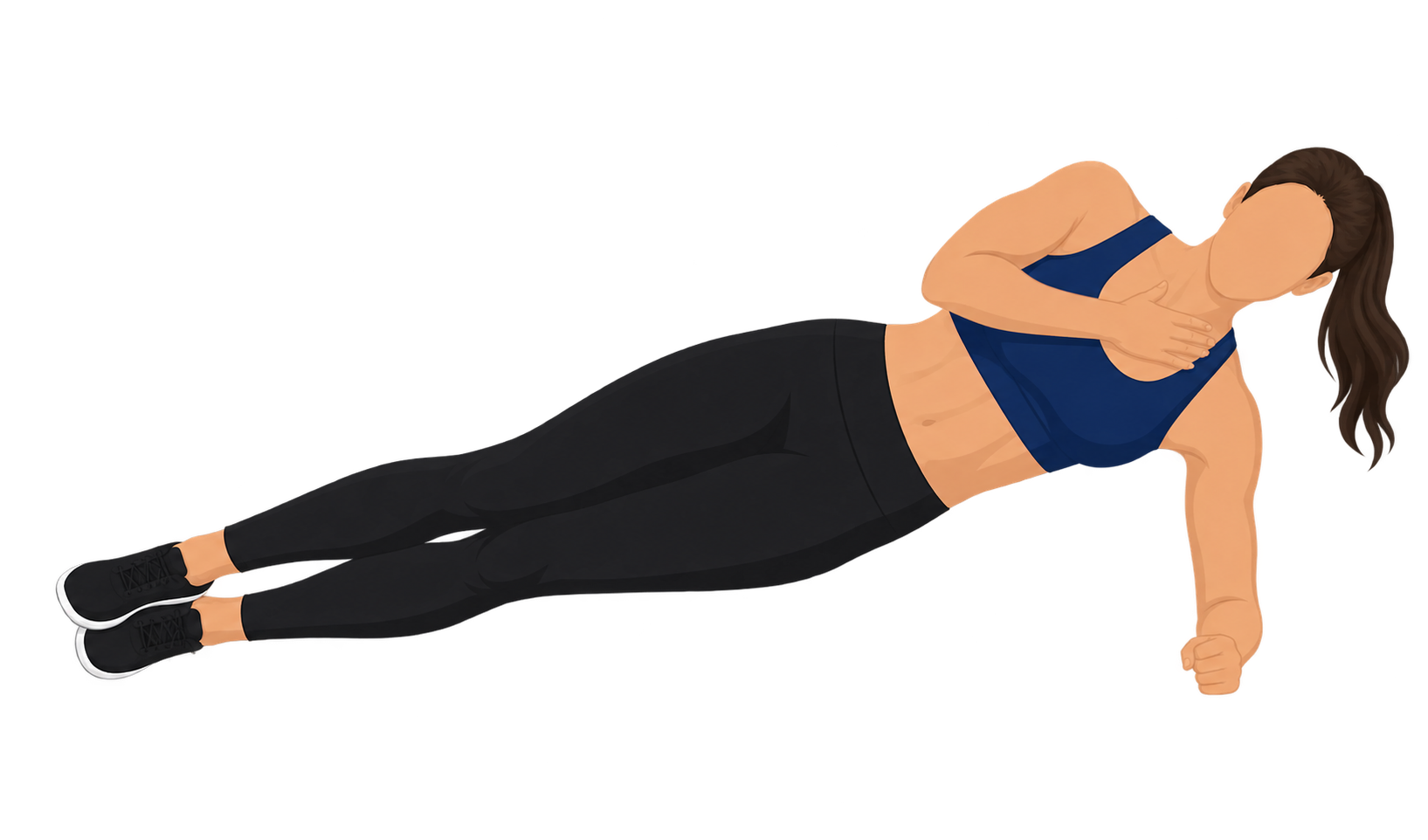
Left Side Bridge
Repeat on your left side, on your left forearm. Same setup, same straight line. Time each side separately — the comparison between them is one of the three ratios this test reports.
Ends when your hip drops from that line.
Each hold is a maximum effort held to failure, so rest fully between them. Timing accuracy matters more than the exact stopwatch used — keep the setup, footwear, and surface consistent so retests are comparable.
The Four Holds in Practice
A walkthrough of the setup and timing for each of the four positions.
Video is external and not produced by Amatal. Follow the written protocol above where the two differ — the timings on this page are scored against the published test setup.
How This Calculator Works
This calculator scores the McGill Core Endurance Battery — four timed isometric holds that measure the endurance of the muscles that stabilise your spine. You enter how long you can hold each position, and the calculator classifies every test against McGill's normative database, then does the part that matters most: it checks the balance and symmetry between the four tests. McGill's central insight was that the relationships between these muscle groups predict spine health better than any single hold time on its own.
Step 1: Enter Your Details
The calculator needs your sex, your age, and the hold time in seconds for each of the four tests.
- SexMcGill reported norms separately for men and women. Notably, women held the extensor test longer than men, while men held the side bridge longer — so the comparison tables genuinely differ. — selects which normative table you are compared against.
- AgeAge is recorded but does not change the standards. McGill's database was a young-adult cohort with no age-graded breakdown, so there is no defensible way to age-adjust these particular norms. — recorded for your records; it does not shift the standards (see below).
- Trunk Flexor, Trunk Extensor, Side Bridge Right, Side Bridge Left — your maximum hold time, in seconds, for each position, taken to the point of form failure.
The Test Protocol
For your results to mean anything against the norms, each hold must be performed the way McGill standardised it. Tests are done in random order with rest between them, and the timer stops the instant the position is lost.
- Trunk Flexor: Sit with your back against a support angled 60° from the floor, hips and knees bent at 90°, arms folded across the chest, toes anchored. The support is pulled back a few inches and timing begins. The hold ends when any part of your upper back touches the support.
- Trunk Extensor (Biering-Sørensen):Named after the 1984 study that first used it. Because the upper body is cantilevered, this test loads the lower back and is not appropriate for anyone with acute back pain. Lie face-down with your upper body extended off the end of a bench from the hips up, ankles and pelvis strapped down, arms folded across the chest. Hold your torso level with the floor. Timing ends when your upper body drops below horizontal.
- Side Bridge (Right & Left): Lie on your side, supported on your forearm and feet, top foot ahead of the bottom one. Lift your hips so your body forms a straight line from head to feet, free arm resting across your chest. The hold ends when your hip drops. Both sides are tested separately.
How Your Level Is Determined
Rather than fixed pass marks, each hold is scored by how far it sits from the average for your sex, measured in standard deviationsA standard deviation (SD) describes the normal spread of scores. About two-thirds of people fall within one SD of the average; reaching two SD above puts you near the top of the group. (SD). Each test is placed on the same five-tier scale used across the site:
- Below Average — more than one SD below the mean. A clear weak point worth prioritising in training.
- Fair — within one SD below the mean. Below the average but within the normal range.
- Good — at or above the population mean. Meets the healthy young-adult average for this test.
- Very Good — one SD above the mean or better. Well-conditioned trunk endurance.
- Excellent — two SD above the mean or better. Among the strongest performers in the database.
Balance & Symmetry — The Heart of the Test
This is where the McGill battery differs from a simple fitness test. McGill found that low-back problems often come not from weak muscles but from imbalance — for example, flexors that out-endure the extensors. The calculator computes three relationships and flags any that fall outside the healthy pattern:
Flagged if ≥ 1.0.A ratio of 1.0 or higher means your flexors out-last your extensors — the reverse of a healthy, stable trunk. The extensors should out-last the flexors.
Flagged if ≥ 0.75. A high ratio points to relative extensor weakness or lateral overactivity.
Flagged if the sides differ by more than 5%, which signals a lateral asymmetry worth correcting.
Each result shows your value, the healthy mean for your sex, and the flag threshold — so a "pass" against the threshold doesn't hide how far you sit from the actual norm. A man at 0.74 on the side-bridge ratio technically clears the 0.75 flag, but is still well above his sex average of 0.58.
How to Read the Standards Table
The table lists one row per test and one column per level. Headers are color-coded to the tiers; on a phone they shorten to abbreviations (BA · F · G · VG · E) — tap any header for its full name.
- Each cell is the minimum hold time (in seconds) needed to reach that level. Reach or beat it and you've reached that tier.
- The thresholds are built directly from the norms: Fair = mean − 1 SD, Good = mean, Very Good = mean + 1 SD, Excellent = mean + 2 SD.
- The Below Average column is the exception.Below Average has no real minimum — it runs from zero up to the Fair threshold. The number shown is just a representative point inside that range. The number there is a representative point for display only, not a mark to hit.
- Your level is highlighted in each row, filled with that tier's color.
Percentile & Your Limiting Link
For each test, your hold time is converted to a percentile using the normal distributionA standard statistical model of how scores spread around an average. Your distance from the mean (in SD) maps to the share of people you'd outperform. around the published mean and SD. The calculator then reports your average percentile across all four holds and names your limiting link — the single test where you score lowest.
Because spine stability depends on the weakest contributor as much as the strongest, the limiting link is often more actionable than your overall average.
Why There Is No Age Adjustment
Unlike some tests on this site, this calculator does not scale the standards by age. McGill's database was drawn from healthy young adults (mean age about 21), and the study did not publish age-graded breakdowns. Inventing a decline curve would mean adding precision the data doesn't support.
The practical consequence: everyone is compared to the young-adult reference. If you're older, expect your hold times to read lower than they would against an age-matched standard — that's expected and honest, not a flaw in your performance. The ratios, however, are far more stable across age, which is another reason the balance section is the most reliable part of your result.
Why Core Endurance Matters
Endurance of the trunk stabilisers — not raw strength — is what keeps the spine stiff and supported through everyday movement. The extensor (Biering-Sørensen) test in particular has prospective evidence behind it: a landmark 1984 study tracked previously healthy adults and found that those with lower back-extensor endurance were more likely to develop first-time low back pain over the following year.
Important context: that finding is an association in a specific population, not proof that training one muscle prevents pain. McGill's own framework emphasises the same point in a different way — it's the balance between flexors, extensors, and the two sides, rather than any one number, that characterises a resilient spine. Treat your results as a map of where your trunk is strong, weak, or asymmetric, not as a diagnosis.
Data Sources and Verification
The norms, ratios, and methods in this calculator were verified against the original published research:
- McGill, S.M., Childs, A., & Liebenson, C. (1999). Endurance times for low back stabilization exercises: clinical targets for testing and training from a normal database. Archives of Physical Medicine and Rehabilitation, 80, 941–944 — the primary source of the mean hold times, standard deviations, and ratio targets (75 healthy young adults; 31 men, 44 women).
- McGill, S.M. Low Back Disorders: Evidence-Based Prevention and Rehabilitation. Human Kinetics — reproduces the normative table and the clinical interpretation of the ratios.
- Biering-Sørensen, F. (1984). Physical measurements as risk indicators for low-back trouble over a one-year period. Spine, 9, 106–119 — origin of the extensor endurance test and the prospective low-back-pain finding.
Limitations and Important Caveats
This calculator provides an estimate, not a clinical measurement. Several factors affect how precisely it reflects your true trunk endurance:
- Young-adult norms, no age adjustment. The reference values come from a young cohort and are applied to all ages. Older users will score lower against them by design.
- Single, modest sample. The norms rest on one study of 75 university-aged subjects. They are the most-cited reference for this battery, but they are not a large or demographically broad population.
- Protocol sensitivity. Trunk angle, strap placement, how level the torso is held, and what counts as "form failure" all shift the result. McGill's high reliability figures assume careful, consistent setup.
- Body leverage. Limb length, torso length, and body weight change how hard each hold is, independent of muscular endurance.
- Order and fatigue effects. Doing the tests in sequence with too little rest lowers later scores. Sleep, recent training, and time of day all matter for a single session.
- The extensor test loads the spine. It is not appropriate during acute back pain or for some populations, and the ratios become unreliable if any single hold is cut short by discomfort.
Disclaimer:
This calculator provides an estimate based on published normative data and standard scoring methods. Real trunk endurance and spine health depend on training history, technique, body proportions, recovery, and individual variation. Always warm up before any fitness test and stop immediately if you experience back pain, dizziness, or unusual discomfort — particularly during the extensor hold, which loads the lower back. This tool is for general informational purposes only and is not medical, fitness, or rehabilitation advice. Consult a healthcare provider before beginning a new exercise program or testing protocol, especially if you have a history of back problems, a pre-existing condition, are over the age of 45, or have been sedentary for an extended period.