
Dips Test
Upper-Body Muscular Endurance (Chest & Triceps)
Lower until your elbows bend to at least 90°, press to full lockout, and don’t pause at the top for more than about 2 seconds. Stop right away if you feel shoulder, elbow or chest pain.
Based on Strength Level’s self-logged community data, mapped to Amatal’s tiers. People who log dips there are mostly regular gym-goers, so these standards are demanding.
Retest every 4–6 weeks with the same protocol and compare against your own previous rep count. That comparison is the most reliable result on this page.
Based on Strength Level’s typical (50th percentile) result at each age from 40 to 65. Ages 25–40 share one peak value in that data.
Estimated from Strength Level’s 5th, 20th, 50th, 80th and 95th percentile points for your age and sex. It compares you with Strength Level users, not the general population.
Dips Standards by Age
Standards Across Age
The Dips Test
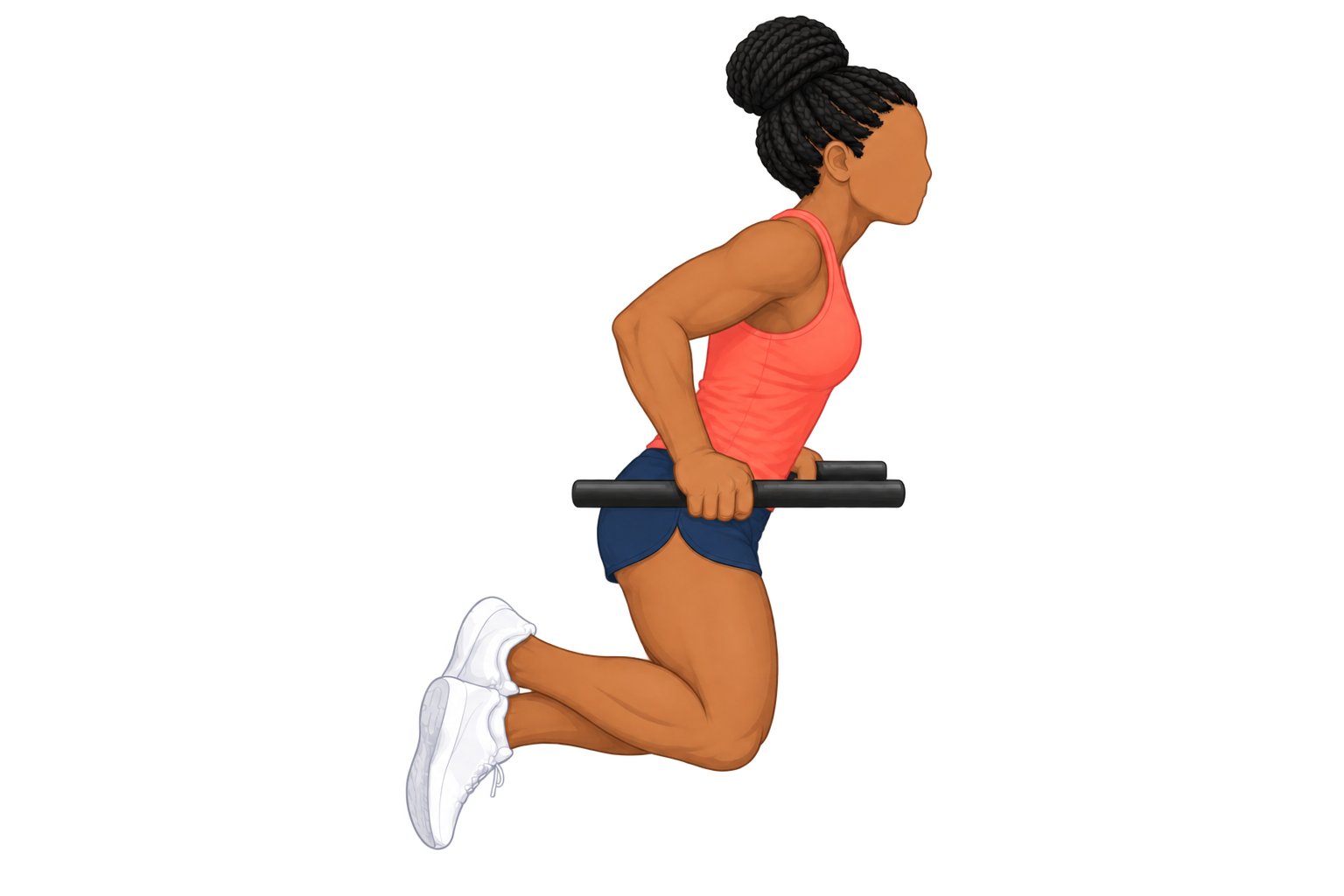
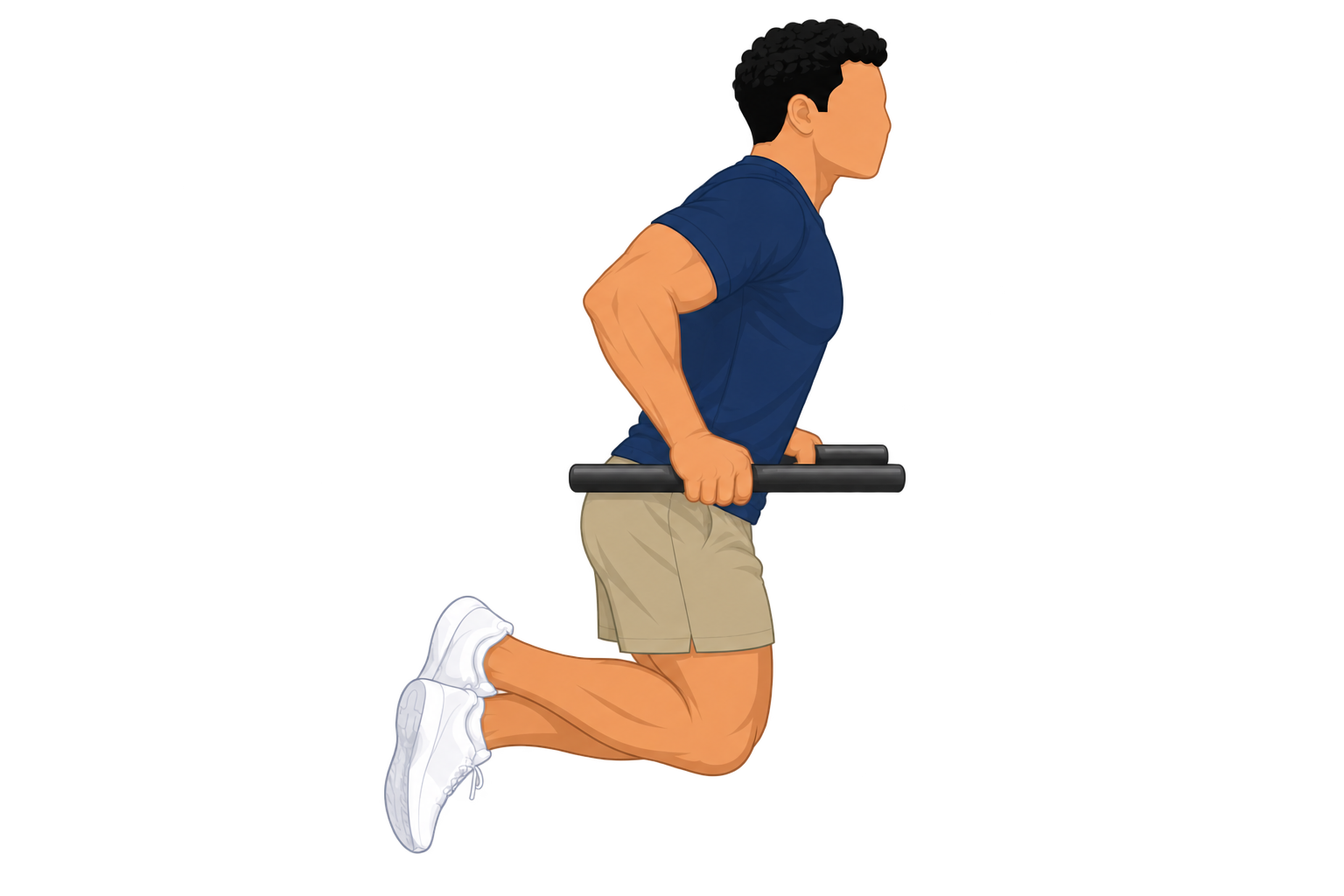
As many full dips as you can on parallel bars, with no time limit. The images below show the start, the bottom of each rep, and a rep that doesn’t count.
Shown from the side.
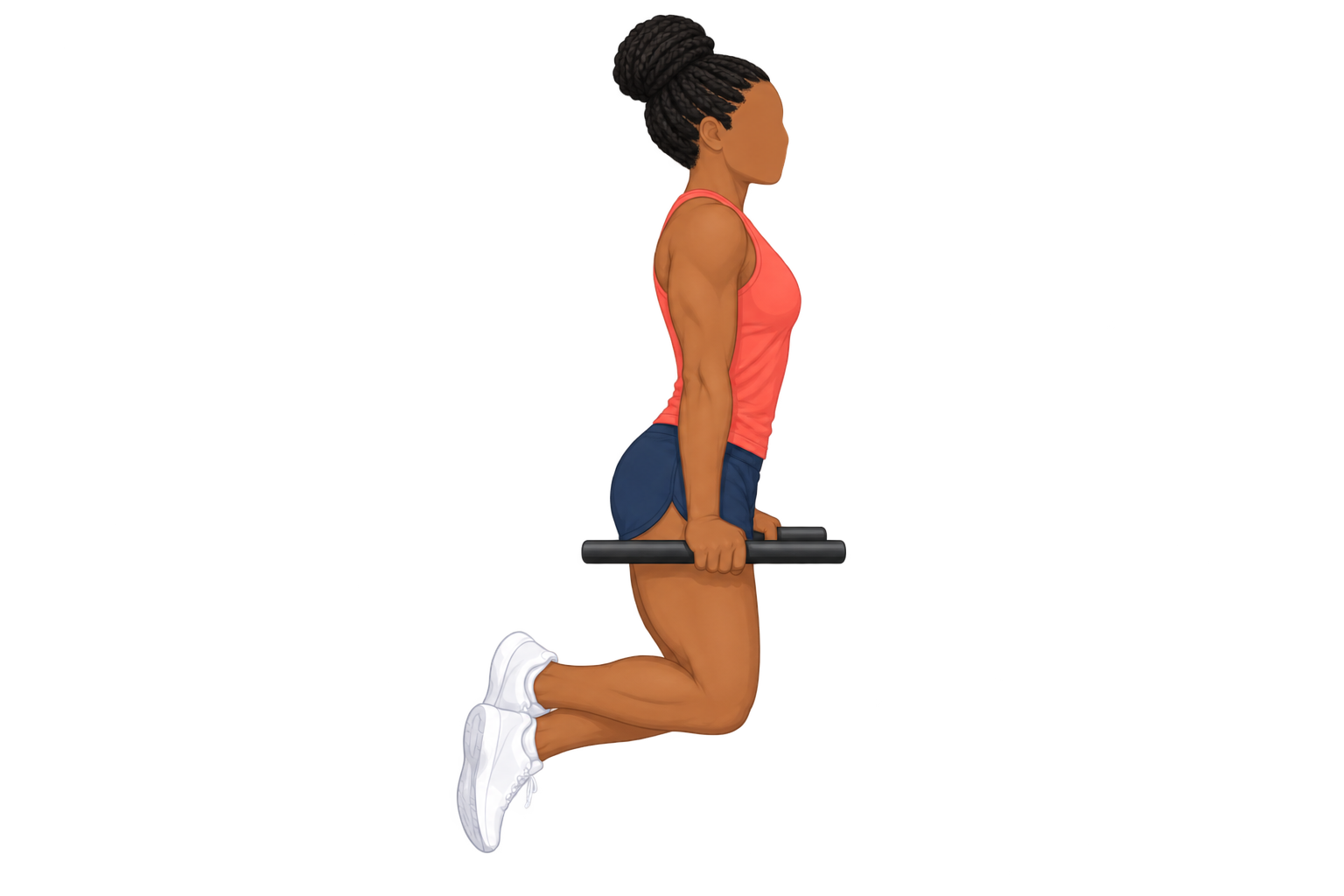
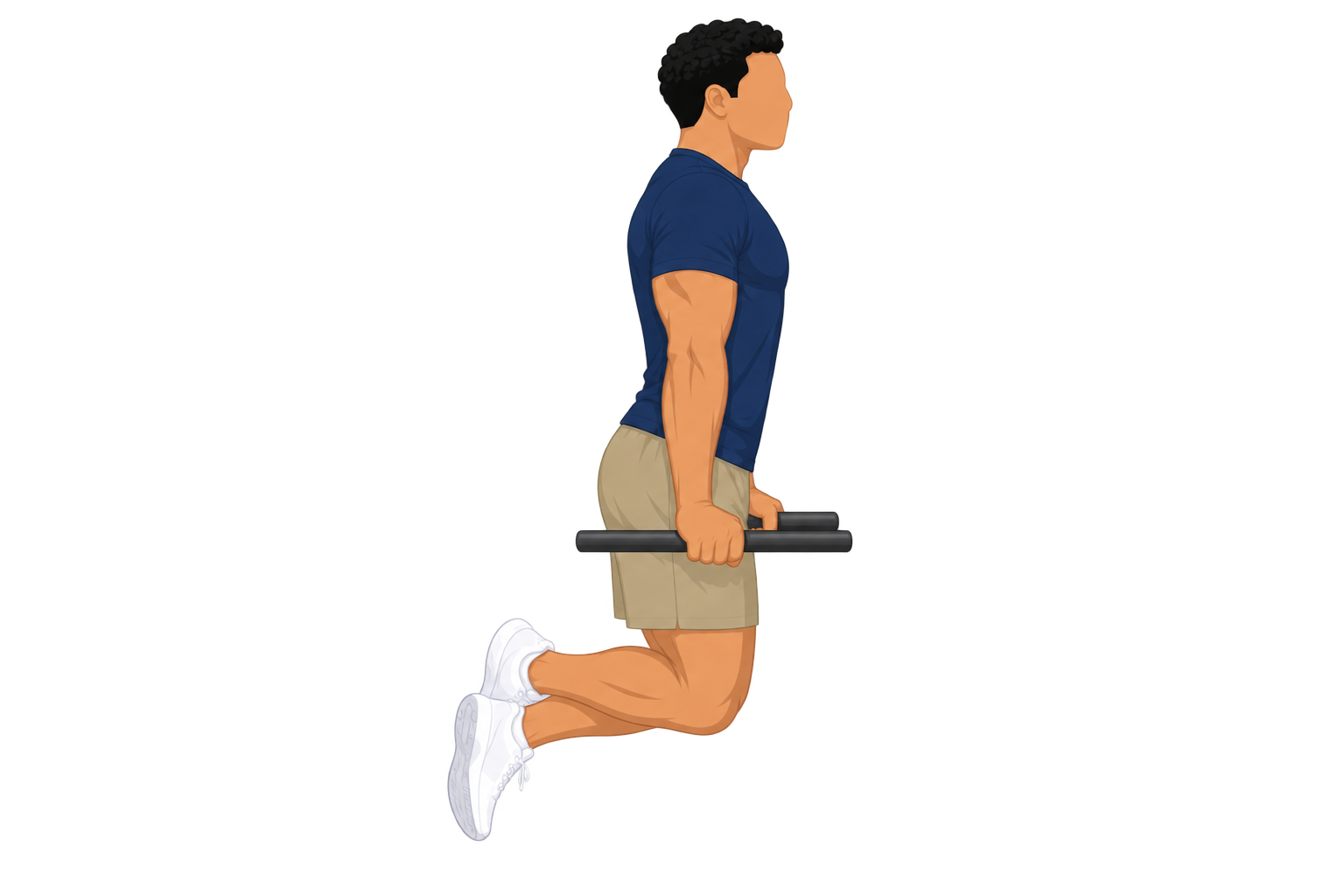
Arms Locked
Support yourself on the bars with your arms straight and locked, shoulders pressed down away from your ears, and a slight forward lean. Bend your knees and cross your ankles so your feet stay clear.
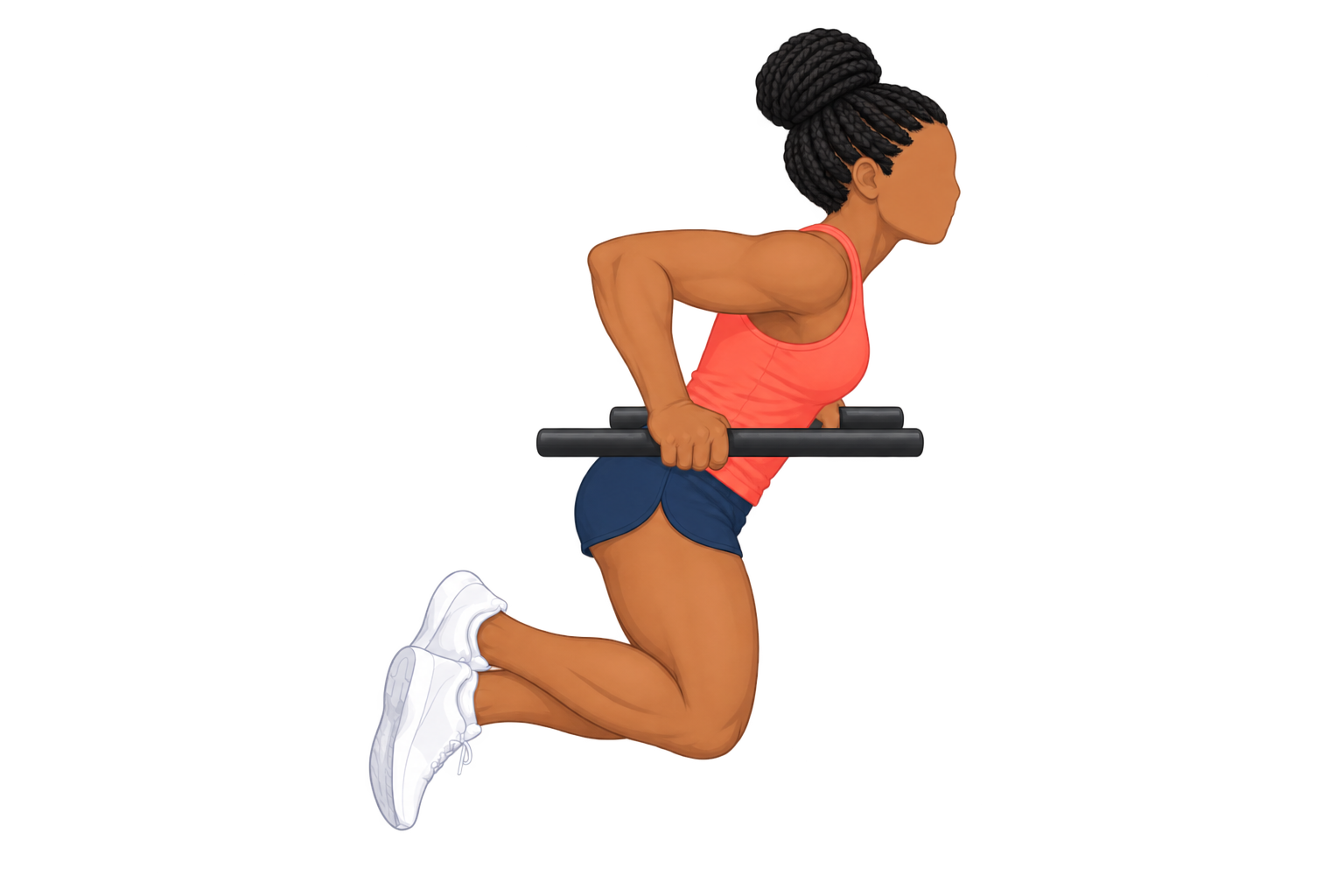
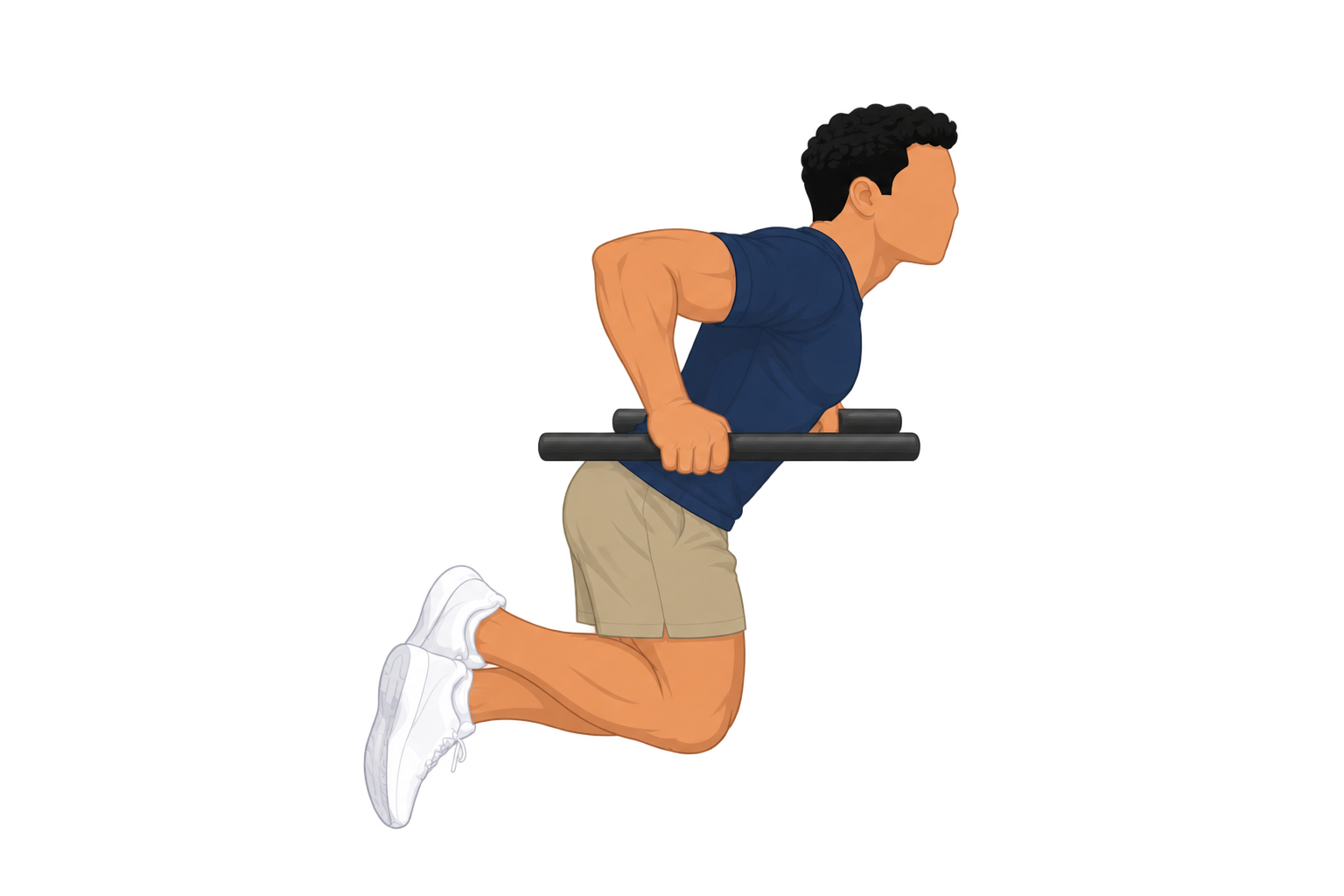
Elbows at 90°
Lower under control until your elbows bend to at least 90 degrees and your upper arms are about parallel to the floor, elbows pointing back. Press back up to full lockout. That is one rep.
Shallow Rep
Stopping before your elbows reach 90 degrees, skipping the lockout, or kicking your legs to get up means the rep doesn’t count. The test ends when you can’t complete a full rep or you pause at the top for more than about 2 seconds.
Warm up first, and stop right away if you feel shoulder, elbow or chest pain. Bench dips and the 60-second dips test are different tests, so the calculator’s standards apply to this max-reps parallel-bar version only.
Dips Technique Video
A short tutorial on parallel-bar dip form: setup, lowering, pressing back up, and how torso lean changes the emphasis.
For the test: use the video for form only. The video covers training sets and assisted options; the test is one max set on parallel bars with no assistance. Lower until your elbows bend to at least 90°, press to full lockout, and don’t pause at the top for more than about 2 seconds. Only full reps count.
This video is from an external YouTube channel (Max Euceda) and is not produced or endorsed by Amatal. It is shown for general technique reference only and is not medical or training advice. Product mentions or links in the video or its description are the creator’s own.
How This Calculator Works
This calculator measures your upper-body muscular endurance using the dip test — a classic bodyweight assessment of the chest, triceps, and front shoulders. You enter how many dips you can complete to exhaustion, and the calculator classifies your result against Amatal’s five-tier scale, then computes your category, your Dip Age, and an estimated percentile for your age and sex.
How These Standards Were Set
Strength Level publishes dips rep counts at five percentile pointsThe rep counts that beat 5%, 20%, 50%, 80% and 95% of Strength Level users of the same age and sex. (5th, 20th, 50th, 80th and 95th) for every five years of age, separately for men and women. Amatal’s tiers use different cutoffs (35th, 65th, 85th and 95th), so each cutoff is placed between Strength Level’s points on a normal-curve (z-score) scale:
Each result is rounded up to a whole rep once, and those same whole numbers drive your category, the table and the chart. For ages between Strength Level’s five-year rows, values are interpolated in a straight line, so your exact age gets its own standards rather than jumping at a birthday.
The calculator covers ages 15 to 65 and does not extrapolate. Above 65 the women’s data no longer separates the tiers, and the men’s thins out. Even at 60 to 65, most women in the data log less than one full dip, so the lower tiers there are floored at one rep and should be read as approximate.
Step 1: Enter Your Details
The calculator needs three inputs: your sex, your age, and the number of dips completed.
- SexDip standards are reported separately for men and women because of biological differences in upper-body muscle mass and strength-to-weight ratio, which strongly affect a movement that lifts most of your body weight. — selects which standards table you are compared against.
- Age — determines the standards for your stage of life. Ages 15 to 65 are supported; above 65 the source data is too thin to rate results.
- Dips Completed — your maximum repetitions on parallel bars, performed continuously with good form, until you cannot complete another full rep.
The Test Protocol
For your result to line up with the standards, perform the movement in a controlled, full-range way:
- Setup: Support yourself on parallel bars or a dip station with arms straight and locked, body upright or leaning slightly forward, legs hanging or bent. Keep your shoulders down and avoid swinging.
- Each repetition: Lower under control until your elbows bend to at least 90 degrees (upper arms about parallel to the floor), then press back up to full arm extension (lockout). That is one rep.
- Pacing: Keep a steady rhythm. A brief breath at lockout is fine, but don’t pause at the top for more than about 2 seconds.
- To exhaustion: Perform as many continuous reps as possible with full range of motion. The test ends when you can no longer reach proper depth or lock out, or when you pause longer than about 2 seconds. Shallow partial reps and leg kicking do not count.
This is a max-reps test with no time limit. A different version, the 60-second dips test, counts how many dips you can do in one minute. That version is not scored here, so don’t compare its results with these standards. Bench dips (hands on a bench behind you, feet on the floor) are a different exercise and are not scored either.
How Your Category Is Determined
Your result is mapped onto the same five-tier scale used across this platform, so the dip test reads consistently alongside the other assessments:
Low · Intermediate · Advanced · Superior · Elite — from below-typical performance up to the strongest performers in your demographic.
Your rep count is compared against the minimum repetitions required for each tier at your age and sex, and you are placed in the highest tier you qualify for:
- Low — below the 35th percentile for your group. A clear starting point with substantial room for improvement. For dips, even a handful of full-range reps is a respectable place to build from.
- Intermediate — around the middle of the data (35th to 65th percentile). Typical of people who train their upper body regularly. Remember the comparison group is gym users, not the general population.
- Advanced — 65th to 85th percentile. Reflects consistent upper-body and pressing-focused training.
- Superior — 85th to 95th percentile. Characteristic of well-conditioned individuals with a strong relative-strength base.
- Elite — 95th percentile and above for your age and sex. Among the strongest performers in the demographic; common among advanced calisthenics and strength athletes.
How to Read the Standards Table
The standards table lists one row for every five years of age from 15 to 65, plus an extra row for your exact age, and one column for each of the five levels. The header labels are color-coded to match the chart bands — on a phone the headers shorten to single letters (L · I · A · S · E); tap any header to see its full name.
- Each cell is a single number — the minimum. It shows the fewest dips needed to reach that level at that age. If your result equals or exceeds it, you've reached that level.
- The Low column shows a range. Low runs from zero up to one rep below the Intermediate minimum, so it is shown as a range (for example, 0–15) rather than a threshold.
- Your row and level are highlighted. The row for your exact age is shaded, and within it, the cell for your achieved level is filled with that tier's color.
Dip Age
Your Dip AgeThe age at which your rep count would be considered typical (median) performance. Conceptually similar to "fitness age" used in cardiovascular testing. is the age at which your result would be average. If you perform more dips than the typical person of your actual age, your Dip Age is younger; if fewer, it is older.
The typical result at each age is Strength Level’s 50th-percentile rep count. In that data the typical result peaks and holds steady from 25 to 40, then declines, so Dip Age is read from the declining side (40 to 65). A result at or above the peak shows as ≤40, and a result below the typical 65-year-old shows as 65+. If you are under 40 and at or above the typical result for your own age, the calculator says so rather than giving you an older Dip Age.
Percentile Estimate
The percentile estimates the share of Strength Level users of your age and sex who log fewer dips than you. Your rep count is placed between Strength Level’s percentile points for your exact age (5th, 20th, 50th, 80th and 95th), on the same z-score scale used for the tiers, so the percentile always agrees with your category:
Beyond the data’s range the calculator doesn’t guess: above the 95th point it shows >95th, and below the lowest point it shows <5th (or ≤20th, for example, where that share of people log less than one full dip).
How Age and Sex Change Your Score
These two inputs do not just describe you — each one directly changes the numbers your result is measured against:
- Age changes the thresholds. The calculator recomputes the rep requirement for every tier at your exact age. Because endurance standards decline with age, the same rep count is judged against lower requirements as you get older — so an identical number of dips can place you in a higher tier at 55 than it would at 25. In this data the standards rise from 15 to 25, hold steady to 40, then decline, which is the shape you see in the table and chart.
- Sex selects a different table. Choosing male or female swaps in Strength Level’s separate men’s or women’s data. The rep counts required for each tier differ between the two, so the same number of dips is scored differently depending on which table applies.
Why Muscular Endurance Matters
Upper-body pressing endurance is more than a gym benchmark. The dip trains the chest, triceps, and shoulders through a large range of motion and demands real relative strength, since you move most of your own body weight. Strong, durable pressing muscles support everyday tasks — pushing, lifting, getting up off the floor — and tend to track alongside broader functional fitness.
For broader context, a notable 2019 cohort study followed 1,104 active adult men and found that those with higher push-up capacity had a markedly lower incidence of later cardiovascular events than those with low capacity. That study looked specifically at push-ups in a relatively fit, male-only population, and it shows an association rather than proof of cause — and importantly, it did not study dips. It's cited here only as a reminder that upper-body muscular endurance is a meaningful marker of overall conditioning, not as a dip-specific finding.
Data Sources and Methods
The dip-specific standards come from Strength Level’s community data. The testing framework and protocol draw on established exercise-science references:
- ACSM's Guidelines for Exercise Testing and Prescription (11th Edition, 2021) — reference for the muscular-fitness testing framework and age/sex normative approach used across this platform. (ACSM publishes push-up norms; it does not provide an equivalent dip table.)
- Heyward, V.H., & Gibson, A.L. (2014). Advanced Fitness Assessment and Exercise Prescription (7th ed.). Human Kinetics — muscular-endurance testing protocol and normative interpretation.
- Strength Level — Dips Standards (strengthlevel.com/strength-standards/dips). By-age rep standards for men and women, built from 517,475 qualifying results (489,613 male, 27,862 female) logged by users from December 2016 to March 2026. Source of all thresholds, the percentile estimate and Dip Age on this page. Mapped to Amatal’s tier cutoffs; Amatal uses its own tier names.
- Topend Sports — Dips Test. Reference for the standard dip protocol (start at lockout, lower to at least a right angle at the elbow). Its 60-second version is a different test and is not scored here.
- Thomas, E., Gennaro, V., Battaglia, G., et al. (2021). Upper body strength endurance evaluation: A comparison between the handgrip strength and three body weight tests. Isokinetics and Exercise Science, 29(2), 185–191 — found parallel-bar dips to exhaustion suitable for evaluating upper-body strength endurance in 38 young men. Supports the test itself; it does not provide norms.
- Yang, J., Christophi, C.A., Farioli, A., et al. (2019). Association Between Push-up Exercise Capacity and Future Cardiovascular Events Among Active Adult Men. JAMA Network Open, 2(2):e188341 — cited for the general upper-body-endurance/health association only; this study measured push-ups, not dips.
Limitations and Important Caveats
This calculator provides an estimate, not a clinical measurement. Several factors affect how precisely it reflects your true muscular endurance:
- Self-selected, self-reported data. This is the most important caveat. Strength Level’s data comes from people who log their training online, mostly regular gym-goers, and results aren’t verified for depth or lockout. Standards are demanding compared with the general population. Treat your category, Dip Age, and percentile as guidance, not clinical norms.
- Smaller women’s sample. The women’s standards rest on about 28,000 results, compared with about 490,000 for men, and fewer still at older ages.
- Low results are imprecise. Strength Level reports anything under one rep as “<1,” so the lower cutoffs are less precise, especially for women and at older ages. At 60 to 65 for women, the lower tiers are floored at one rep.
- Modeled steps. The 35th, 65th and 85th percentile cutoffs are placed between Strength Level’s published points on a normal-curve scale, and ages between its five-year rows are interpolated. Ratings stop at 65.
- Form, depth, and tempo variability. Dip depth and lockout vary widely between people. Inconsistent range of motion is the largest source of error in self-administered dip tests — a "deep, controlled" rep and a shallow bounce are not the same.
- Body weight is not scored. Because the dip moves your own body weight, body mass and proportions strongly influence how hard each rep is. Strength Level’s bodyweight tables show heavier lifters log fewer reps (for men, a typical 20 reps at 180 lb versus 15 at 310 lb), but it publishes no combined age-and-bodyweight table, so this calculator scores by age and sex only.
- Joint demand. Dips place meaningful load on the shoulders and elbows. If you feel pain (not normal muscular fatigue), stop — a maximal dip test is not appropriate for everyone.
- Single-test snapshot. Fatigue, sleep, time of day, and recent training all affect a single test. For tracking progress, retest under the same conditions every few weeks.
Disclaimer:
This calculator provides an estimate based on Strength Level’s self-logged community data, mapped to Amatal’s tiers; it does not use validated clinical norms. Real muscular endurance depends on training history, technique, body proportions, recovery, and individual variation. Always warm up before any fitness test and stop immediately if you experience pain, dizziness, or unusual discomfort — dips in particular load the shoulders and elbows. This tool is for general informational purposes only and should not be considered medical, fitness, or training advice. Consult a healthcare provider before beginning a new exercise program, especially if you have a pre-existing condition, are over the age of 45, have a history of shoulder or elbow injury, or have been sedentary for an extended period.