How the Single-Leg Stance Calculator Works
The
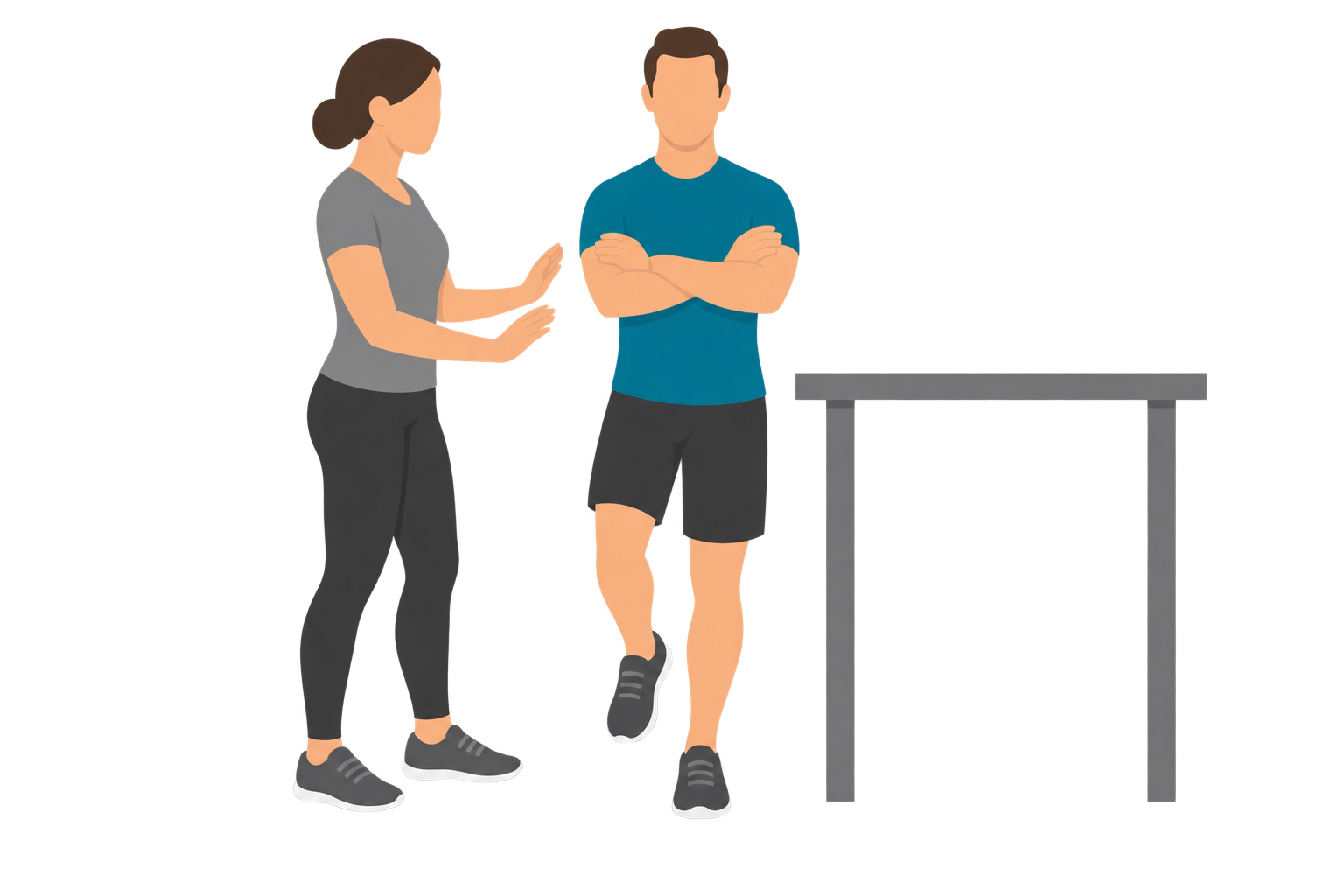
single-leg (unipedal) stance testA timed test of static balance: you stand on one leg and hold the position as long as you can without the raised foot touching down or your arms uncrossing.
is one of the simplest and most widely used measures of standing balance. This calculator times how long you can balance on each leg, under either eyes-open or eyes-closed conditions, and reads each result against published reference data for your age. Because it scores both legs, it also tells you how symmetric your balance is from side to side.
The norms come from a study of 549 healthy adults aged 18 to 99 (Springer et al., 2007), and the eyes-open interpretation also uses fall-risk cut points established in separate clinical research. This is a screening tool, not a performance ranking — there is no "elite" balance score, only how your result compares to what is typical and to thresholds linked to fall risk.
Step 1: Time Each Leg (Best of Three)
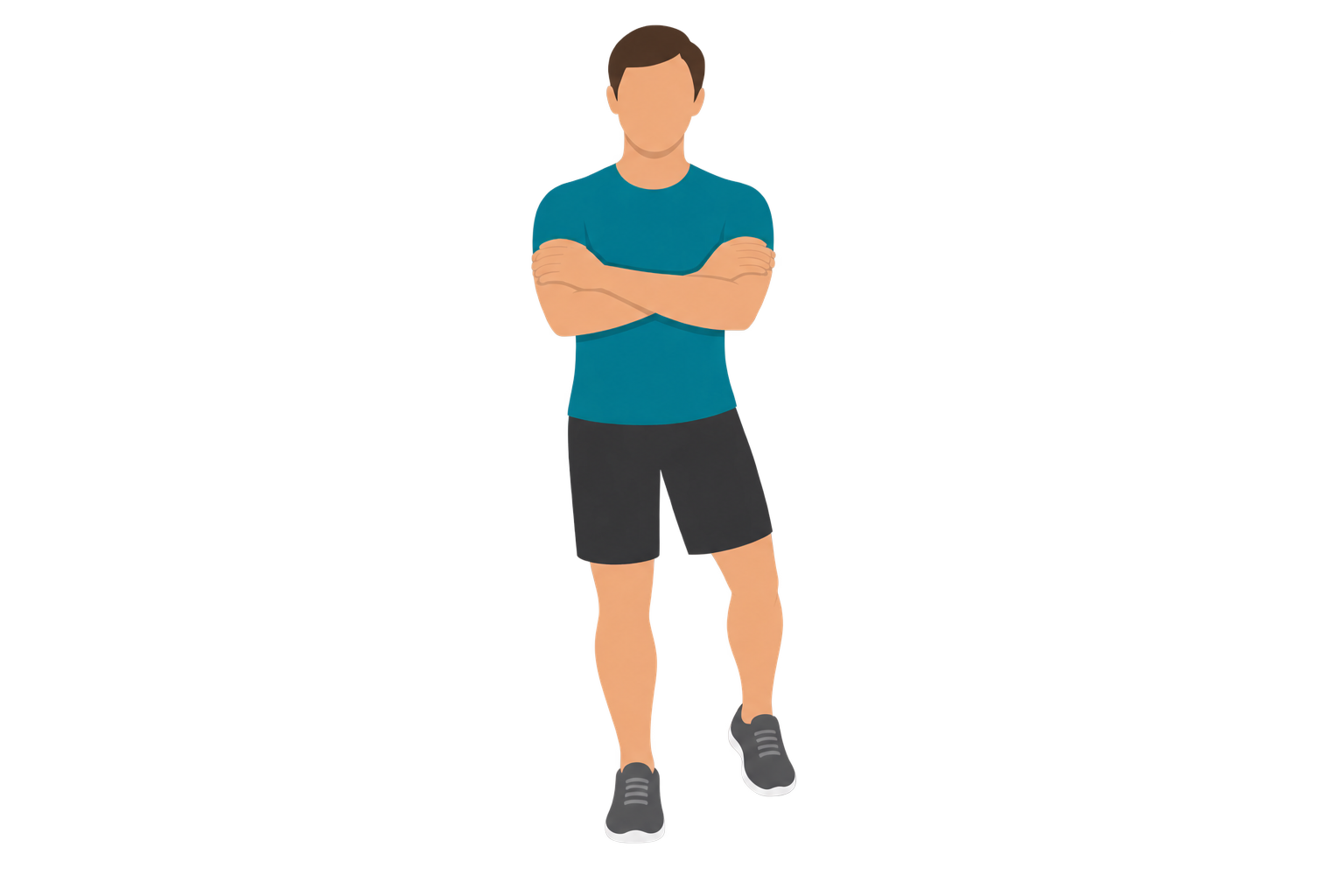
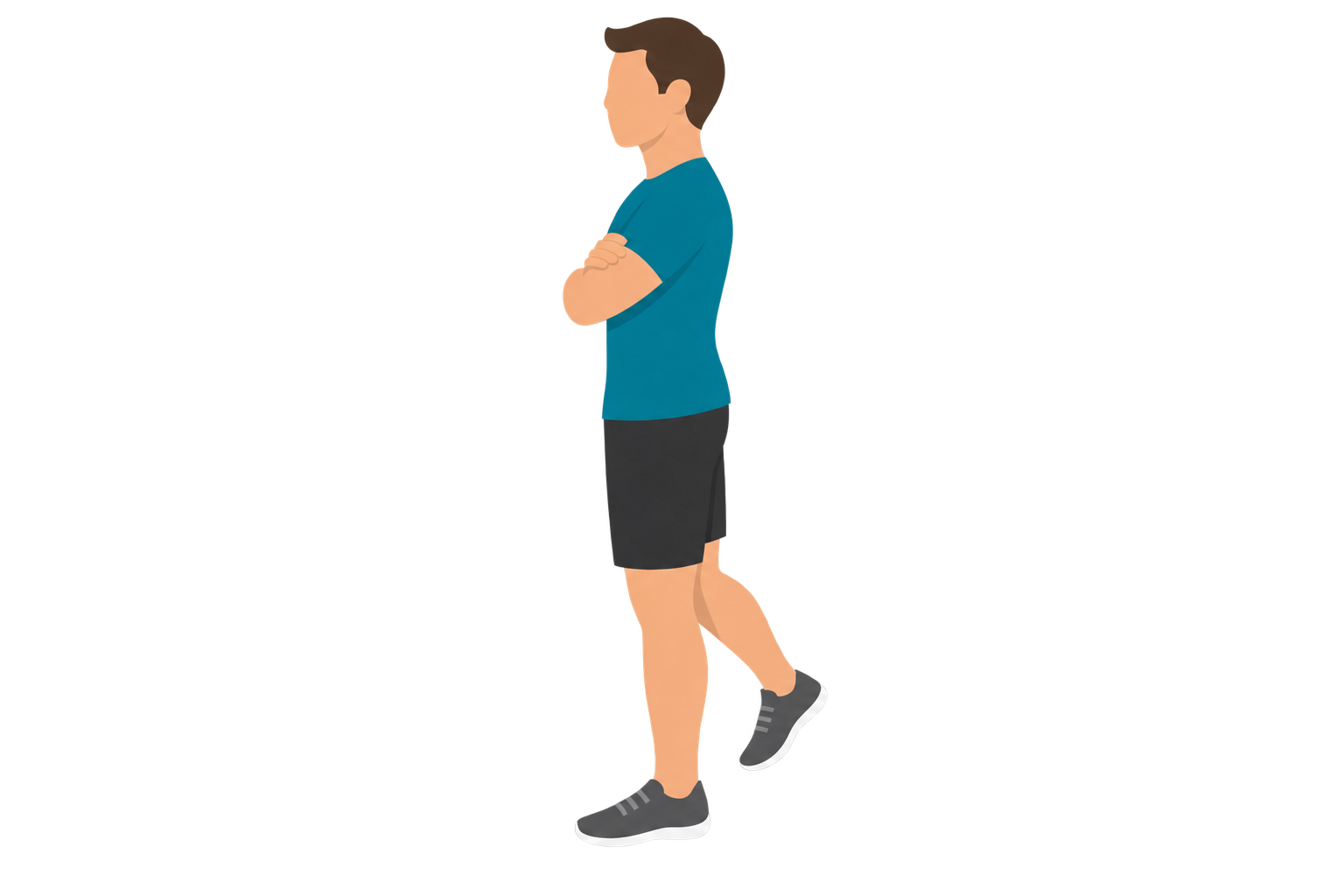
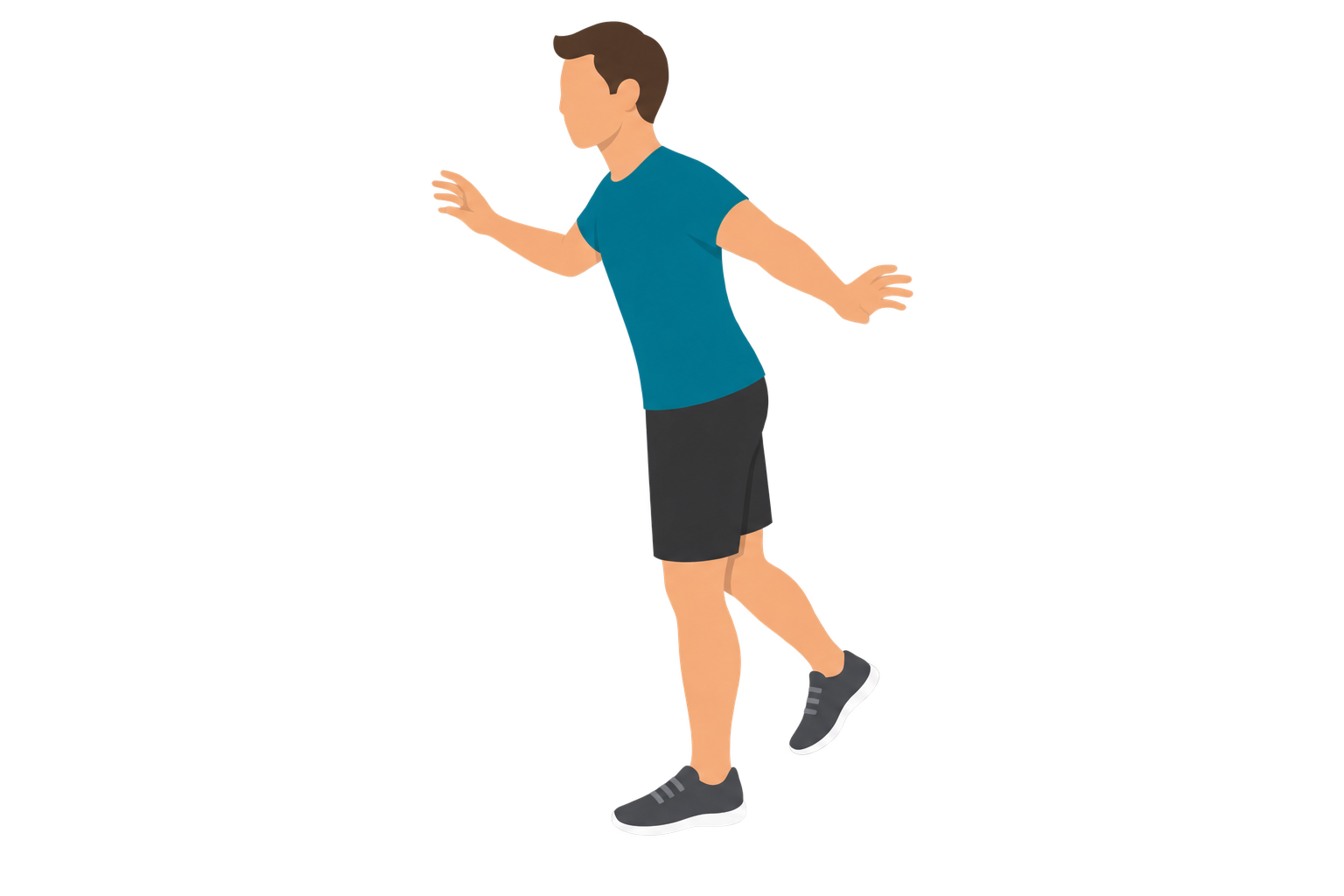
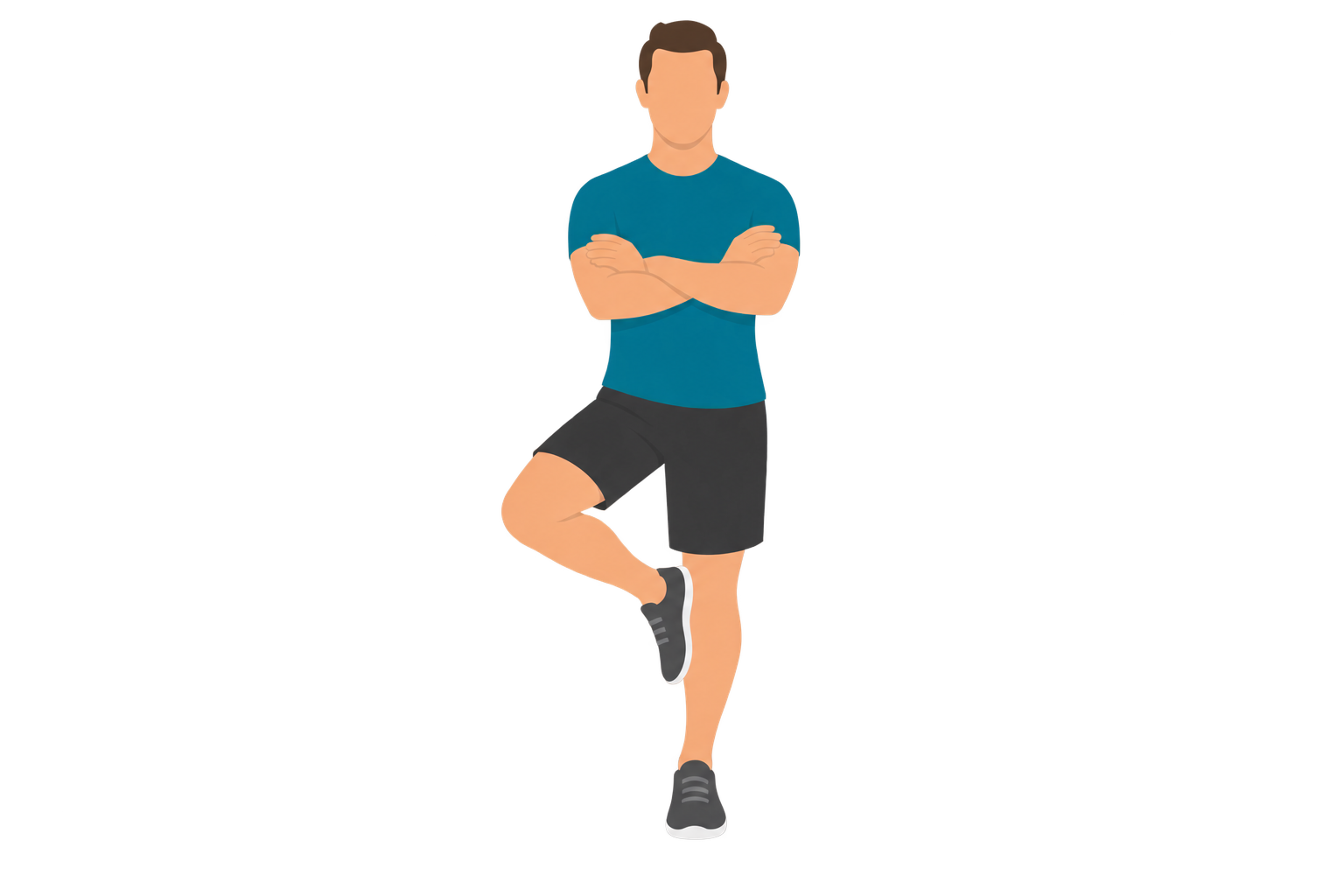
Stand on one leg with your arms crossed over your chest and the raised foot held near the opposite ankle. Start the clock when you settle, and stop it the moment your form breaks — the raised foot touches down or touches the stance leg, your arms uncross, or the standing foot shifts or hops. Take your best of three trials on each leg and enter both. You can enter one leg if you only tested one, but entering both unlocks the side-to-side comparison.
You may have seen this test done with hands on hips instead. That version is real and appears in other published protocols, but it is not the one the norms on this page were built from, and the two are not interchangeable — arm position changes how long you can hold. Use the crossed-arms position to compare against these numbers, and whichever you choose, keep it the same every time you retest.
The standardized protocol stops timing at 45 seconds, so very long holds are recorded at that ceiling. You can enter a longer time, but it is read against norms built on a 45-second cap.
Step 2: Eyes Open vs. Eyes Closed
The eyes-open test is the standard balance screen. The eyes-closed version removes vision — the sense most people lean on hardest to stay upright — forcing you to rely on your
proprioceptionYour body's internal sense of joint and limb position, fed by receptors in muscles, tendons, and joints.
and
vestibular systemThe balance organs of the inner ear, which sense head motion and orientation relative to gravity..
Eyes-closed times are dramatically shorter and the test is far more sensitive to subtle deficits. Switching conditions resets the result, because each condition is judged against its own norms.
Step 3: Score Against the Right Benchmark
The two conditions are interpreted differently, because the research supports different benchmarks for each.
Eyes open is scored against validated fall-risk cut points — fixed time thresholds linked in clinical studies to the likelihood of falling:
- High fall risk — held under 5 seconds.
In older adults, an inability to hold a single-leg stance for 5 seconds has been associated with markedly higher rates of injurious falls (Vellas et al., 1997).
- Increased fall risk — 5 to under 10 seconds.
Below the widely used 10-second screening threshold but above the 5-second high-risk mark.
- Low fall risk — 10 to under 30 seconds.
Clears the 10-second cut point, a widely used screening threshold (Jacobs et al., 2006; Araujo et al., 2022), though later studies have not consistently reproduced it as a clean divider between fallers and non-fallers.
- Normal balance — 30 seconds or more.
Clears the 30-second functional benchmark (Hurvitz et al., 2000), which is also the common upper cut-off for the test.
Eyes closed has no equally well-established absolute thresholds, so each leg is graded instead against the age-matched average — how your time compares to what is typical for people your age with eyes closed:
- Below normal range — well below the age-group average (more than two
standard deviationsA measure of how spread out the values in a group are. Being more than two standard deviations below the mean places you outside the typical range for the group.
below).
- Below average for age — clearly under the age-group average.
- Within normal range — around the age-group average.
- Above average for age — comfortably above the age-group average.
Left vs. Right: Reading the Symmetry
When you enter both legs, the calculator reports which leg is stronger, the gap between them in seconds, and that gap as a percentage of the stronger leg:
Difference = | Left − Right | · expressed as a percentage of the stronger leg
Some side-to-side variation is completely normal, so a small difference is not a concern. What the calculator flags is the more meaningful signal: when your two legs land in different categories, or when the difference is both large and consistent. In real life it is the weaker leg that limits stability — when you step off a curb or catch yourself on one foot, you don't get to choose your stronger side. There is no single universally validated cut-off for left/right balance asymmetry, so this is offered as a prompt to pay attention, not a diagnosis.
Why Age Matters — and Why Sex Doesn't
- Age — Balance declines gradually with age, and the drop is steep with eyes closed. A 25-year-old and an 80-year-old should not be held to the same number, so every result is compared to its own age band (18–39, 40–49, 50–59, 60–69, 70–79, 80–99).
- Sex — There is no sex selector, and that is deliberate. The source study found single-leg stance performance was strongly age-dependent but not significantly different between men and women, so the norms are pooled across sexes. Adding a sex input would invent a distinction the data does not support.
The Chart and the Norms Table
Two reference views accompany your result:
- Reference Norms by Age Group — the average hold time for each age band, with your band highlighted, so you can see at a glance how balance changes across the lifespan and where your age sits.
- Hold Time vs. Age-Matched Norms — a chart plotting that age-group average as a line, with your two legs marked as dots in your age band. For eyes open, the 5-, 10-, and 30-second fall-risk thresholds are drawn as reference lines so you can see exactly which bands your legs clear.
Only the average is shown as a comparison anchor. The full statistical spread of these norms is very wide — especially with eyes closed, where the variation between individuals is larger than the average itself — so plotting a "normal range" would be too broad to be useful and could imply false precision. The average is the honest, readable reference point.
An Honest Note on the Eyes-Open Ceiling
For healthy younger adults, balancing on one leg with eyes open is easy — most comfortably pass 30 seconds and reach the 45-second test ceiling. That means the eyes-open test does little to separate good balance from excellent balance in younger people; it mainly screens for deficits in older adults or those with impairments. If you are young and fit and want a meaningful challenge, the eyes-closed condition is far more revealing.
Data Sources
- Springer BA, Marin R, Cyhan T, Roberts H, Gill NW (2007). "Normative values for the unipedal stance test with eyes open and closed." Journal of Geriatric Physical Therapy, 30(1):8–15. Source of the age-banded average hold times for both conditions (n = 549, ages 18–99, best of three trials, 45-second cap, pooled across sexes).
- Vellas BJ, et al. (1997). One-leg balance as a predictor of injurious falls in older persons — basis for the 5-second high-risk threshold.
- Jacobs JV, et al. (2006); Araujo CG, et al. (2022). Work supporting the 10-second cut point as a marker of impaired balance and health risk. Jacobs' cut point was derived in people with Parkinson's disease and has not been consistently reproduced in later work; Araujo supports the same threshold in a general middle-aged and older population.
- Hurvitz EA, et al. (2000). Unipedal stance and fall risk in older outpatients — basis for the 30-second functional benchmark.
Why This Is a Screen, Not a Performance Test
- There is no "elite" tier. Holding longer and longer is not the point; clearing the age-appropriate and fall-risk benchmarks is. Once you are steadily balanced, more seconds add little information.
- The thresholds are clinical, not athletic. They come from fall-prediction research, so a "Low fall risk" result means your balance is functionally sound, not that it is competition-grade.
- The cut points were validated mostly in middle-aged and older adults. They are most informative for those groups and for anyone with a balance concern; they are coarse for young, healthy people, who tend to pass them easily.
Limitations and Important Caveats
This calculator screens balance from a single timed task. Real balance and fall risk depend on much more than it can capture:
- Self-testing conditions — Surface, footwear, fatigue, focus, and whether you tested near support all affect your time. A clinic-administered test is more controlled.
- The thresholds are screening cut points, not guarantees — A "Normal balance" result does not rule out falling, and a low result does not confirm you will fall. They shift the odds; they don't decide them.
- Very old age — Past about 80, the typical eyes-open hold is already under 10 seconds, so the fixed thresholds understate normal age-related decline; the age-matched average is the better reference there.
- Health conditions — Inner-ear disorders, neurological conditions, medication effects, vision problems, and injuries all influence balance and are outside the scope of this tool.
- One moment in time — A single test is a snapshot. Balance varies day to day, and a trend over repeated tests is more meaningful than any one result.
Disclaimer:
This calculator provides a balance screen based on a timed single-leg stance and published reference data. It is not a medical assessment and cannot diagnose fall risk, a balance disorder, or any condition. Always test in a safe space — beside a wall, sturdy chair, or counter you can grab — ideally with someone nearby, and stop immediately if you feel dizzy or unsteady. The fall-risk thresholds are screening cut points drawn largely from research in middle-aged and older adults; a "normal" result does not rule out fall risk, and a low result does not confirm it. If you have a history of falls, dizziness, vertigo, neurological or inner-ear conditions, vision problems, or new balance concerns, consult a healthcare provider or physical therapist for a proper evaluation. This tool is for general informational purposes only and should not be considered medical, rehabilitative, or fitness advice.