How the Timed Up and Go Calculator Works
The Timed Up and Go (TUG) measures
basic functional mobilityThe everyday movements of standing up, walking, turning, and sitting down — the transfers you rely on dozens of times a day.
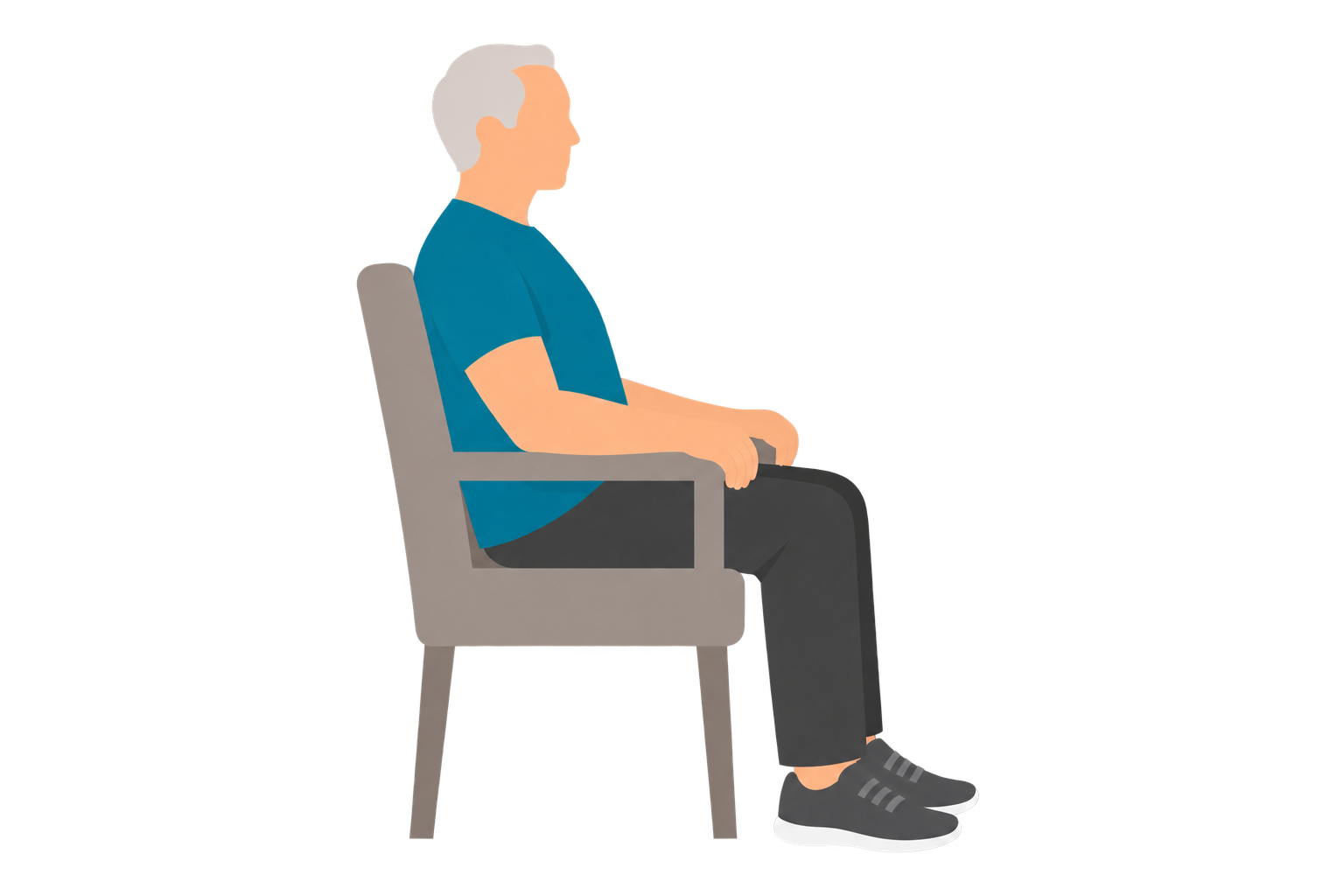
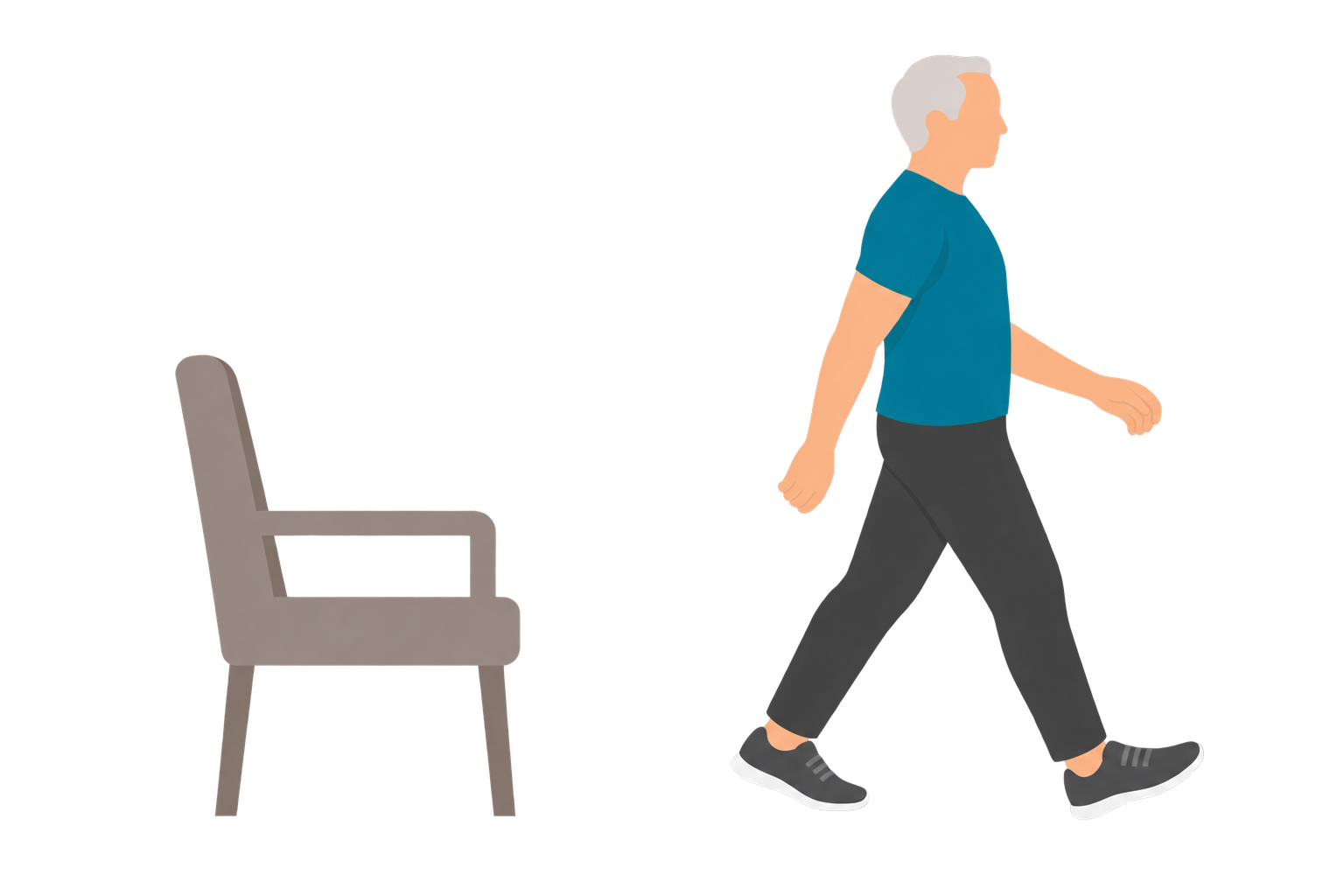
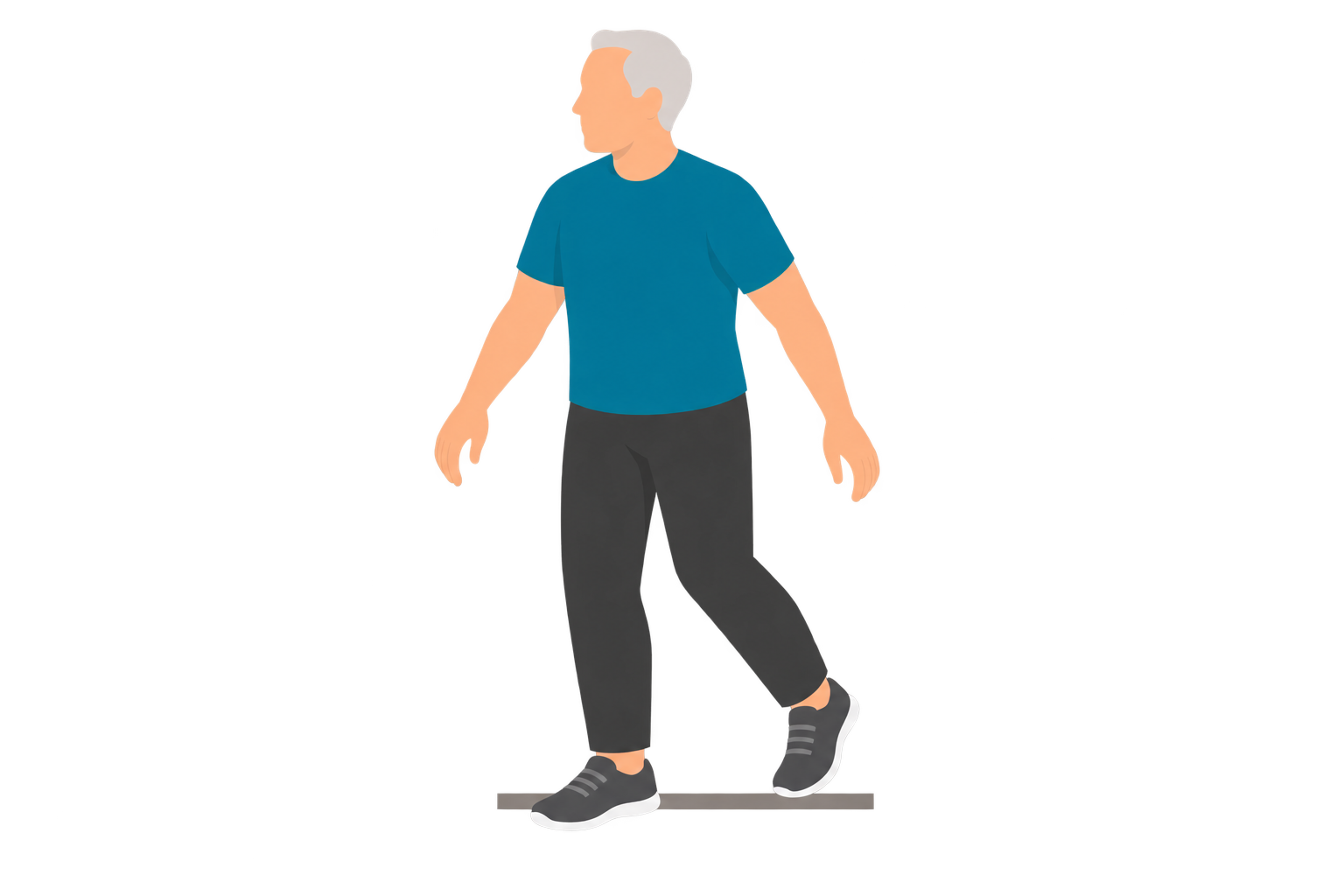
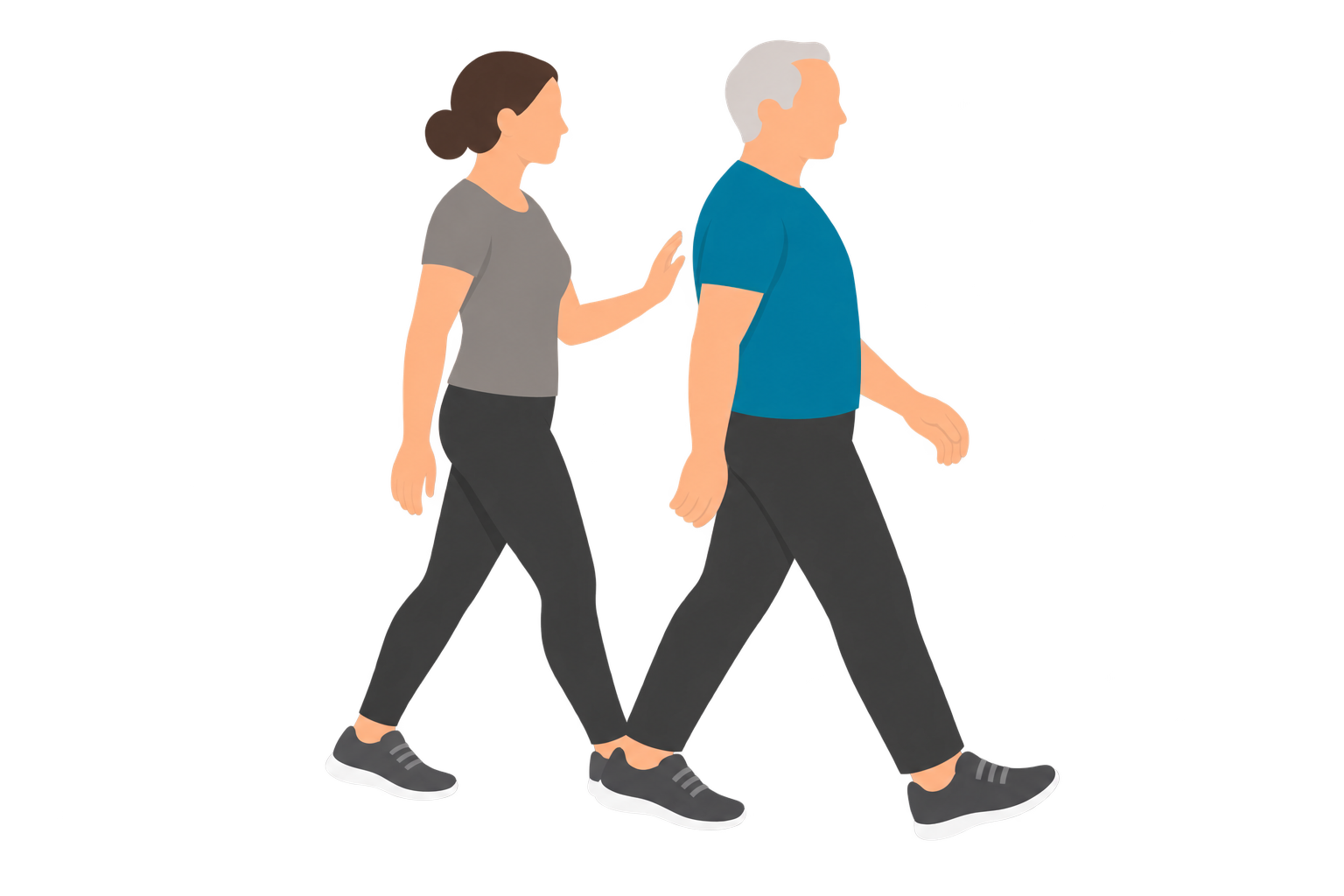
by timing a short, everyday sequence: stand up from a chair, walk three meters, turn, walk back, and sit down. That string of ordinary movements turns out to be one of the most useful quick screens for mobility and fall risk, because it rolls several abilities into a single number.
It was introduced by Diane Podsiadlo and Sandra Richardson in 1991 (refining an earlier “Get Up and Go” test) and is now a standard tool in clinics worldwide — quick, needs only a chair, a stopwatch, and three meters of floor.
Step 1: Set Up and Time the Test
- Start seated in a standard armchair (about a 46 cm seat), back resting against the chair.
- On the word “go,” stand up, walk three meters at a comfortable, safe pace, turn around, walk back, and sit down again.
- Use your usual footwear and walking aid if you have one — the test reflects how you actually move.
- Timing runs from “go” until you are seated again. One practice trial is allowed; record the timed run. Faster is better.
Step 2: Your Time, Two Ways
Fall-risk thresholds. Your time is placed into a band drawn from published cut points:
- Lower fall risk — under 12 seconds.
- Increased fall risk — 12 to 13.5 seconds (the CDC’s screening flag).
- High fall risk — 13.5 seconds or more (a threshold with high
specificityA slow time at this threshold rarely shows up in people who aren’t at risk, so crossing it is a meaningful flag. A 2014 meta-analysis of ten studies put its specificity at about 74%.
for falls).
- Dependent mobility — 30 seconds or more, a level typically associated with needing help to move.
Age comparison. For ages 60 and over, your time is also set against the average for your age group, so you can see whether you’re quicker or slower than typical — separate from the fall-risk bands.
Why Several Thresholds?
The TUG has no single “official” cutoff — different research groups landed on different lines for different purposes, and that’s genuinely how the evidence sits. Rather than pick one and hide the rest, the calculator layers the well-established ones: the CDC’s 12-second screening flag, the 13.5-second mark, which rarely flags people who aren’t at risk, and the 30-second level from the original study that signals dependent mobility. Each comes from a real source, and together they give a graded read instead of a single pass/fail.
Why the Cutoffs Are an Older-Adult Screen
These thresholds were validated in older adults, and the age averages start at 60 for the same reason — that’s the population the reference data describes. A healthy younger adult typically finishes in well under 10 seconds, so clearing the 12-second line says little about them. For anyone under 60, the calculator notes this and treats the test mainly as a personal baseline to track over time: a sudden slowing of more than a couple of seconds is more telling than the absolute number.
A Note on Sex
The age averages are pooled across men and women. That’s deliberate: the sex difference in TUG time is small and doesn’t run consistently in one direction — women tend to be marginally quicker in the early 60s, and the gap narrows or reverses with age — so a single pooled average is the honest summary rather than splitting it into two shaky numbers.
Reading the Gauge and the Table
- Where You Fall (gauge) — a scale colored green → orange → red → dark red at the 12, 13.5, and 30-second lines, with your time marked below the bar and, for ages 60+, your age average marked above it.
- Reference Times by Age (table) — the average TUG time for each older-adult age group and the point above which a time counts as slower than typical, with your group highlighted.
Why the TUG Works
A single time captures a lot at once: the leg strength to rise from a chair, your
gait speedHow fast you walk — on its own one of the strongest predictors of mobility and health in older adults.
over the three meters, the dynamic balance to keep moving, and — often the riskiest moment — the turn. Turning demands quick, coordinated weight-shifting, and it’s where many real falls happen, so a test that includes a turn tends to screen well. Its repeatability is excellent (inter-rater reliability around 0.99), which is part of why it’s so widely trusted.
What Affects Your Time
- Leg strength — Rising from the chair and controlling the sit-down both draw on lower-limb power.
- Walking speed and balance — Your natural pace and steadiness over the short walk and turn.
- Footwear and walking aids — Using your usual aid is correct, not cheating; it reflects real-world mobility.
- The chair and setup — Seat height, armrests, and floor surface all nudge the time, so repeat tests should use the same setup.
Data Sources
- Podsiadlo D, Richardson S (1991). “The Timed ‘Up & Go’: a test of basic functional mobility for frail elderly persons.” Journal of the American Geriatrics Society, 39(2):142–148 — the test and its functional-mobility milestones, including the 30-second level.
- Bohannon RW (2006). “Reference values for the Timed Up and Go Test: A Descriptive Meta-Analysis.” Journal of Geriatric Physical Therapy, 29(2):64–68 — the age-group averages (60–99) used here.
- Shumway-Cook A, et al. (2000) and the CDC STEADI initiative — the 13.5-second and 12-second fall-risk thresholds, respectively.
- Barry E, Galvin R, Keogh C, Horgan F, Fahey T (2014). “Is the Timed Up and Go test a useful predictor of risk of falls in community dwelling older adults: a systematic review and meta-analysis.” BMC Geriatrics, 14:14 — pooled specificity of 0.74 and sensitivity of 0.31 at the 13.5-second cut point, the basis for treating the TUG as better at confirming fall risk than ruling it out, and as a screen to use alongside other measures rather than in isolation.
Limitations and Important Caveats
- Better at confirming risk than ruling it out. A slow time is a meaningful flag, but some people who go on to fall still finish within the normal range — so a quick time is reassuring, not a guarantee.
- The thresholds are population-specific. They were set in community-dwelling older adults; other groups have their own cut points (for example, longer times after hip fracture), and the test isn’t designed for children.
- One moment in time. A single run is a snapshot. The trend matters more — a sudden increase of more than about two seconds between tests is worth raising with a clinician.
- It’s a screen, not a diagnosis. The TUG points to who may need a closer look; it doesn’t explain why, and works best alongside other measures.
Disclaimer:
This calculator scores the Timed Up and Go test against published age norms and fall-risk thresholds. It is for general informational and screening purposes only and is not a medical assessment, a diagnosis, or a prediction of falls. Always test in a clear space with sturdy support within reach and someone nearby, and use your usual footwear and walking aid. The thresholds apply to older adults and should not, on their own, drive conclusions about your balance or decisions about activity — a normal time does not guarantee safety, and a slow one does not confirm a problem. If you have balance concerns, dizziness, frailty, or a history of falls, consult a qualified healthcare provider. This tool does not replace professional assessment.