
Total 1RM Calculator
Raw three-lift total standards by weight class and age
Enter your best set for each lift. 1RM is computed for each and summed.
Total Competition Standards
Standards by Age
Total Calculator Dashboard
Strength Balance
Per-Lift World Record %
Strength Score (DOTS)
Next Tier Target
Per-Lift Progress
Weight Class Comparison
Where You Fall
What Makes Up a Total
Squat, bench press, and deadlift, and roughly how much each typically contributes to an elite total.
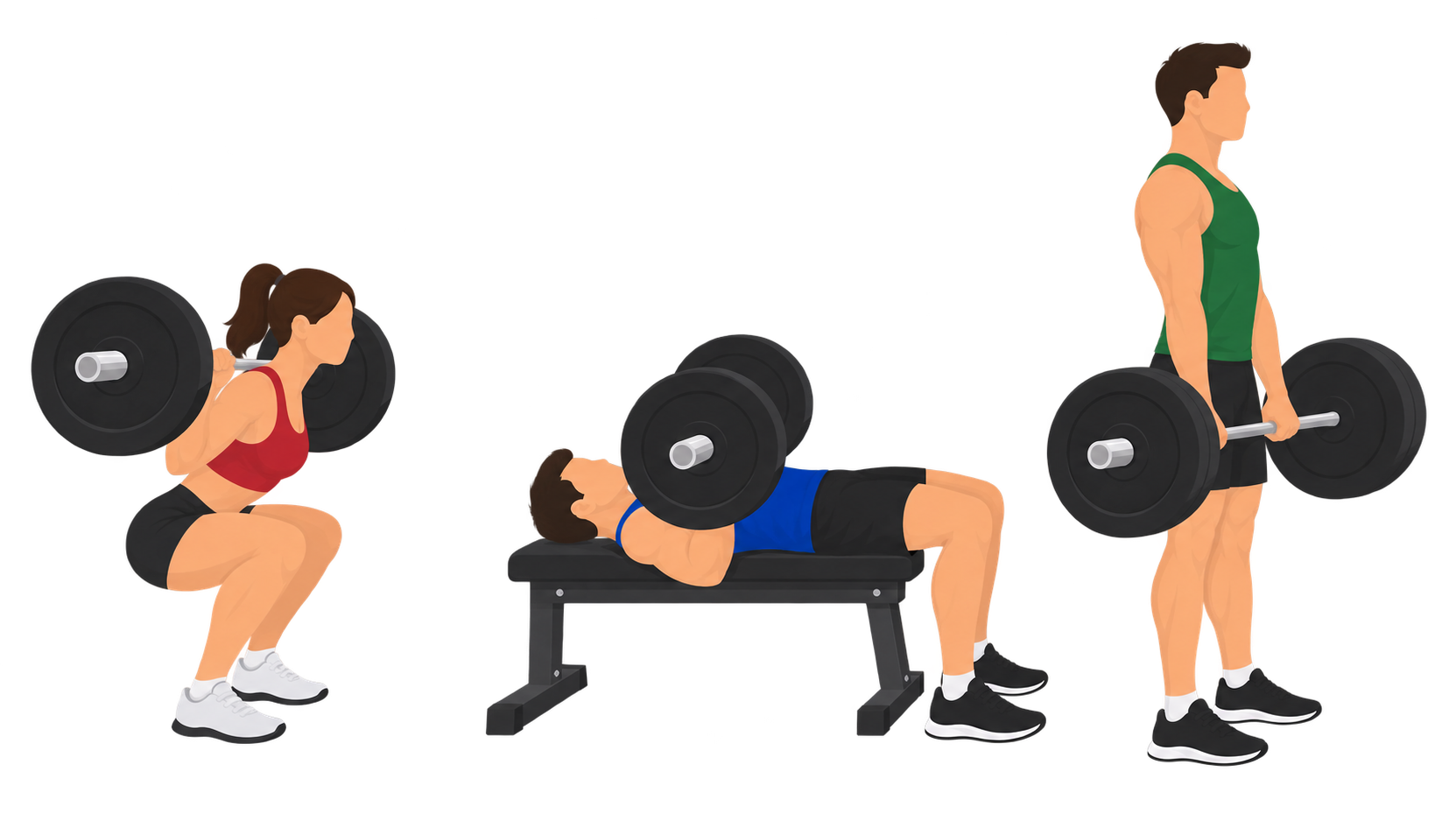
Typical share of an elite raw total. Individual proportions vary with leverages and training background.
All Three Lifts, One Standard
A full walkthrough of the squat, bench, and deadlift rules referees judge on meet day.
Video is external and not produced by Amatal. For the exact IPF wording behind each rule, see the individual squat, bench, and deadlift pages — follow the written rules where the two differ.
- Squat Calculator — the first of the three competition lifts, testing full-depth lower-body strength.
- Bench Press Calculator — the upper-body press, testing pressing strength off the chest.
- Deadlift Calculator — the final lift, testing posterior-chain strength from the floor to full lockout.
How the Total Calculator Works
This calculator estimates your 1 Rep Max (1RM) in all three powerlifting disciplines — squat, bench press, and deadlift — sums them into your projected total, and compares that total to strength standards based on your sex, age, and bodyweight. The 1RM estimates use two scientifically-tested formulas, and the standards are built from verified world records in two major federations: USAPL (USA Powerlifting) and IPF (International Powerlifting Federation).
Step 1: Estimate Each Lift, Then Sum the Total
For each lift, the calculator estimates your 1RM1 Rep Max — the maximum weight you can lift for a single repetition with proper form. In powerlifting, this is measured with a barbell. using the average of two well-established formulas. Averaging them reduces the bias of any single formula and gives more reliable estimates across different rep ranges.
If you enter 1 repetition, the calculator skips the formulas and uses your lifted weight directly — by definition, the most you can lift for a single rep is your 1 rep max. Each lift's 1RM is computed independently and then added together to produce your projected total. Results are shown as a whole number in pounds or to the nearest 0.5 in kilograms, matching the smallest plate increments common in powerlifting gyms.
An honest note on the total: your projected total is the sum of three fresh 1RM estimates. In a real meet you attempt the lifts one after another over several hours, so accumulated fatigue usually makes a competition total land a little below the sum of three independent fresh maxes. Treat the projected total as a best-case ceiling, not a guaranteed meet result.
Step 2: Compare Across Bodyweights
Raw numbers don't compare fairly between a 132 lb lifter and a 240 lb lifter. The calculator handles this two ways. The simplest is the strength ratio — your lift relative to your own bodyweight:
The dashboard goes further with a DOTS score (explained below), a single number that places lifters of any bodyweight and either sex on the same scale. Together they let you judge your total against people who aren't built like you.
Step 3: Match Your Total to Strength Standards
Your projected total is compared to standards built from verified federation world records, adjusted for your sex, age, and exact bodyweight, and assigned to one of three tiers:
- Casual — Recreational lifters not competing. Most recreational lifters who don't compete. Rapid progress is typical with consistent training and proper programming.
- Competitor — Strong enough to enter and place at a meet. Regional-level competitive strength. Typical of someone with 2–5 years of dedicated training and competition experience.
- Elite — Top-tier national and world-class lifters. National to world-class strength. Top tier of competitive lifters; typically years of elite-level training and competition.
The tier thresholds are derived from each weight class's world-record total and scaled by age multipliers, then applied to your exact bodyweight and age using continuous interpolation rather than broad categories.
Why Age and Bodyweight Matter
- Bodyweight — Lighter and heavier athletes face different biomechanical realities, so they're compared separately. Instead of forcing you into a broad class, the calculator computes thresholds at your exact bodyweight by interpolating between published class boundaries — a 165.5 lb lifter is held to a 165.5 lb standard, not the 165 or 181 lb one.
- Age — Strength typically peaks between 24 and 40, then declines gradually. Standards are scaled by age multipliers so a 60-year-old isn't measured against a 28-year-old's numbers. The curves (ages 15–75, both sexes) follow USAPL and IPF age-category expectations.
Federation Differences: USAPL vs. IPF
- USAPL (USA Powerlifting): Pound-based weight classes; the primary domestic federation in the United States.
- IPF (International Powerlifting Federation): Kilogram-based weight classes; governs international competition worldwide.
Both are drug-tested raw federations with similar rules, but their records, weight-class boundaries, and competitive pools are independent. Switching between USAPL (lb) and IPF (kg) resets the calculator, since each federation's standards come from its own record data.
The Three Lifts
- Squat — Typically 35–37% of an elite lifter's total. Tests the largest muscle groups and is usually the second-heaviest of the three at the elite level.
- Bench Press — Typically 22–25% of an elite total. The "lightest" lift because it relies on smaller upper-body muscles, but it demands the most technical precision relative to load.
- Deadlift — Typically 38–40% of an elite total. Mechanically efficient and often the heaviest lift at world-class levels.
The Dashboard
Beyond the tier, the total calculator breaks your performance down into cards:
- Strength Balance — Each lift is shown as a percentage of your total, color-coded against the normal range for that lift (squat 35–37%, bench 22–25%, deadlift 38–40%): green in range, blue above it, yellow below it. That shows how your total is composed. Your weakest link, though, is decided differently — by relative strength, comparing each lift to its own weight-class world record, not by its share of your total. Share of total can mislead: a very strong deadlift inflates your total and can make a perfectly good squat look "small" by share, even when that squat sits closer to its record than your bench does to its own. Relative strength is the honest basis for naming the lift that's genuinely lagging. When the three lifts sit within a few points of one another relative to their records, the card simply reads Balanced.
- Per-Lift World Record % — Each lift shown as a percentage of its weight-class world record, revealing which lifts are strongest relative to elite competition. This is the same relative-strength measure used to pick your weakest link.
- DOTS ScoreA dimensionless strength index that normalizes lifters across bodyweights and sexes. Replaced Wilks as the IPF's official scoring formula, allowing direct comparison between any two lifters regardless of weight class. — A bodyweight-and-sex-normalized score for your total, with a level label: below 300 is novice, 300+ local-meet, 350+ regional, 400+ national, 450+ international, and 500+ world-class.
- Next Tier Target — How much you need to add to your total to reach the next tier: Competitor, then Elite, and finally the world record. It reports a single number rather than splitting it across the three lifts, because the squat, bench, and deadlift respond very differently to training and rarely improve in equal increments — a fixed per-lift split would be misleading.
- Progress Bars — Each lift's progress from zero to the world record, with the Competitor and Elite thresholds marked, so you can see at a glance how close you are.
- Weight Class Comparison — How you'd rank in the class below and above yours, to understand the implications of cutting or gaining weight for competition.
Where You Fall
The distribution curve places your total within a modeled, illustrative spread of lifters of your sex, age, and weight class. It is not census data — it is a right-skewed (log-normal) model anchored to this calculator's own standards: the Competitor line near the top third and the Elite line near the top few percent, with the curve trimmed at the weight-class world record. Your marker shows roughly where your total sits and an approximate percentile. Read it as a visual sense of "how rare is this," not an exact population statistic.
Data Sources and Verification
- USAPL Database (usapl.liftingdatabase.com) — Official Raw World Records, Open Division, verified through 2025–2026, for all three lifts and totals.
- OpenIPF and IPF Worlds results — IPF Classic (raw) records from openipf.org and official IPF World Classic Championship reports (2023–2025).
- Cross-verification — Standards were checked against published meet reports (e.g. 2025 IPF World Classic Championships and USAPL competition records, 2022–2026) and BarBend/OpenIPF analysis to ensure the records used are current and correctly attributed. These are documented competition results, not estimates.
Methodology: Monotonic Progression
World-record totals aren't always monotonically increasing by weight class — sometimes a lighter class holds a higher absolute record than the next class up. To keep comparisons fair, the calculator assigns each weight class the maximum record from that class or any lighter class. This prevents heavier lifters from facing lower thresholds, and the same rule is applied across squat, bench, deadlift, and total standards.
Why Powerlifting Standards Are Different
- The standards are higher. Tiers are anchored to actual competition performance, so "Competitor" here is well above an "Intermediate" tier in a typical gym-data calculator.
- The standards are sport-specific. They assume powerlifting-style training: low reps, heavy weight, competition technique.
- The standards reflect raw lifting only. Equipped powerlifting (knee wraps, bench shirt, deadlift suit) allows 10–30% more per lift; these standards are calibrated for raw competition with belt and wrist wraps only.
- The standards are federation-specific. USAPL and IPF have different pools and judging, so the calculator separates them.
Limitations and Important Caveats
This calculator provides estimates, not measurements. Real performance depends on factors it can't capture:
- Training history and specificity — It assumes competent technique and enough training age to handle the estimated weights.
- Technical proficiency — Powerlifting demands precise technique; good form can add 5–10% to what you lift, poor form removes that and more.
- Individual anatomy — Limb proportions and leverages matter. Long-armed lifters tend to deadlift more easily; short-armed lifters tend to bench more easily.
- Equipment and federation rules — Calibrated for raw lifting (belt and wraps only). Equipped gear and looser federations allow more weight.
- Fatigue and recovery — A fresh 1RM is heavier than one after a hard session, and a meet stacks all three lifts in one day. The total is not adjusted for meet fatigue.
- Psychological factors — Confidence and competition experience affect maximal attempts.
- Drug testing — USAPL and IPF are tested federations, so these records reflect drug-free performance; untested federations have higher records.
- Sex differences — Male and female standards are calibrated separately, reflecting documented differences in the records themselves.
Disclaimer:
This calculator provides an estimate based on tested formulas, verified federation world records, and large-scale powerlifting data. Real performance depends on technique, training history, recovery, anatomy, equipment, and individual variation. Always lift safely with proper form and adequate warmup. When attempting near-maximal weights, ensure you have spotters or safety bars, stable footing, and a controlled environment. Never sacrifice form for load. Powerlifting movements demand technical precision — if you're unfamiliar with a lift, consult a qualified coach before attempting heavy singles. This tool is for general informational purposes only and should not be considered medical, fitness, or training advice. Consult a healthcare provider before beginning a new training program, especially if you have pre-existing injuries or conditions.