
YMCA Body Fat
Weight & Waist Estimate
Metric uses kg and cm; Imperial uses lb and inches.
Body Fat Categories
| Category | Men (%) | Women (%) |
|---|
Where You Fall
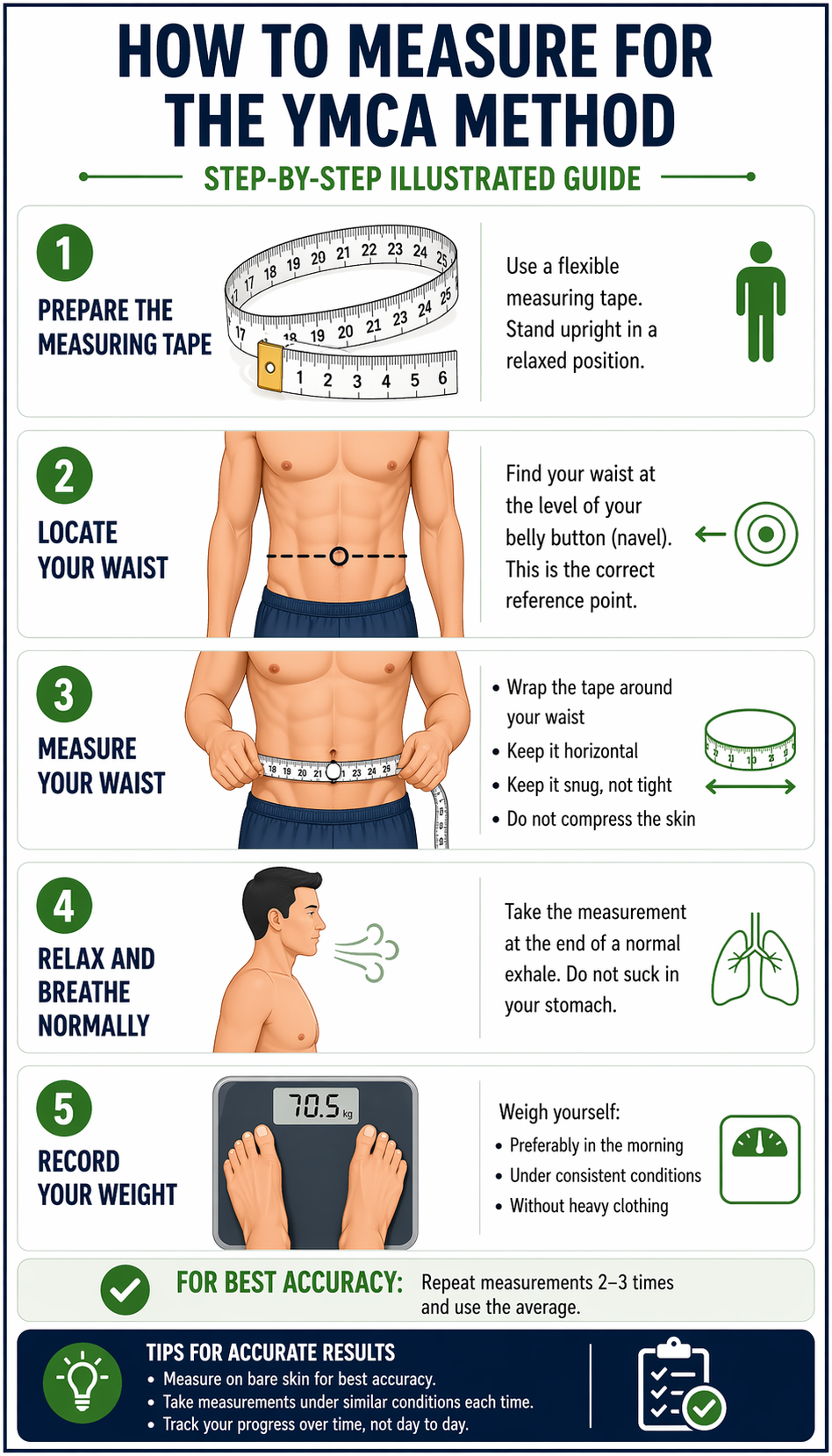
How the YMCA Method Works
This calculator estimates your body fat percentage from just two inputs: your body weight and your waist circumference. It's the classic YMCA field formula — built to give a quick, practical approximation with nothing more than a scale and a tape measure. Body fat percentage is the share of your total weight that comes from fat, and it's commonly used to gauge fitness and health against general population standards.
Taking the Measurements — What Counts
With only two inputs, each one carries real weight — so measure carefully and the same way each time:
- WaistMeasured around the abdomen at the level of the navel, horizontal to the floor, taken after a normal breath out. Snug but not compressing. — the single circumference the whole estimate hinges on.
- WeightIdeally measured in the morning, before eating, in light clothing, for consistency between readings. — your total body weight.
For the most reliable trend, take both under the same conditions each time — morning, before eating, same scale and tape.
Convert, Then Apply the Formula
The YMCA formula is defined for pounds and inches, so if you enter kilograms and centimetres the calculator converts them first — otherwise the numbers come out wildly wrong. These are the actual equations it runs:
Waist is in inches and weight in pounds. The only difference between the sexes is the constant — 98.42 for men, 76.76 for women — which reflects the higher essential fat women naturally carry.
Your Result and Its Category
Your estimate is placed into one of five categories for your sex. The classification is done on the exact calculated value and only rounded for display, so results sit in the right band even near a boundary:
- Essential — the minimum fat the body needs to function. Men 2–5% · Women 10–13%. Dropping below this range can carry health risks.
- Athletic — lean and performance-oriented. Men 6–13% · Women 14–20%. Typical of well-trained athletes.
- Fitness — a fit, healthy range. Men 14–17% · Women 21–24%. Common among people who train regularly.
- Average — around the population average. Men 18–24% · Women 25–31%. Acceptable, with room to improve.
- High — above the healthy range. Men 25%+ · Women 32%+. Associated with increased health risk.
A Note on the Data
Be clear-eyed about what this method is: the simplest and roughest estimate in the set. Because it leans on a single waist measurement plus total weight, it can't tell muscle from fat — a lean, muscular person with a heavier bodyweight can read higher than they should, and someone who carries fat away from the waist can read lower. It's genuinely useful for a fast ballpark and for watching a trend, but it's less accurate than skinfold calipers or multi-site tape methods like the U.S. Navy formula.
So treat the percentage as a rough figure, and lean on what a simple method does well: measured the same way over time, the direction of change is more trustworthy than any single reading.
Where You Fall
The category spectrum shows the five bands laid out across the body-fat range for your sex, with a marker at your result. It's a positioning aid built from the same category boundaries the calculator uses. The ranges are population reference bands and are not adjusted for age, so read them as general guidance rather than a personalised target.
Data Sources and Verification
- Formula — the YMCA body-fat equation, using body weight and waist circumference (a standard fitness-assessment field method).
- Category ranges — American Council on Exercise (ACE) body fat norms.
Limitations and Important Caveats
This calculator provides a rough estimate, not a clinical measurement. Real accuracy depends on factors it can't capture:
- One circumference only — with just a waist measurement it can't distinguish muscle from fat, so muscular or unusually proportioned people can get skewed results.
- Measurement matters — because there are only two inputs, a small error in either shifts the result noticeably; measure the same way each time.
- Roughest of the methods — skinfold and multi-site tape methods are more accurate; use this for speed and trend-tracking.
- Not the lab — DXA and hydrostatic weighing are the accurate references if you need a precise number.
- One metric among many — body fat percentage is a single data point and shouldn't be used in isolation or to drive extreme changes.
Disclaimer:
This YMCA body fat calculator provides an estimate based on body weight and waist circumference using generalized formulas. Results vary with individual body composition, fat distribution, and measurement accuracy. This tool is for general informational purposes only and should not be considered medical, fitness, or nutritional advice. Consult a qualified healthcare provider to interpret your results and before beginning a new training or nutrition program, especially if you have a pre-existing condition.