
Navy Body Fat
US Navy Circumference (Tape) Method
Units apply to all measurements below.
Body Fat Categories
| Category | Men (%) | Women (%) |
|---|
Where You Fall
How the Navy Method Works
This calculator estimates your body fat percentage from height and a few circumference (tape) measurements — no calipers required. Developed by Hodgdon and Beckett at the Naval Health Research Center in 1984, it's the formula the U.S. Navy uses in its physical readiness program. The idea is simple: where you carry girth — especially at the waist relative to the neck — tracks how much fat you're carrying, so a log-based equation on those measurements predicts body fat surprisingly well for something you can do with a tape measure at home.
Taking the Measurements — What Counts
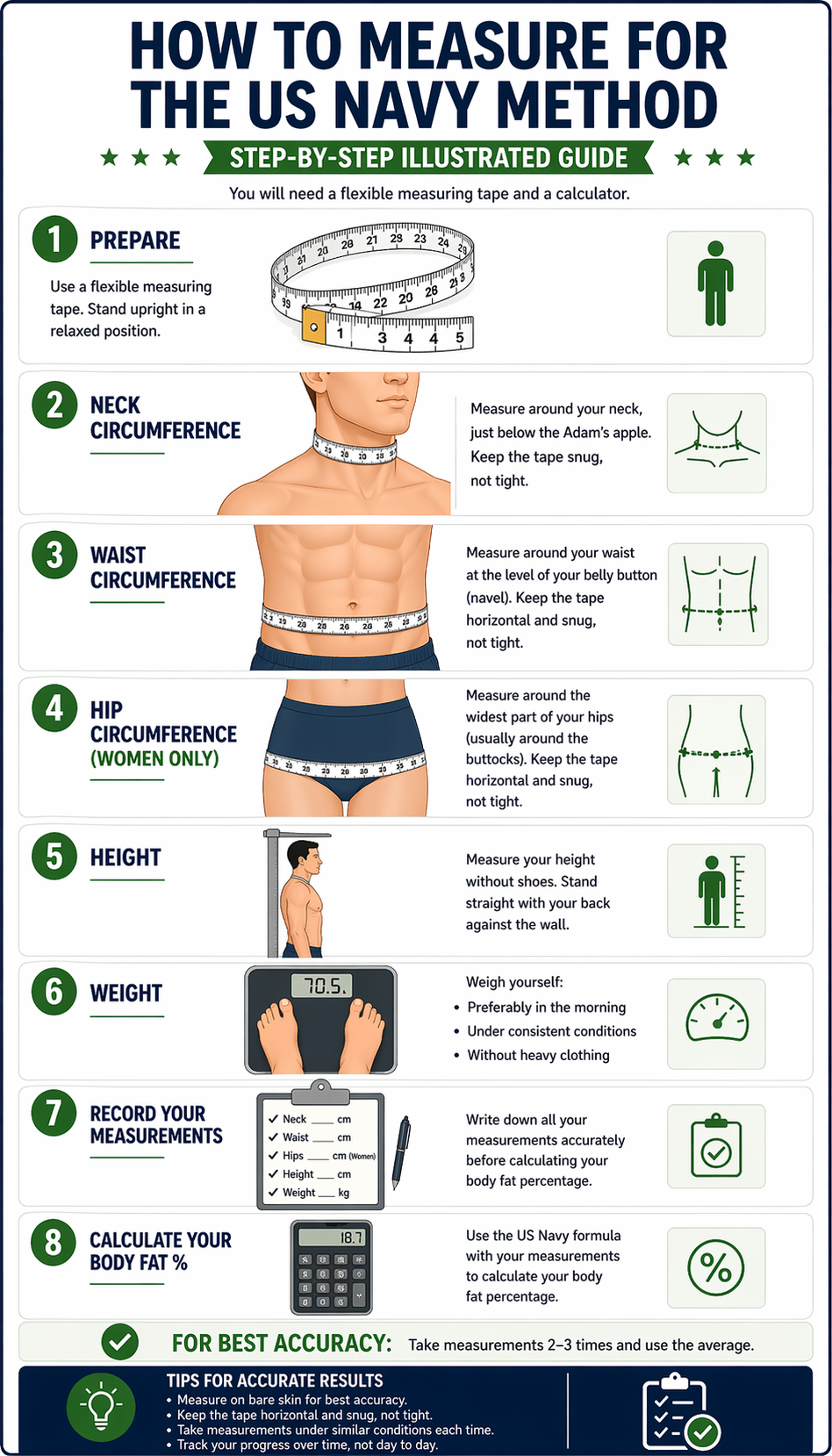
Men measure three things; women measure four:
- Men: neck, waist, height.
- Women: neck, waist, hips, height.
This method lives or dies on tape technique, because it feeds the numbers through a logarithm — so small errors near the extremes get amplified. Keep the tape level and snug (not tight), measure relaxed after a normal breath out, and use the same tape each time. Where to place it:
- NeckJust below the larynx (Adam's apple), with the tape sloping slightly downward to the front. Don't flare the shoulders.
- Waist — menAround the abdomen at the level of the navel, horizontal to the floor.
- Waist — womenAt the narrowest point of the torso, horizontal to the floor.
- Hips — womenAround the widest point of the hips and buttocks, horizontal to the floor.
- HeightStanding tall without shoes.
The Formula
Nothing here is a black box — these are the actual published equations the calculator runs. They're defined for measurements in inches; if you enter centimetres, the calculator converts internally before applying them. log₁₀ is the common (base-10) logarithm:
Because the men's formula takes the log of (waist − neck), your waist has to be larger than your neck for it to work; for women, waist + hip must exceed the neck. If not, the measurements need re-checking — the calculator will flag it rather than return a nonsense value.
Your Result and Its Category
Your estimate is placed into one of five categories for your sex. The classification is done on the exact calculated value and only rounded for display, so results sit in the right band even near a boundary:
- Essential — the minimum fat the body needs to function. Men 2–5% · Women 10–13%. Dropping below this range can carry health risks.
- Athletic — lean and performance-oriented. Men 6–13% · Women 14–20%. Typical of well-trained athletes.
- Fitness — a fit, healthy range. Men 14–17% · Women 21–24%. Common among people who train regularly.
- Average — around the population average. Men 18–24% · Women 25–31%. Acceptable, with room to improve.
- High — above the healthy range. Men 25%+ · Women 32%+. Associated with increased health risk.
A Note on the Data
These numbers rest on real, validated science. Hodgdon and Beckett built the equations against hydrostatic (underwater) weighing, and later studies have confirmed them against DEXA scans: done carefully, the method typically lands within ±3–4% of a lab measurement, with only a small average bias in each direction by sex. That's why every branch of the U.S. military uses it for readiness assessments — it's quick, needs only a tape, and repeats reliably.
Honesty cuts both ways, so the limits are worth naming. Because it reads girth rather than fat directly, it can misjudge people whose shape breaks the average pattern — a very muscular neck or a lean athlete with a thick waist can skew the estimate. And the log transform means a half-inch of tape error near the extremes shifts the result more than it would in the middle. Treat the percentage as a solid estimate, and lean on the method's real strength: measured the same way over time, it's an excellent progress tracker.
Where You Fall
The category spectrum shows the five bands laid out across the body-fat range for your sex, with a marker at your result. It's a positioning aid — a way to see at a glance where you sit and how far each neighbouring band is — built directly from the same category boundaries the calculator uses. The ranges themselves are population reference bands and are not adjusted for age, so read them as general guidance rather than a personalised target.
Data Sources and Verification
- Formula — Hodgdon, J.A. & Beckett, M.B. (1984), Naval Health Research Center (Reports 84-11 for men, 84-29 for women); used in the U.S. Navy Physical Readiness Program.
- Category ranges — American Council on Exercise (ACE) body fat norms.
Limitations and Important Caveats
This calculator provides an estimate, not a clinical measurement. Real accuracy depends on factors it can't capture:
- Tape technique is everything — placement, tension, and posture can each shift the result by a few points; consistency matters more than any single reading.
- It reads shape, not fat — people whose proportions differ from the average (very muscular, or lean with a thicker waist) can get a skewed estimate.
- Log sensitivity — small measurement errors near the extremes produce larger errors in the final number.
- Not the lab — DXA and hydrostatic weighing are more accurate references; use those if you need a precise, one-off number.
- One metric among many — body fat percentage is a single data point. It doesn't measure fitness, strength, or health on its own, and it shouldn't be used to drive extreme changes.
Disclaimer:
This U.S. Navy body fat calculator provides an estimate based on circumference measurements — neck, waist, and hips (for women) — along with height. Results vary with measurement accuracy, body-fat distribution, and individual differences in body composition. This method is not as precise as clinical assessments and is for general informational purposes only. It does not constitute medical, fitness, or nutritional advice. Consult a qualified healthcare provider to interpret your results and before beginning a new training or nutrition program, especially if you have a pre-existing condition.