
Skinfold Body Fat
Parrillo 9-Site Method
Units apply to the body weight field below.
Body Fat Estimates
| Category | Men (%) | Women (%) |
|---|
Where You Fall
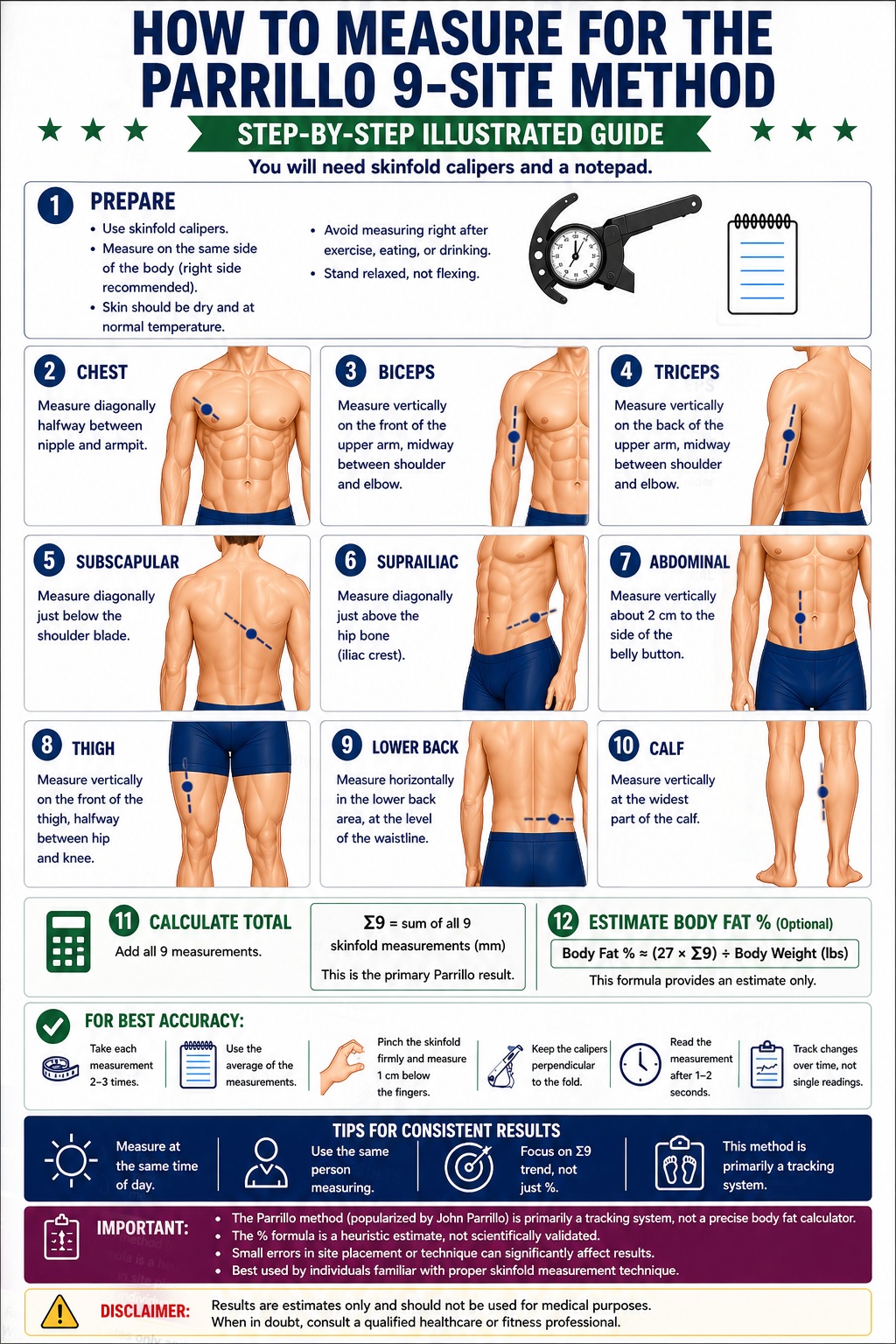
How the Parrillo Estimator Works
This estimator uses the Parrillo 9-site skinfold method, which samples subcutaneous fat across nine areas of the body. Developed by John Parrillo for competitive bodybuilders, it was built for one job above all: tracking body composition changes over a training cycle. It uses the same nine sites for women and men, and — unlike the Jackson–Pollock or Durnin–Womersley equations — it leans on the raw sum of the folds rather than a body-density model.
Taking the Measurements — What Counts
Measure each site in millimetres on the right side of the body, and — for consistency — take each one two or three times and use the average. Hover any site for where it sits:
- ChestDiagonal fold between the nipple and the armpit.
- BicepsVertical fold on the front of the upper arm.
- TricepsVertical fold on the back of the upper arm.
- SubscapularDiagonal fold just below the shoulder blade.
- SuprailiacDiagonal fold just above the hip bone.
- AbdominalVertical fold next to the belly button.
- ThighVertical fold on the front of the thigh, halfway between hip and knee.
- Lower BackDiagonal fold in the lower back area near the waist.
- CalfVertical fold at the widest part of the calf.
The Sum Is the Point
In the Parrillo method, the sum of the nine folds is the real result — the single number worth watching from month to month:
A falling Σ9 measured the same way each time is strong evidence you're losing fat — regardless of what the percentage says. That's the method's genuine strength.
From Sum to Body Fat — The Math
To turn that total into a percentage that's easier to interpret, Parrillo applies one simple step — the same formula for everyone, with no age or sex terms:
Because it divides by bodyweight, this is a proportion rather than a body-density estimate: two people with identical folds but different weights get different percentages. It's a rough conversion layered on top of the sum — useful for a ballpark figure, but the sum underneath it is the more trustworthy signal.
Your Result and Its Category
Your estimate is placed into one of three descriptive bands for your sex. The classification is done on the exact value and only rounded for display:
- Lean — a lean, defined range. Men 6–13% · Women 14–20%. Typical of people who train consistently.
- Average — around the general population range. Men 14–24% · Women 21–31%. Acceptable, with room to move either way.
- Higher — above the lean/average range. Men 25%+ · Women 32%+. Keep in mind Parrillo tends to read high.
These are broad descriptive bands, not a clinical grading — and because Parrillo tends to read high, a result here may land a band above where a validated method would put you.
A Note on the Data — Read This One
Being straight about sourcing matters here. Unlike Jackson–Pollock and Durnin–Womersley — which were built and published against underwater weighing — the Parrillo formula comes from a 1993 bodybuilding book, not a peer-reviewed validation study. It has been shown to overestimate body fat by as much as roughly 4.7% compared with other methods, and in at least one peer-reviewed comparison it behaved as a statistical outlier while the Jackson–Pollock equations agreed with each other.
So treat the percentage as a rough, likely-high estimate, and lean on what this method actually does well: the sum of folds, measured the same way over time, is an excellent progress tracker. The number that matters most here is your own Σ9, trending down.
Where You Fall
The category spectrum shows the three bands laid out across the body-fat range for your sex, with a marker at your estimate. It's a positioning aid built from the same boundaries the calculator uses — read it as general orientation, remembering that the underlying estimate tends to run high.
Data Sources and Verification
- Formula — Parrillo, J. & Greenwood-Robinson, M. (1993), High-Performance Bodybuilding. A practitioner method, not a peer-reviewed validated equation.
- Category bands — generic descriptive ranges, not specific to Parrillo.
Limitations and Important Caveats
This estimator provides a rough figure, not a clinical measurement. Real accuracy depends on factors it can't capture:
- Not validated — the Parrillo formula has no published validation against laboratory methods and tends to overestimate; treat the percentage as approximate.
- Technique is everything — inconsistent site location, pinch, or caliper pressure swings the result; consistency matters more than any single reading.
- Weight-sensitive — because the formula divides by bodyweight, changes in weight shift the percentage even when the folds don't.
- Track the sum — the total in millimetres is the most reliable output; watch it trend over time rather than chasing a single percentage.
- One metric among many — body fat is a single data point and shouldn't be used in isolation or to drive extreme changes.
Disclaimer:
The Parrillo method can overestimate body fat percentage by as much as about 4.7% compared with other methods. The formula used here is a practical estimation, not an official or clinically validated calculation. The most important value in this method is the total skinfold measurement in millimetres, which reflects changes in body fat over time. Body fat percentages shown are approximate and vary with body composition, measurement technique, and individual differences. For best results, use this estimator consistently under the same conditions rather than focusing on a single reading. This tool is for general informational purposes only and is not medical, fitness, or nutritional advice; consult a qualified healthcare provider before making significant changes to your training or nutrition.