
Skinfold Body Fat
Durnin & Womersley 4-Site Method
Body Fat Categories
| Category | Men (%) | Women (%) |
|---|
Where You Fall
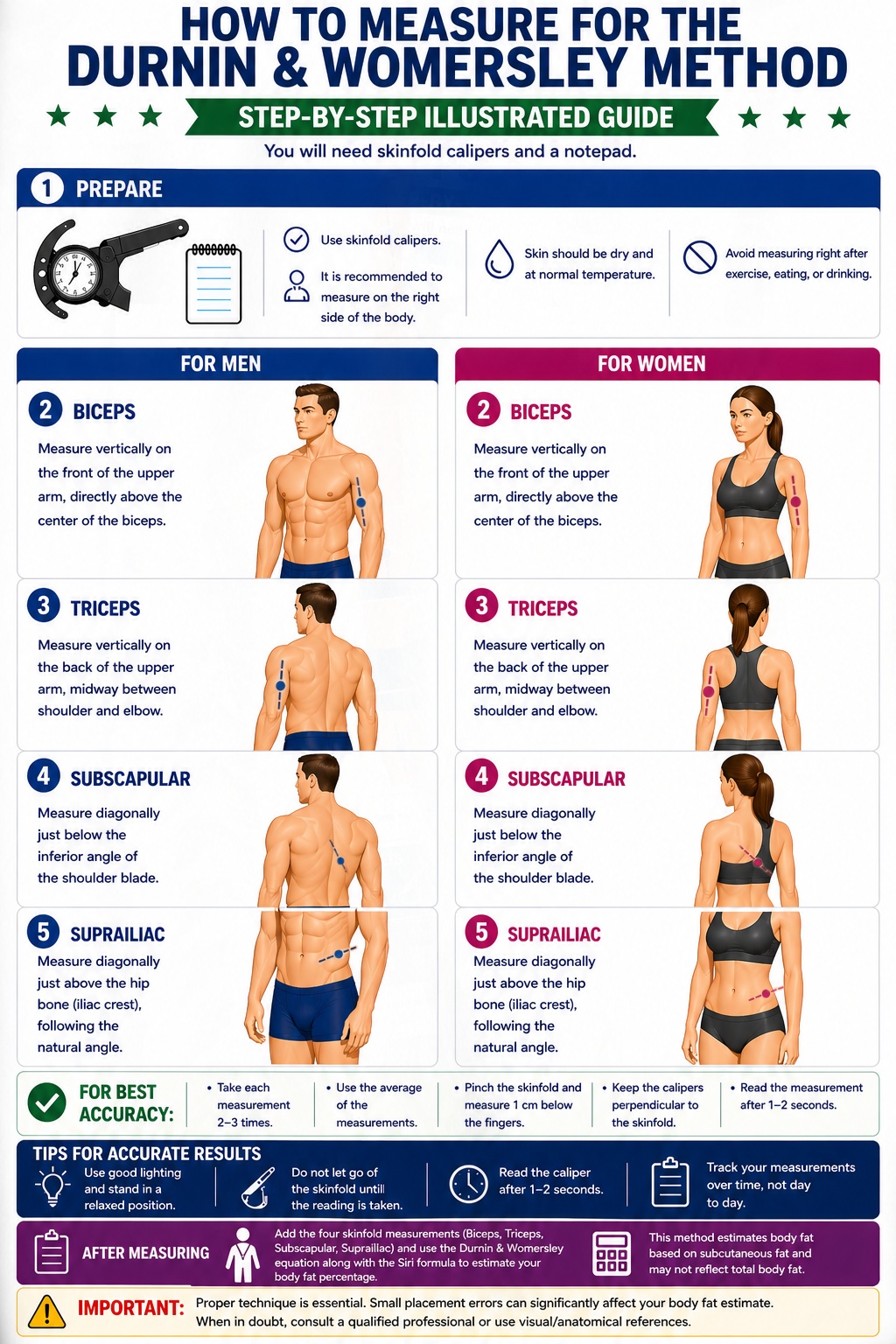
How the Durnin & Womersley Test Works
This calculator estimates your body fat percentage from skinfold measurementsThe thickness of a pinch of skin and the fat directly beneath it, measured with calipers in millimetres. Most of your body's fat sits just under the skin, so these folds track total body fat reasonably well. taken with calipers at four sites. Published in 1974 by J.V.G.A. Durnin and John Womersley at the University of Glasgow, it's one of the oldest and most widely used skinfold methods. Rather than adding the folds directly, it uses the logarithm of their sum — the relationship between skinfolds and body density curves rather than running in a straight line, and the log transform straightens it out — then applies an equation matched to your sex and age group.
Taking the Measurements — What Counts
Durnin & Womersley uses the same four sites for everyone — biceps, triceps, subscapular, and suprailiac — which makes it simpler to administer than methods that change sites by sex. Accuracy still lives and dies on technique: take every site on the right side of the body, pinch the fold firmly between thumb and forefinger, place the caliper jaws about 1 cm from your fingers and perpendicular to the fold, and read after one to two seconds. Take two or three readings per site and use the average, and use a calibrated caliper. The single most important factor is consistency: the same person, the same sites, the same conditions every time.
- Biceps — vertical fold on the front of the upper arm, about 1 cm above the triceps site.
- Triceps — vertical fold on the back of the upper arm, halfway between shoulder and elbow.
- Subscapular — diagonal fold just below the bottom tip of the shoulder blade.
- Suprailiac — diagonal fold just above the hip bone, along the natural fold line.
From Calipers to Body Fat — The Math
Nothing here is a black box — these are the actual published equations the calculator runs. First, the sum of your four folds is log-transformed and fed into the Durnin & Womersley equation for your sex and age to estimate body density. In every equation, L is log₁₀ of the sum of the four skinfolds in millimetres:
| Age | Men | Women |
|---|---|---|
| Under 17 | 1.1533 − 0.0643·L | 1.1369 − 0.0598·L |
| 17–19 | 1.1620 − 0.0630·L | 1.1549 − 0.0678·L |
| 20–29 | 1.1631 − 0.0632·L | 1.1599 − 0.0717·L |
| 30–39 | 1.1422 − 0.0544·L | 1.1423 − 0.0632·L |
| 40–49 | 1.1620 − 0.0700·L | 1.1333 − 0.0612·L |
| 50+ | 1.1715 − 0.0779·L | 1.1339 − 0.0645·L |
That density is then converted to a body fat percentage with the Siri equationPublished by William Siri in 1961, it converts whole-body density into a fat percentage using a two-compartment model of the body as fat and fat-free mass.:
Your Result and Its Category
Your estimated body fat is placed into one of five categories for your sex. The classification is done on the exact calculated value and only rounded for display, so results sit in the right band even near a boundary:
- Essential — the minimum fat the body needs to function. Men 2–5% · Women 10–13%. Dropping below this range can carry health risks.
- Athletic — lean and performance-oriented. Men 6–13% · Women 14–20%. Typical of well-trained athletes.
- Fitness — a fit, healthy range. Men 14–17% · Women 21–24%. Common among people who train regularly.
- Average — around the population average. Men 18–24% · Women 25–31%. Acceptable, with room to improve.
- High — above the healthy range. Men 25%+ · Women 32%+. Associated with increased health risk.
Why Age and Sex Matter
- Age is banded, not continuous. Durnin & Womersley published a separate equation for each age group — under 17, then each decade up to 50+ — because the way skinfolds relate to body density shifts with age. One side effect: estimates can step slightly as you cross a band boundary (say, from 29 to 30), since a different equation takes over.
- Sex changes the equation, not the sites. Men and women store fat differently, so each has its own set of constants — but unlike some methods, both use the same four measurement sites.
A Note on the Data
These numbers rest on real, peer-reviewed science. Durnin and Womersley built their equations by measuring 481 adults aged 16 to 72 against hydrostatic (underwater) weighing — the laboratory standard of the era. Done carefully, the method typically lands within ±3–4% of a lab measurement, and in some head-to-head comparisons against a modern four-compartment reference it has shown less underestimation bias than the Jackson & Pollock equations.
Honesty cuts both ways, so the limits are worth naming. The equations were built from a single, fairly heterogeneous sample, which gives them broad general use but limited population specificity. Like most skinfold methods, they tend to underestimate body fat at the higher end, and every skinfold result is a prediction stacked on a prediction — it inherits the assumptions of the underlying density model. Treat the percentage as a solid estimate, and lean on the method's real strength: measured the same way over time, it's an excellent progress tracker.
Where You Fall
The category spectrum shows the five bands laid out across the body-fat range for your sex, with a marker at your result. It's a positioning aid — a way to see at a glance where you sit and how far each neighbouring band is — built directly from the same category boundaries the calculator uses. The ranges themselves are population reference bands and are not adjusted for age, so read them as general guidance rather than a personalised target.
Data Sources and Verification
- Body density equations — Durnin, J.V.G.A. & Womersley, J. (1974), British Journal of Nutrition, from four skinfolds across six age bands per sex.
- Density-to-fat conversion — Siri (1961).
- Category ranges — American Council on Exercise (ACE) body fat norms.
Limitations and Important Caveats
This calculator provides an estimate, not a clinical measurement. Real accuracy depends on factors it can't capture:
- Technique is everything — inconsistent site location, pinch, or caliper pressure will swing the result more than the equation itself does.
- Population fit — the equations come from one broad sample and are least reliable for groups very different from it; specialised equations exist for some populations.
- It can underestimate — skinfold methods tend to read low at higher body-fat levels and for very muscular individuals.
- Age banding creates small steps — because each age group has its own equation, results can shift slightly at a band boundary rather than changing smoothly.
- Not the lab — DXA and hydrostatic weighing are more accurate references; use those if you need a precise, one-off number.
- One metric among many — body fat percentage is a single data point. It doesn't measure fitness, strength, or health on its own, and it shouldn't be used to drive extreme changes.
Disclaimer:
This calculator provides an estimate based on the Durnin & Womersley skinfold equations and age- and sex-adjusted category standards. Real accuracy depends on measurement technique, caliper quality, anatomy, population, and individual variation. Body fat percentage is only one indicator of health and should not be used in isolation or to justify extreme dietary or training changes. This tool is for general informational purposes only and should not be considered medical, fitness, or nutritional advice. Consult a qualified healthcare provider to interpret your results and before beginning a new training or nutrition program, especially if you have a pre-existing condition.