
T-Test
Change-of-Direction Agility Assessment
Read the disclaimer below before attempting this test.
T-Test Standards by Age
Standards Across Age
Where You Fall in Your Age Group
How to Run the T-Test
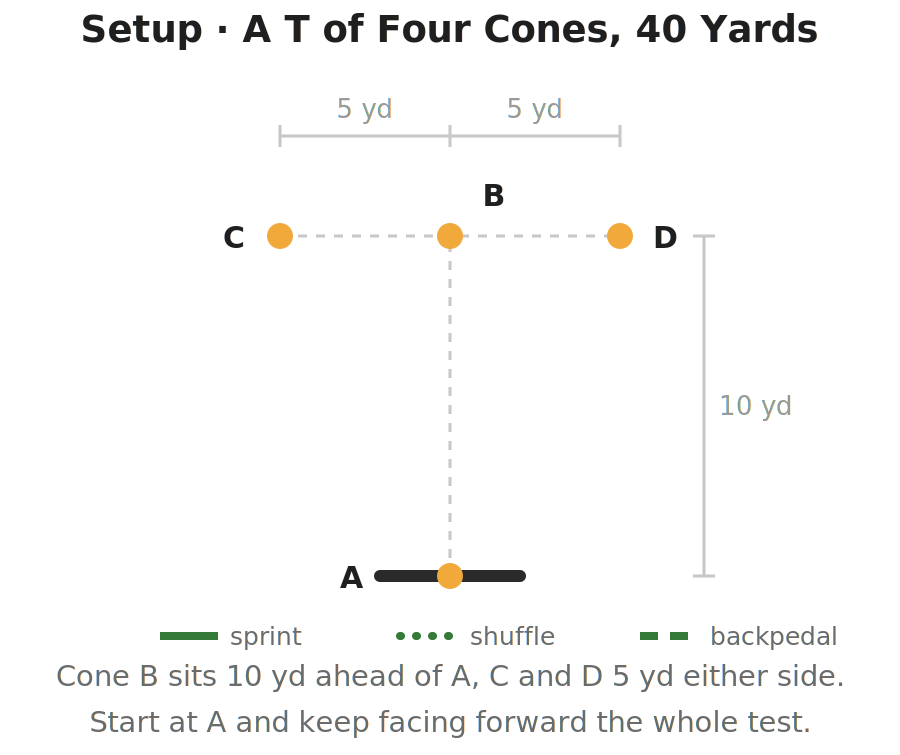
Four cones in a T, 40 yards in total — sprint forward, shuffle both ways, backpedal home, all facing the same direction.
Setup · A T of Four Cones, 40 Yards
Set cone B 10 yd ahead of A, then C and D 5 yd to either side of B. Start behind A. You face forward for the entire test — turning to look where you are going voids the trial.
Step 1 · Sprint 10 Yards to B
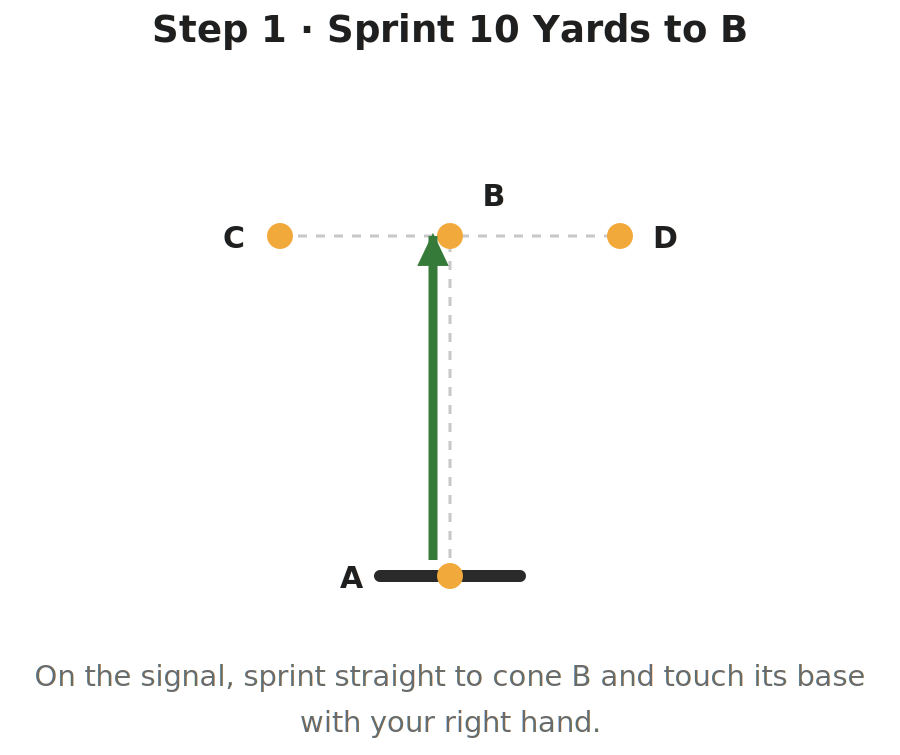
On the signal, sprint straight ahead to cone B and touch its base with your right hand. This is the only forward running in the test.
Step 2 · Shuffle Left, Right, Back
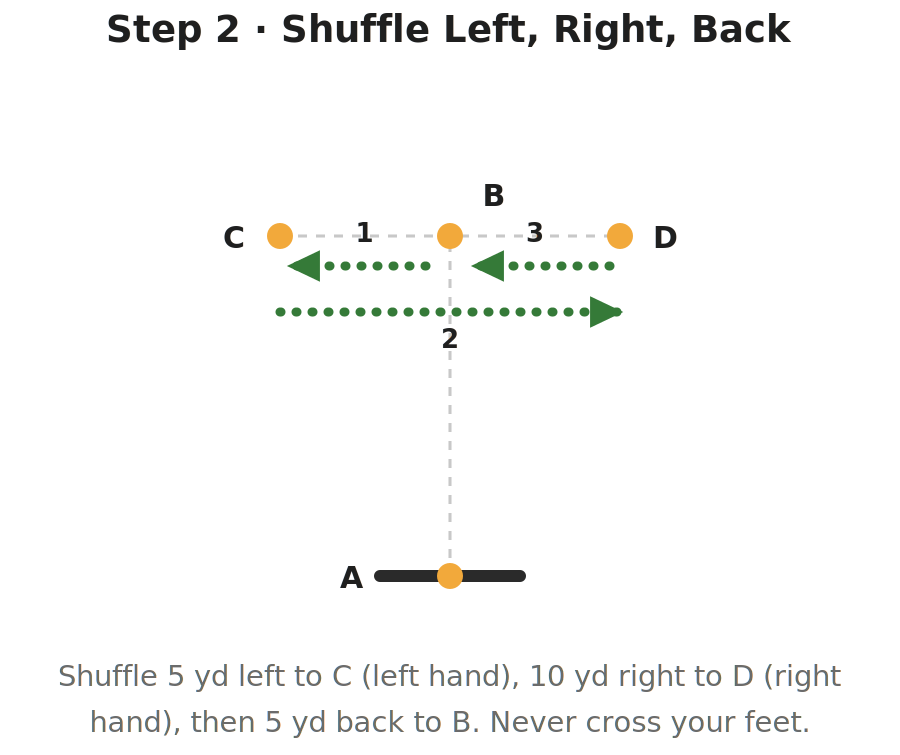
Side-step 5 yd left to C and touch it with your left hand, 10 yd right to D with your right hand, then 5 yd back to B. Shuffle throughout — crossing your feet voids the trial.
Step 3 · Backpedal Home to A
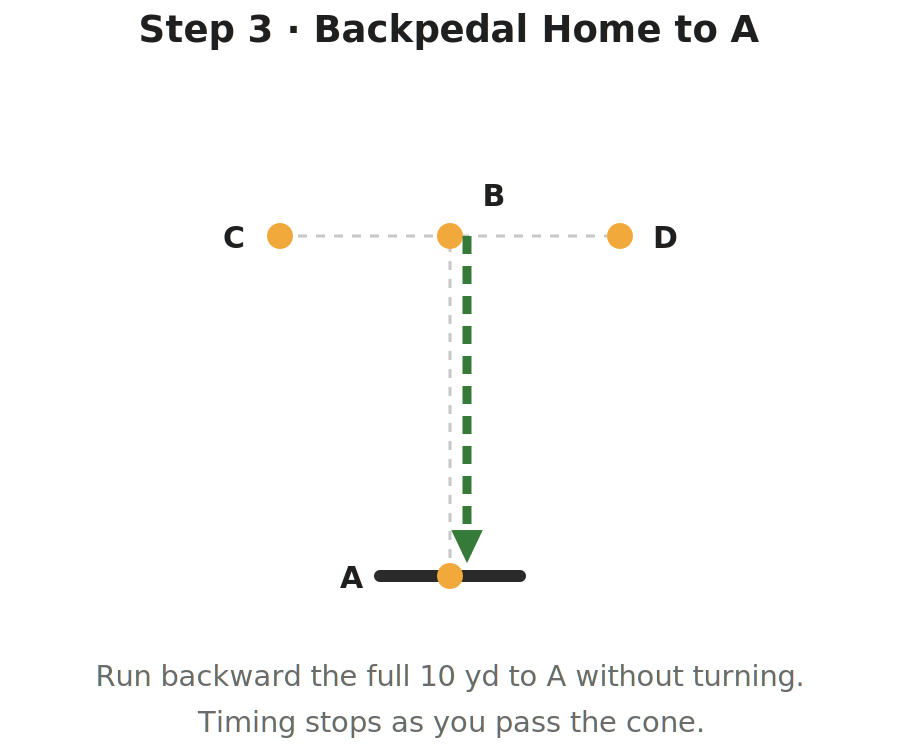
Run backward the full 10 yd to A without turning your body. Timing stops as you pass cone A. That is 40 yd in total.
In the diagrams a solid line is a forward sprint, a dotted line a lateral shuffle, and a dashed line a backpedal. Three faults void a trial: crossing one foot over the other during a shuffle, failing to touch the base of a cone, and turning your body to face the direction you are moving. Take the best of two or three attempts with full rest between them, and keep the surface and footwear consistent so retests compare.
The Test in Practice
A coaching walkthrough of the T-Test course, cone by cone.
Video is from a third-party coaching channel, not produced by Amatal, though Physiopedia cites this same clip in its own T-Test reference. It is not the source of the rating scale here, so treat the protocol above as the reference — 10 yd sprint to B, 5 yd shuffle left to C, 10 yd right to D, 5 yd back to B, then backpedal to A, touching the base of every cone. Remember the three faults that void a trial: crossing your feet, missing a cone, or turning to face the direction of travel.
- SEMO Agility Test — the other test here that mixes sprinting, shuffling and backpedaling, over a smaller court.
- Illinois Agility Run — all forward running and weaving; performance on the two correlates closely.
- Edgren Side Step Test — strips the test down to the lateral shuffle alone and counts it against the clock.
How This Calculator Works
This calculator measures your change-of-direction agility using the T-Test — one of the most widely used field assessments of agility, leg power, and leg speed. You enter your total time in seconds to complete the course, and the calculator classifies your result against published T-Test reference norms, then computes your category, your Agility Age, and an estimated percentile for your age and sex.
One thing to keep in mind throughout: for the T-Test, a lower time is better. Every part of the calculator — the tiers, the table, the charts, the percentile — is built around faster being better, which is the opposite of a reps-based test where more is better.
Step 1: Enter Your Details
The calculator needs three inputs: your sex, your age, and your T-Test time.
- SexT-Test norms are reported separately for men and women because of biological differences in lower-body power, speed, and strength-to-weight ratio. — selects which normative table you are compared against.
- Age — determines the performance standards expected for your stage of life.
- T-Test Time — your total time, in seconds, from the start signal until you cross the finish on the backpedal. This single time is your score; there is no separate technique setting.
The Test Protocol
For results that match the norms, the test must be performed the same way the norms were collected. The T-Test uses four cones arranged in a "T" shape:
- Cone setup: Place cone A at the start. Cone B is 10 yards directly ahead of A. Cones C and D sit 5 yards to the left and right of B, so C and D are 10 yards apart. Total course distance is 40 yards.
- Sprint: On the signal, sprint forward from A to B and touch the base of cone B with your right hand.
- Shuffle left: Side-shuffle 5 yards left to cone C and touch its base with your left hand.
- Shuffle right: Side-shuffle 10 yards right to cone D and touch its base with your right hand.
- Shuffle back: Side-shuffle 5 yards left back to cone B and touch its base.
- Backpedal: Run backward from B to A. Timing stops as you pass cone A.
Three faults invalidate a trial and call for a retest: crossing one foot over the other during a shuffle, failing to touch the base of a cone, and failing to face forward for the entire test. Equipment is simple — four cones, a measured surface, and a stopwatch — but surface and footwear should be kept consistent between tests.
How Your Category Is Determined
The commonly published T-Test rating scale uses four named ratings (Excellent, Good, Average, Poor) for each sex. To keep every assessment on this platform consistent, those ratings are mapped onto the single five-tier scale used across the site:
Elite = "Excellent" · Superior & Advanced = "Good" (split into two) · Intermediate = "Average" · Low = "Poor"
Four of the five tier boundaries sit exactly on the published Excellent, Good, and Average cut points; the Superior tier is an added subdivision within the "Good" band so the scale matches the platform's standard five-tier structure. The young-adult (age 22) reference thresholds the calculator uses are:
Women (age 22): Elite ≤ 10.5s · Superior ≤ 11.0s · Advanced ≤ 11.5s · Intermediate ≤ 12.5s · Low > 12.5s
Your time is compared against the cutoff for each tier at your age and sex, and you are placed in the highest (fastest) tier you qualify for — that is, the best tier whose time ceiling you match or beat:
- Low — slower than the typical range for your group. Corresponds to the published "Poor" rating. A clear starting point with substantial room for improvement.
- Intermediate — around the population average. Corresponds to "Average." Typical of recreationally active adults.
- Advanced — above average for your group. The slower half of the published "Good" band. Reflects consistent agility and conditioning work.
- Superior — well above average. The faster half of the published "Good" band. Characteristic of well-conditioned, trained individuals.
- Elite — top tier for your age and sex. Corresponds to "Excellent." Among the quickest performers in the demographic.
The Smooth Age Model
The T-Test was validated primarily on college-aged adults, so its firmest reference point is the young-adult athlete. Using a single set of standards for everyone would ignore the fact that change-of-direction speed, like sprint speed and power, declines gradually and continuously with age rather than staying flat and then dropping off a cliff.
To model this honestly, the calculator anchorsThe published young-adult thresholds are placed at age 22; the remaining anchors at 17, 30, 40, 50, 60, and 70 carry the age-related slowing applied to those baselines. the published thresholds at age 22 and defines additional anchor ages at 17, 30, 40, 50, 60, and 70, then interpolates a smooth value for every age in between:
Ages below 17 are held at the youngest values, and ages beyond 70 are extrapolated by continuing the slowing trend out to 75. The age-22 thresholds are calibrated to published reference norms; the values at every other age are modeled estimates derived from published agility-decline rates, not numbers measured directly at each age.
Reading the Two Charts
The calculator draws two complementary visuals, and they answer different questions.
- Standards Across Age plots average speedSpeed = the 40-yard course distance ÷ your time, in yards per second. It is the average pace over the whole course, not a top speed. rather than raw time. Time is converted to speed (40 yards ÷ your time) for one reason: so that a faster performance sits higher on the chart. That puts Elite at the top and Low at the bottom and lets the chart read like any familiar "higher is better" graph. The five shaded bands are your tiers at every age; the dot marks your age and speed; the band the dot sits in is your level. The bands slope gently downward with age as standards ease. Your tooltip shows both your speed and your real time.
- Where You Fall in Your Age Group is a modeled distributionA normal (bell) curve fitted to the same tier percentiles used elsewhere in the calculator. Real agility times are mildly right-skewed, so the curve is an illustrative approximation, not a measured population. of T-Test times for your exact age and sex, shaded into the five tiers, with a dashed line and dot marking where you fall. Slower times are on the left and faster times on the right, so the tiers run Low → Elite across the curve. The red Low region looks large and the gold Elite region small on purpose: that honestly reflects that Low covers roughly the bottom third of people while Elite is only the top few percent.
How to Read the Standards Table
The standards table lists one row for every five years of age, and one column for each of the five levels, running Low → Elite from left to right. The header labels are color-coded to match the chart bands — on a phone the headers shorten to single letters (L · I · A · S · E); tap any header to see its full name.
- Each cell is a single number — the time ceiling. It shows the slowest time still allowed for that level at that age. If your time equals or beats it (you are that fast or faster), you have reached that level.
- The Low column is the exception.Low has no ceiling — it covers every time slower than the Intermediate cutoff. The cell shows ">" followed by that cutoff. Because Low covers everything slower than the Intermediate cutoff, its cell shows a "greater-than" value rather than a target you aim to hit.
- Your row and level are highlighted. The row closest to your age is shaded, and within it, the cell for your achieved level is filled with that tier's color.
Agility Age
Your Agility AgeThe age at which your time would be considered typical (around-median) performance. Conceptually similar to "fitness age" used in cardiovascular testing. is the age at which your time would be average. If you post a faster time than the typical person of your actual age, your Agility Age is younger; if slower, it is older.
The calculator scans the smooth age model for the age whose median performance — the middle of the Intermediate band — equals your time, giving you an intuitive single-number summary of where your change-of-direction speed sits on the aging curve.
Percentile Estimate
The percentile estimates the share of people in your age-and-sex group you are faster than. Because the reference data provides category boundaries rather than a full distribution, the percentile is approximated by mapping each tier cutoff to its corresponding percentile and interpolating between them:
Your time is placed along this scale to produce an approximate percentile. It is a reasonable guide, not a precise population statistic.
How Age and Sex Change Your Score
These two inputs do not just describe you — each one directly changes the numbers your result is measured against:
- Age changes the thresholds. The calculator recomputes the time cutoff for every tier at your exact age. Because agility standards ease with age, the same time is judged against more forgiving cutoffs as you get older — so an identical time can place you in a higher tier at 55 than it would at 25. This is why the entire standards table and chart shift across age.
- Sex selects a different table. Choosing male or female swaps in an entirely separate set of normative values. The cutoffs differ between the two, so the same time is scored against different benchmarks depending on which table applies.
Why Agility Matters
The T-Test is a benchmark for planned change-of-direction ability — the capacity to accelerate, decelerate, move laterally, and reaccelerate while keeping body control. Those qualities underpin performance in court and field sports and in tactical occupations, and they draw on leg power and speed as much as on footwork. Pauole and colleagues (2000) found the T-Test to be highly reliable and well correlated with measures of leg power and sprint speed, which is part of why it remains a staple of field testing.
Important context: the T-Test is a pre-planned drill — you know the course in advance. It therefore measures the physical side of agility (the ability to change direction quickly) rather than reactive agility, which is the ability to read and respond to an unpredictable stimulus. A great T-Test time reflects strong movement mechanics and lower-body speed, but it is one piece of the broader agility picture, not the whole of it.
Data Sources and Methodology
The norms and methods in this calculator are built from established testing references:
- Semenick, D.M. (1990). Tests and Measurements: The T-Test. NSCA Journal, 12(1), 36–37 — the original description of the T-Test protocol.
- Pauole, K., Madole, K., Garhammer, J., Lacourse, M., & Rozenek, R. (2000). Reliability and Validity of the T-Test as a Measure of Agility, Leg Power, and Leg Speed in College-Aged Men and Women. Journal of Strength and Conditioning Research, 14(4), 443–450 — reliability, validity, and young-adult reference data.
- Topend Sports. T-Test of Agility — the widely cited four-level rating scale used to calibrate the young-adult tier boundaries.
- Mackenzie, B. (2005). 101 Performance Evaluation Tests. Electric Word plc — field-testing protocols and interpretation.
A note on the age values: the T-Test's firmly published reference is the young-adult athlete. The per-age numbers around that anchor are modeled by interpolation, and values for older ages are extrapolated from general agility-decline trends. Treat the per-age standards as a sensible, transparent benchmark — directly published at the young-adult anchor, and modeled, but clearly labeled as such, everywhere else.
Limitations and Important Caveats
This calculator provides an estimate, not a clinical measurement. Several factors affect how precisely it reflects your true agility:
- Modeled age values. The young-adult reference is the firmly published anchor. The per-age numbers around it are modeled by interpolation, and values for older ages are extrapolated from general agility-decline trends. These are reasonable estimates, not directly measured figures at each age.
- Approximate percentile. The percentile is mapped from category boundaries rather than a complete population distribution, so it should be read as a guide, not an exact statistic.
- Setup and surface variability.Cone spacing, the testing surface, footwear, and whether each cone is actually touched all change the time. Standardize them to make retests meaningful. Non-standard setups bias the result. Keep the course, surface, and footwear consistent across tests.
- The speed chart shows average pace. Standards Across Age plots the average speed over the full 40-yard course, not your top speed at any instant.
- The distribution curve is modeled. The age-group bell curve is a normal approximation fitted to the tier percentiles; real agility times are slightly skewed, so it is illustrative rather than an exact population.
- Single-test snapshot. Fatigue, warm-up, time of day, and recent training all affect a single trial. For tracking progress, retest under the same conditions every few weeks and take the best of two or three trials.
- Planned agility only. The T-Test does not capture reactive agility — your ability to respond to an unpredictable cue.
Disclaimer:
This calculator provides an estimate based on established normative data and a modeled age curve. Real agility depends on training history, movement mechanics, body proportions, recovery, and individual variation. The T-Test involves maximal acceleration, hard deceleration, and rapid changes of direction that place significant stress on the knees, ankles, and hips. Always warm up thoroughly beforehand and stop immediately if you experience pain, dizziness, or unusual discomfort. This tool is for general informational purposes only and should not be considered medical, fitness, or training advice. Consult a healthcare provider before beginning a new exercise or testing program, especially if you have a pre-existing condition, are over the age of 45, or have been sedentary for an extended period.