
Hexagon Test
Agility, Balance & Foot-Speed Assessment
Best of two trials. Restart if you land on a line or jump the wrong side.
Read the disclaimer below before attempting this test.
Hexagon Test Norms
Where You Fall
How to Run the Hexagon Agility Test
Six sides, 24 inches each. Jump out and back over every line, three times around, against the clock.
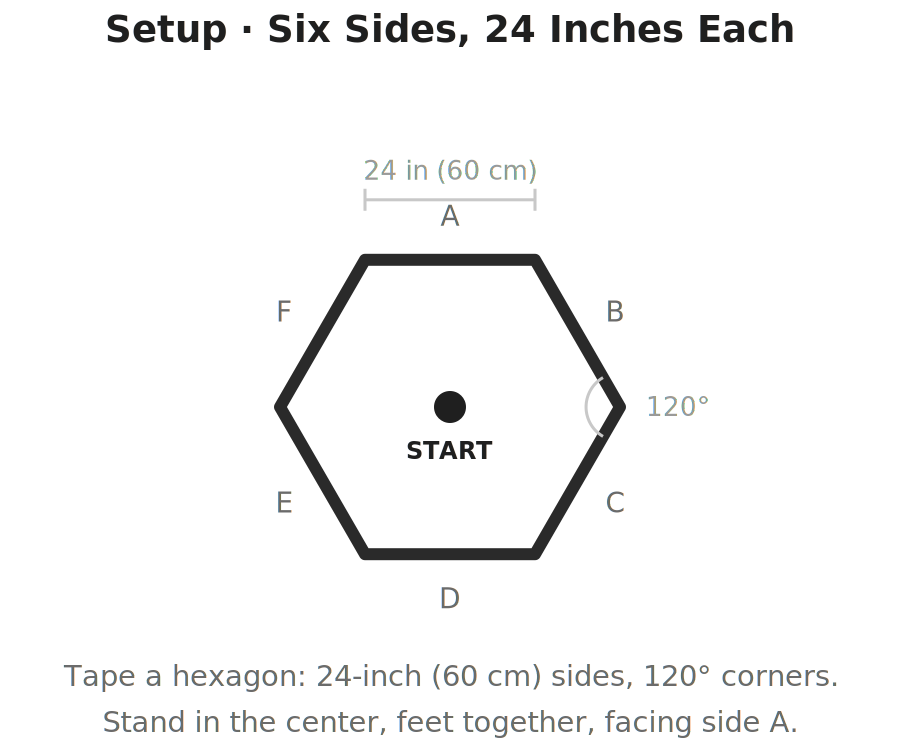
Setup · Six Sides, 24 Inches Each
Tape a hexagon on a non-slip floor with 24-inch (60 cm) sides and 120° corners. Label the sides A to F. Stand in the middle, feet together, facing side A.
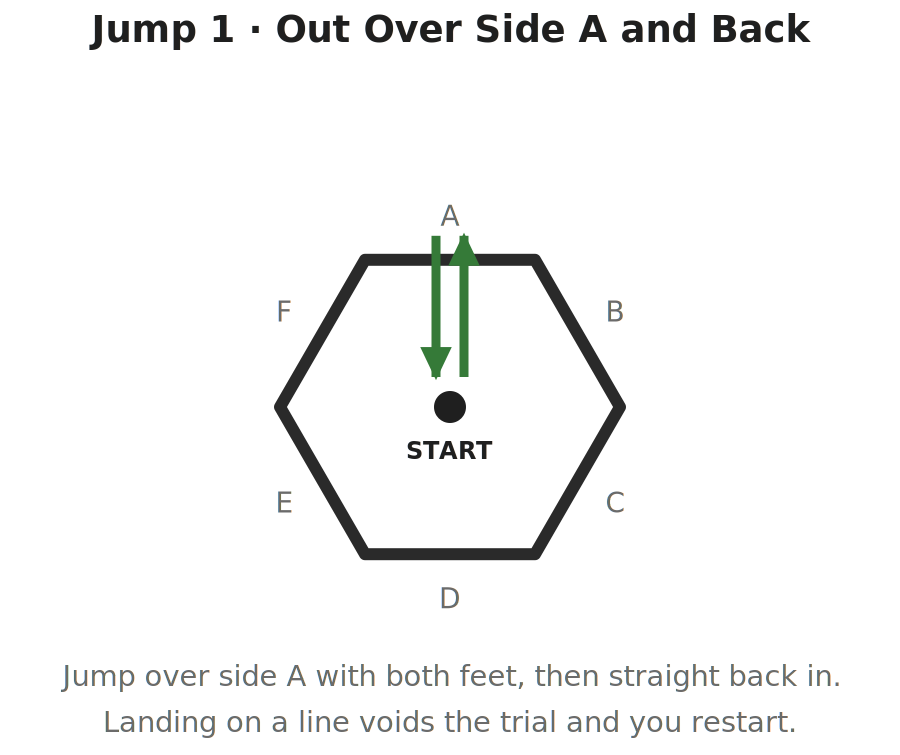
Jump 1 · Out Over Side A and Back
On the signal, jump over side A with both feet together, then straight back into the middle. Clear the tape — landing on a line ends the trial.
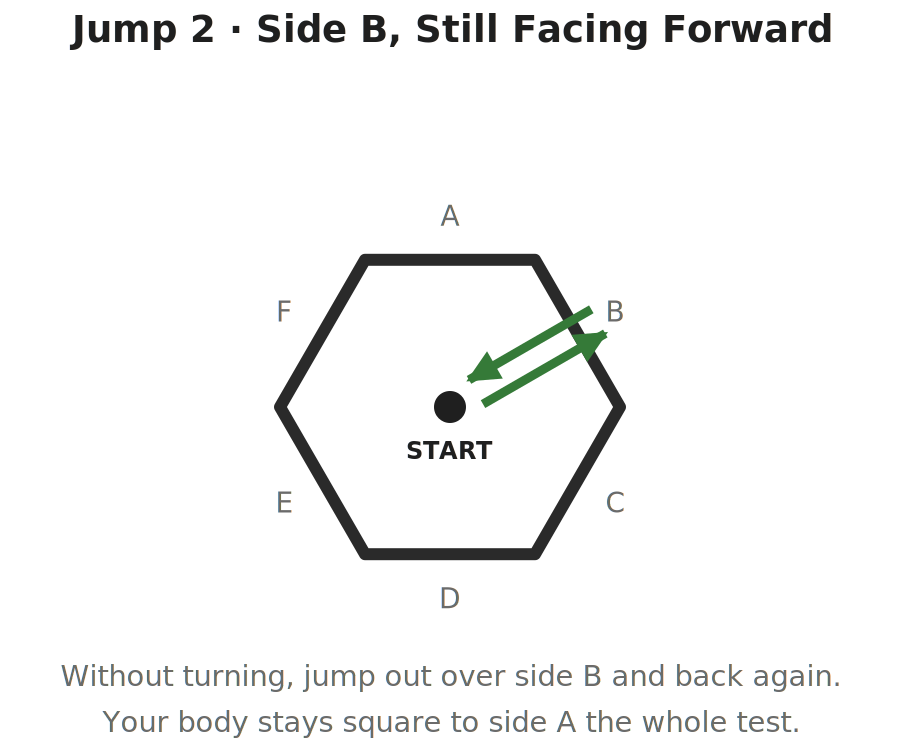
Jump 2 · Side B, Still Facing Forward
Move to the next side and repeat, without turning your body. You stay square to side A for the whole test, so each jump goes out at a different angle.
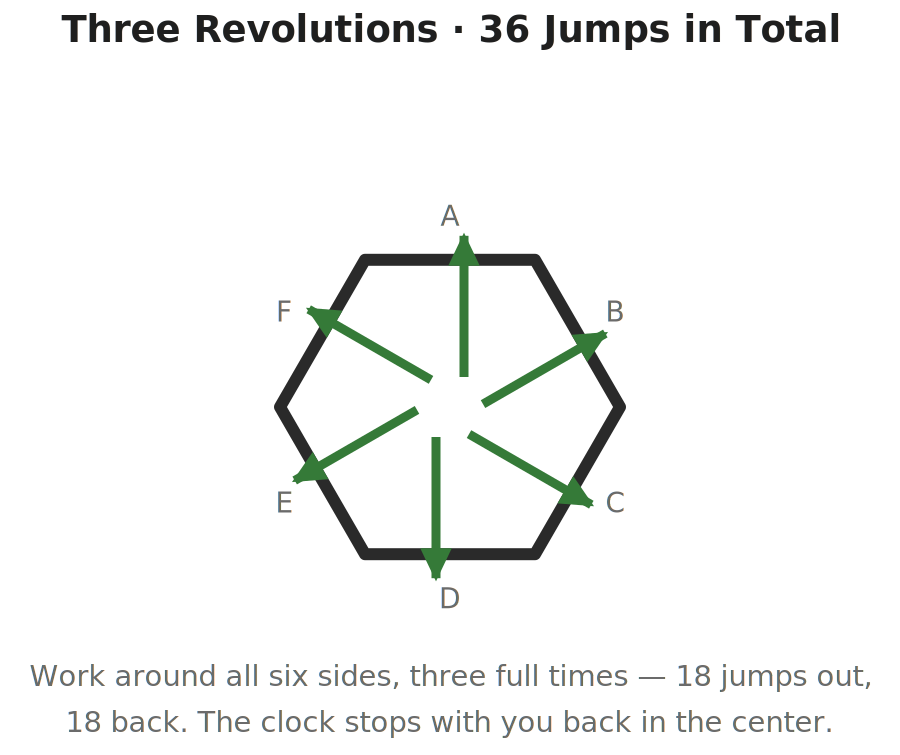
Three Revolutions · 36 Jumps in Total
Work around all six sides three full times — 18 jumps out, 18 back. Timing stops when you land back in the center after the third revolution.
Four faults void a trial and call for a restart: landing on a line instead of clearing it, jumping the wrong side or going out of sequence, losing balance and taking an extra step, and changing the direction you face. Take a submaximal practice run first — there is a measurable learning effect between a first and second attempt — then record the best of two trials. Running it in both directions and comparing the times will show any left-right imbalance.
The Test in Practice
A training-facility demonstration of the jump-over-and-back pattern around the hexagon.
Video is from EZIA Human Performance, not produced by Amatal, and it is framed as a training drill rather than a scored test administration — so treat the protocol above as the reference: 24-inch sides, 120° corners, feet together in the center, facing one side throughout, three full revolutions. Hexagon size and revolution count vary between demonstrations, and the reference times here assume the standard setup.
- Edgren Side Step Test — the other counted-pattern test on this site, and the one that shares this page's single-cohort norms approach.
- 505 Agility Test — swaps two-footed hopping for a running 180-degree turn, and scores each leg separately.
- Illinois Agility Run — a full-speed course over 60 meters, at the opposite end of the range from this tight six-side pattern.
How This Calculator Works
This calculator measures your agility, dynamic balance, and foot speed using the Hexagon Test — a simple, highly repeatable field assessment of how quickly you can move while keeping control of your body. You enter your time in seconds to complete three full revolutions of the hexagon, and the calculator classifies your result against a published reference norm table, then computes your rating and an estimated percentile for your sex.
One thing to keep in mind throughout: for the Hexagon Test, a lower time is better. Every part of the calculator — the rating bands, the norms table, the distribution curve, the percentile — is built around faster being better, the opposite of a reps-based test where more is better.
Step 1: Enter Your Details
The calculator needs two inputs: your sex and your Hexagon Test time.
- SexHexagon norms are reported separately for males and females, reflecting differences in lower-body power, speed, and movement mechanics in the reference population. — selects which normative column you are compared against.
- Hexagon Test Time — your time, in seconds, to complete three full revolutions, taking the better of two trials. This single time is your score; there is no separate technique setting.
Notice there is no age input. That is deliberate: the only widely published norms for this test were collected on 16–19 year olds, and there is no validated age-graded data to support adjusting the bands by age. Rather than invent an age curve, the calculator compares everyone against that single published standard and is upfront that comparisons outside 16–19 are approximate.
The Test Protocol
For results that match the norms, the test must be performed the way the norms were collected. The Hexagon Test uses a six-sided shape marked on the floor:
- Setup: Mark a hexagon with athletic tape. Each side is 24 inches (about 60.5 cm) and each internal angle is 120°. Label the sides A through F.
- Start: Stand with both feet together in the center, facing the front side (A).
- Jump out and back: On the signal, jump across the side and immediately back to the center.
- Continue around: Still facing forward, jump over the next side and back, working around the hexagon.
- Three revolutions: Repeat until you have completed three full circuits — 18 jumps out and 18 back, 36 movements in total.
- Both directions: Perform the test both clockwise and counter-clockwise; the better time in each direction is recorded.
Four faults invalidate a trial and call for a restart: landing on a line rather than clearing it, jumping over the wrong side or out of sequence, losing balance and taking an extra step, and changing the direction you are facing. Keep your body square to the same side for the entire test rather than rotating to face each one. A practice trialBeekhuizen et al. (2009) identified a measurable learning effect between first and second attempts, so an unrecorded practice run improves the accuracy of your scored trial. beforehand is recommended, and surface and footwear should be kept consistent between tests.
How Your Rating Is Determined
Your time is compared against a published norm table for 16–19 year olds, reported separately for each sex. Unlike some assessments on this platform, the published scale here already has five named bands, so they are kept verbatim rather than remapped onto the site's usual Low–Elite tiers.
The reference thresholds the calculator uses are:
Female: Excellent < 12.2s · Above Average 12.2–14.3s · Average 14.4–16.5s · Below Average 16.6–18.8s · Poor > 18.8s
Your time is placed in the best (fastest) band you qualify for — the highest rating whose time ceiling you match or beat:
- Poor — slower than the typical range for your group. A clear starting point with substantial room to improve foot speed and coordination.
- Below Average — somewhat slower than typical. Below the middle of the reference group but within reach of the average band with practice.
- Average — around the middle of the reference group. Typical of the 16–19 reference population; a solid, representative result.
- Above Average — faster than most of the group. Reflects good change-of-direction speed and consistent movement conditioning.
- Excellent — top band for your sex. Among the quickest performers in the reference demographic.
How to Read the Norms Table
The norms table lists one row for each of the five ratings, from Excellent at the top to Poor at the bottom, with a column for Male and Female times. The rating names are color-coded to match the distribution curve.
- Each cell is a time range — the window of times that earns that rating. Excellent shows a "<" value (be that fast or faster) and Poor shows a ">" value (anything slower).
- Your band is highlighted in the column for your sex, filled with that rating's color, so you can see at a glance where you landed and what the next band up requires.
Reading the Distribution Curve
The calculator draws one chart: Where You Fall, a modeled distributionA normal (bell) curve fitted to the published bands. Real agility times are mildly right-skewed, so the curve is an illustrative approximation, not a measured population. of Hexagon times for your sex, shaded into the five rating zones, with a dashed line and dot marking where you fall. Slower times are on the left and faster times on the right, so the bands run Poor → Excellent across the curve.
The curve is modeled, not measured, but it is built directly from the published numbers rather than invented. The five bands are spaced almost evenly (about 2.2 seconds apart), which is the fingerprint of a mean-and-standard-deviation construction. So a normal curve is fitted with its center at the midpoint of the Average band and its spread set to the band range divided by three:
Percentile Estimate
The percentile estimates the share of people in the reference group you are faster than. It is read directly from the fitted curve — the proportion of the modeled distribution that would post a slower time than yours:
Because the curve is modeled from category boundaries rather than a full raw dataset, treat the percentile as a reasonable guide, not a precise population statistic.
How Sex Changes Your Score
Choosing male or female swaps in an entirely separate set of normative values. The cutoffs differ between the two columns, so the same time is scored against different benchmarks depending on which table applies — and the distribution curve and percentile shift accordingly. Sex is the only input that changes the standard you are measured against; there is no age adjustment, for the reasons above.
Reliability and What Counts as Real Improvement
The Hexagon Test is one of the more repeatable field agility tests. Beekhuizen and colleagues (2009) reported intraclass correlationsA statistic from 0 to 1 describing how consistently the test reproduces the same score on repeat attempts; values above 0.90 are considered excellent. of about 0.94 for same-day and 0.92 for between-day retests. They also put the minimal detectable change at roughly one second — meaning an improvement needs to exceed about a second before you can be confident it reflects a real gain rather than ordinary measurement noise.
Why Agility Matters
The Hexagon Test is a benchmark for planned change-of-direction ability — the capacity to move quickly and repeatedly while keeping body control. Those qualities underpin performance in court and field sports and in tactical occupations, and they draw on lower-body power and coordination as much as on footwork. Pauole and colleagues (2000) found agility-test performance correlated moderately with vertical jump height and 40-yard sprint time, and later work in young tennis players (Fernández-Fernández et al., 2021) linked hexagon performance to change-of-direction, sprint, and jump measures.
Important context: the Hexagon Test is a pre-planned drill — you know the pattern in advance. It therefore measures the physical side of agility (the ability to change direction quickly while balanced) rather than reactive agility, which is the ability to read and respond to an unpredictable stimulus. A great hexagon time reflects strong movement mechanics and foot speed, but it is one piece of the broader agility picture, not the whole of it.
A practical extension: comparing your clockwise and counter-clockwise times reveals left/right movement asymmetry. A difference greater than roughly 10% between directions is often flagged as a potential imbalance worth targeted training. This calculator scores a single time, so to assess asymmetry, run both directions and compare them yourself.
Data Sources and Methodology
The norms and methods in this calculator are built from established testing references:
- Beashel, P., & Taylor, J. (1997). Advanced Studies in Physical Education and Sport — the lineage of the widely cited hexagon rating bands.
- Mackenzie, B. (2005). 101 Performance Evaluation Tests. Electric Word plc — field-testing protocols and the normative table for 16–19 year olds.
- Beekhuizen, K.S., Davis, M.D., Kolber, M.J., & Cheng, M.S. (2009). Test-Retest Reliability and Minimal Detectable Change of the Hexagon Agility Test. Journal of Strength and Conditioning Research, 23(7), 2167–2171 — reliability and the ~1-second minimal detectable change.
- Pauole, K., Madole, K., Garhammer, J., Lacourse, M., & Rozenek, R. (2000). Journal of Strength and Conditioning Research, 14(4), 443–450 — agility-test validity and correlations with leg power and speed.
- Fernández-Fernández, J., et al. (2021). Int. J. Environ. Res. Public Health, 18(8), 4038 — hexagon performance in young tennis players.
A note on the numbers: the rating thresholds are taken verbatim from the published 16–19 norm table and are not modeled. The only modeled element is the distribution curve and the percentile read from it, which are fitted transparently to those same published bands and labeled as estimates. An older variant of the female norms runs the bands wider (Poor > 21.8s); this calculator uses the internally consistent set shown above.
Limitations and Important Caveats
This calculator provides an estimate, not a clinical measurement. Several factors affect how precisely it reflects your true agility:
- Norms are for ages 16–19. There is no validated age-graded data for this test, so comparisons for older or younger athletes are approximate rather than age-adjusted.
- The distribution curve and percentile are modeled. They are fitted to the published bands as a normal approximation; real agility times are slightly skewed, so they are illustrative rather than exact.
- Setup variability.Hexagon size, the number of revolutions, the surface, and footwear all change the time. Standardize them to make retests meaningful. Results vary with hexagon size and revolution count — use the standard 24-inch side and three revolutions for valid comparison.
- Learning effect. First attempts tend to be slower; an unrecorded practice trial improves accuracy.
- Planned agility only. The test does not capture reactive agility — your ability to respond to an unpredictable cue.
- Single-test snapshot. Fatigue, warm-up, and recent training all affect a single trial. For tracking progress, retest under the same conditions every few weeks and take the better of two trials.
Disclaimer:
This calculator provides an estimate based on published normative data and a modeled distribution curve. Real agility depends on training history, movement mechanics, body proportions, recovery, and individual variation. The Hexagon Test involves repeated explosive jumping and landing that place stress on the ankles, knees, and hips. Always warm up thoroughly beforehand and stop immediately if you experience pain, dizziness, or unusual discomfort. This tool is for general informational purposes only and should not be considered medical, fitness, or training advice. Consult a healthcare provider before beginning a new exercise or testing program, especially if you have a pre-existing condition, are over the age of 45, or have been sedentary for an extended period.