
505 Agility Test
180° Change-of-Direction Speed & Bilateral Symmetry
Pick the cohort closest to your sport and level. These are athletic reference groups, not population averages.
Best of 3 turning off the left foot.
Best of 3 turning off the right foot.
A separate flat 10m sprint. Enables the COD-deficit calculation (turning cost vs. straight-line speed).
Read the disclaimer below before attempting this test.
Left vs Right
How You Compare by Cohort
How to Run the 505 Agility Test
A 10 m flying start, then a timed 5 m sprint, 180° turn, and 5 m return through the gates.
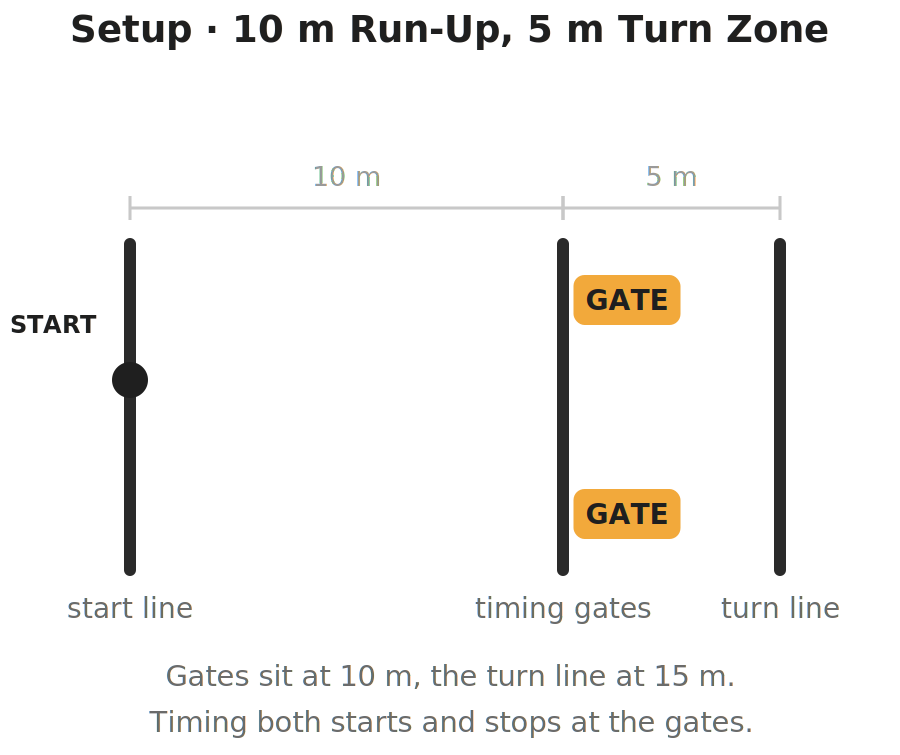
Setup · 10 m Run-Up, 5 m Turn Zone
Mark a start line, place the timing gates at 10 m, and mark the turn line at 15 m. The gates both start and stop the clock, so the same pair does double duty.
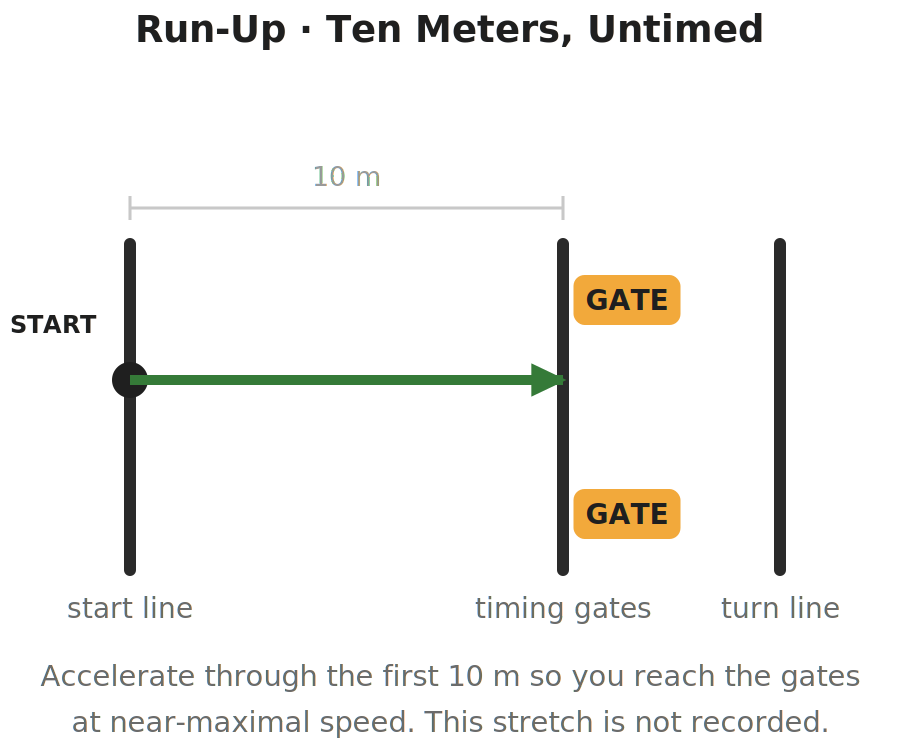
Run-Up · Ten Meters, Untimed
Accelerate through the first 10 m so you hit the gates at near-maximal speed. This stretch is not recorded — it exists so the test measures turning rather than a standing start.
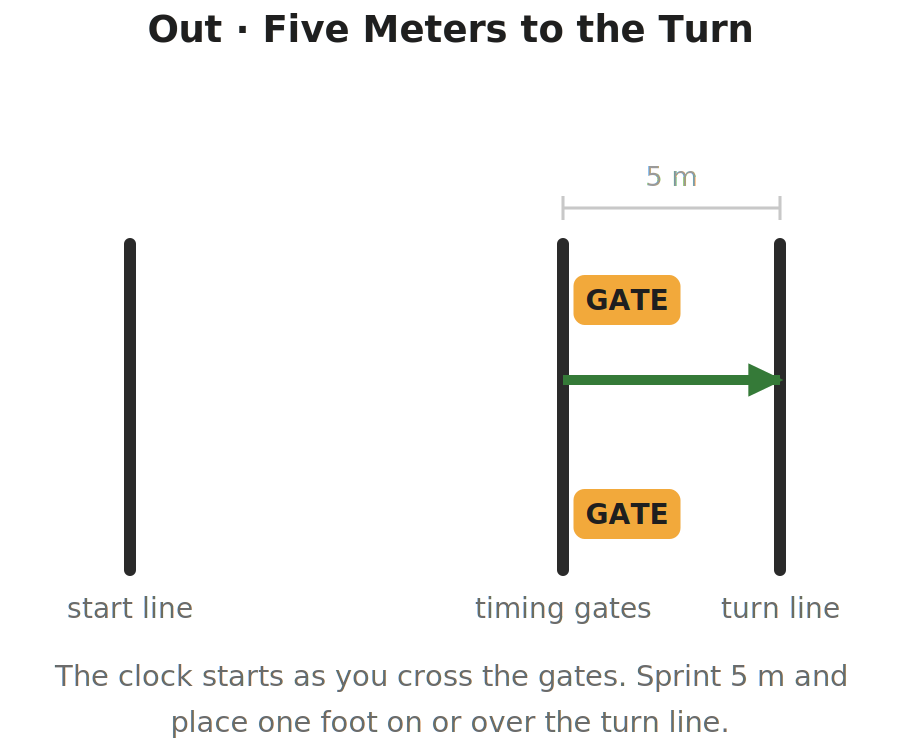
Out · Five Meters to the Turn
The clock starts the moment you cross the gates. Sprint 5 m and place one foot on or over the turn line — a short turn that misses the line invalidates the trial.
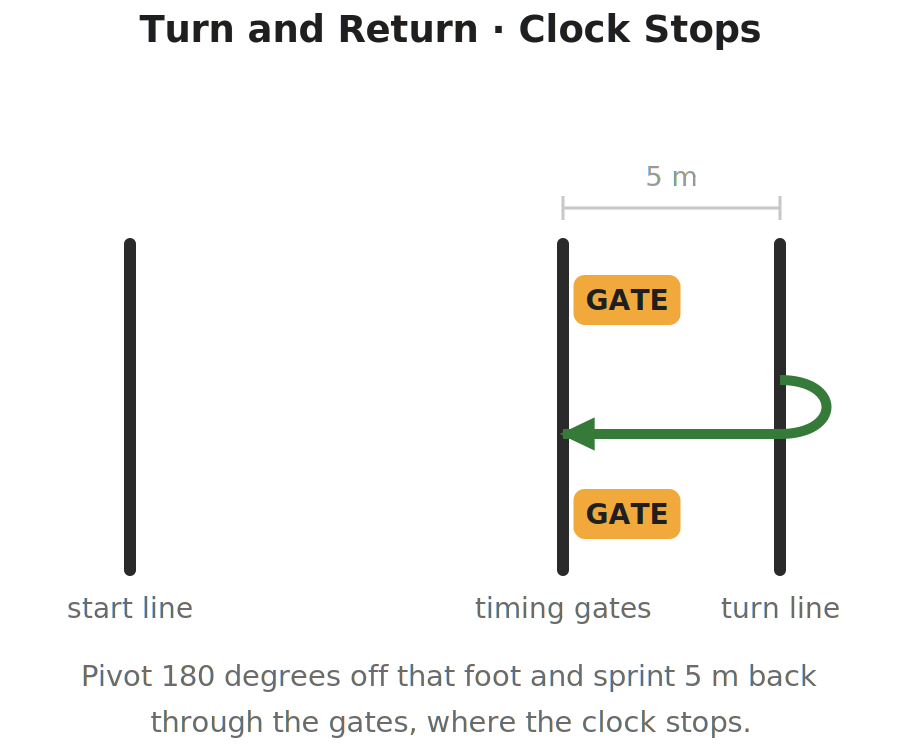
Turn and Return · Clock Stops
Pivot 180° off that foot and sprint 5 m back through the gates, where the clock stops. Your recorded time covers only this out-and-back, never the run-up.
Run three trials turning off each foot, with 2–3 minutes rest between efforts, and record the best time per leg to the nearest 0.01 s — those two times are what the calculator compares. The reference times assume the traditional 505 with the gates at 10 m; a modified 505 uses a shorter run-up and its numbers are not interchangeable. Electronic gates and a hand-held stopwatch also differ by a tenth of a second or more, so keep the surface, footwear, and timing method consistent between sessions.
The Test in Practice
A short tutorial showing the 505 run with electronic timing gates in place.
Video is from a third-party timing-equipment maker, not produced by Amatal, and it is a tutorial rather than the source of the reference times on this page. Treat the protocol above as the reference — gates at 10 m, turn line at 15 m, an untimed 10 m run-up, and one foot on or over the turn line. Setups vary between demonstrations, so check that any version you copy matches the traditional 505 before comparing your time here.
- 5-10-5 Shuttle — two 180-degree turns instead of one, with the acceleration the 505 deliberately strips out.
- 4×10m Shuttle Run — repeated turns over four legs, scored against general-population norms rather than athletic cohorts.
- 3-Cone Drill — swaps the flat 180-degree turn for tight bends around an L-shaped course.
How This Calculator Works
This calculator looks at your 505 change-of-direction speed from two angles. First and foremost it measures your bilateral symmetry — how evenly you turn off your left foot versus your right — because that is the single most actionable thing the 505 reveals. Second, it places your best turn against published reference times for specific athletic cohorts (by sport, sex, and level), and optionally calculates your change-of-direction (COD) deficit if you also supply a flat 10m sprint time.
Two things to keep in mind throughout. As with any timed test, a lower time is better. And unlike most other calculators on this platform, this one has no age model and no age-graded percentile — for an honest reason explained below: the published 505 data simply does not support one.
Step 1: Enter Your Details
The calculator takes up to five inputs — two of them optional in effect:
- Sex505 reference times are reported separately for men and women; the literature shows men average roughly 6% faster than women on the traditional 505. — selects which set of cohort reference times you are compared against, and which sports appear in the dropdown.
- Sport / Reference Cohort — the published athletic group you want to benchmark against. Pick the one closest to your own sport and competitive level.
- Left-Leg Turn — your best time, in seconds, from three trials turning off the left foot.
- Right-Leg Turn — your best time from three trials turning off the right foot.
- 10m Sprint Time (optional) — a separate flat 10m sprint. Supply it and the calculator unlocks the COD-deficit card; leave it blank and that section is simply hidden.
The Test Protocol
For your result to mean anything against the references, the test must be run the standard way. The traditional 505 uses a short, straight course measured in meters:
- Course setup: Mark a start line, a timing line at 10m, and a turn line at 15m. Timing gates (or a single channel of cones) sit at the 10m line.
- Run-up: From the start line, accelerate through the first 10m. This run-up exists so you are at near-maximal speed when timing begins — it keeps the test about turning, not standing-start acceleration.
- Timed portion: The clock starts as you cross the 10m line, you sprint the final 5m to the turn line, place one foot on or over it, execute a 180° turn, and sprint 5m back through the timing line, where the clock stops. Your time covers only that 5m-out + turn + 5m-back segment.
- Both sides, best of three: Run the test three times turning off each foot, with 2–3 minutes rest between efforts, and record the best time for each leg to the nearest 0.01s. Those two best times are what you enter.
Keep the surface, footwear, and timing method consistent between sessions. A stopwatch and timing gates do not produce interchangeable numbers, so compare like with like when you retest.
Bilateral Symmetry — The Headline
The 505 is one of the few field tests where measuring both sides separately is built into the protocol, which makes left/right symmetry its most useful output. The calculator reports your best time (your faster side), your average of the two, and your asymmetry, calculated as:
It also names your weaker side — the leg that produced the slower turn — and flags your absolute gap in seconds. Your result is sorted into one of three zones, drawn from commonly cited 505 symmetry guidance:
- Excellent symmetry — asymmetry of 5% or less (and under 0.15s). Both legs turn essentially evenly. This is the target range — aim to stay within roughly 5%.
- Moderate asymmetry — above 5% but below the flag threshold. A real but sub-threshold gap. Worth monitoring over repeat tests rather than acting on immediately.
- Notable asymmetry — greater than 10%, or an absolute gap of 0.15s or more. Often associated with a muscular imbalance, a mobility restriction, or a prior-injury pattern. Commonly addressed with extra unilateral work on the weaker side.
The symmetry gaugeThe marker sits at the far right when your asymmetry is 0% and slides leftward as the gap widens, reaching the far-left red end at about 20% or more. visualizes this on a colored track. The track runs red on the left (high asymmetry) through orange in the middle to green on the right (perfect symmetry), with the scale reading from ≥20% on the left down to 0% on the right. The more even your two turns, the further right — toward green — your marker sits.
The Sport Benchmark
The benchmark card answers a different question: how does your best turn compare to a real group of athletes? The calculator subtracts your best time from the chosen cohort's published mean to give a gap in seconds — shown in green if you are faster than that group's average, red if slower.
Where the original source also reported a standard deviationA measure of how spread out a group's times were. With a mean and SD, your time can be placed on that group's bell curve as an approximate percentile. for the cohort, the calculator goes one step further and estimates an approximate percentile within that specific group, by placing your time on a normal curve fitted to the cohort's mean and SD. Where no SD was published, it shows the gap only — it will not invent a percentile.
Why There's No Age Curve Here
Most calculators on this platform model a smooth age curve and report an age-graded percentile. This one deliberately does not, and the reason is data integrity. The published 505 evidence is overwhelmingly drawn from specific athletic cohorts — team-sport players at defined competitive levels — rather than from age-stratified general-population samples. There is no validated lifespan curve from, say, 17 to 70 to interpolate against.
Rather than fabricate an age-decline model and dress invented numbers up as standards, the calculator stays with what the literature actually supports: real cohort reference times, clearly attributed, plus the symmetry and COD-deficit metrics that do not depend on population norms at all.
COD Deficit (Optional)
If you enter a flat 10m sprint time, the calculator computes your change-of-direction deficitThe portion of your 505 time attributable to decelerating, turning, and re-accelerating — as opposed to pure straight-line speed.. The 505's timed portion covers about 10m of running (5m out, 5m back) plus one turn, so comparing it to a flat 10m sprint isolates the cost of the turn itself from your straight-line speed:
The card also shows the raw gap in seconds, and rates the percentage against commonly cited bands:
A high deficit alongside a fast straight-line sprint points to the turn — braking, foot plant, re-acceleration — as the area with the most to gain, rather than top-end speed.
Reading the Two Charts
The calculator draws two visuals, each answering a different question.
- Left vs Right shows your two best times as side-by-side bars, with the faster side in green and the slower side in orange (or red if your gap crosses the flag threshold). It makes any side-to-side difference immediately visible. A meaningful, repeatable gap across sessions is the signal worth acting on — a one-off difference can just be trial-to-trial noise.
- How You Compare by Cohort is a horizontal bar chart. Each bar is a real athletic cohort from the literature, sorted fastest to slowest, with your chosen cohort highlighted in green and a black "You" bar for your best turn. Shorter bars are faster, so you can see at a glance which groups you sit ahead of or behind. Match yourself to the cohort that genuinely reflects your sport and level rather than the fastest one on the chart.
Why Change of Direction Matters
The 505 is a benchmark for planned 180° change-of-direction speed — the ability to sprint, decelerate hard, reverse direction, and re-accelerate while keeping body control. Those qualities underpin performance in court and field sports, and the turn itself is a high-demand moment for the lower body. It was originally developed in 1985 with cricket in mind — a batter turning between the wickets — and has since spread to soccer, basketball, rugby, netball, tennis, and many other sports.
Important context: despite its name, the 505 measures change of direction, not true agility. The turn is pre-planned — you know exactly where and when it is coming. Real agility also involves reacting to an unpredictable stimulusFor example, cutting in response to an opponent's movement, where perception and decision-making add time the 505 never captures., which this test does not capture. A fast 505 reflects strong mechanics and turning ability, but it is one piece of the agility picture, not the whole of it.
Data Sources and Methodology
The references and methods in this calculator are drawn from established sources:
- Draper, J.A., & Lancaster, M.G. (1985). The 505 test: A test for agility in the horizontal plane. Australian Journal of Science and Medicine in Sport, 17(1), 15–18 — the original protocol.
- Ryan, C., Uthoff, A., McKenzie, C., & Cronin, J. (2021). Traditional and Modified 5-0-5 Change of Direction Test: Normative and Reliability Analysis. Strength and Conditioning Journal — the review collating 50 studies across 11 sports, source of most of the sport-, sex-, and level-specific cohort means and standard deviations used here (including the netball, tennis, rugby union, and cricket cohorts).
- Nimphius, S., Callaghan, S.J., Spiteri, T., & Lockie, R.G. (2017). Change of direction and agility tests: Challenging our current measures of performance. — the basis for the COD-deficit concept.
- Topend Sports. 505 Agility Test — the elite soccer/basketball reference figures, the bilateral-asymmetry thresholds (>10% / ≥0.15s; aim ≤5%), and the COD-deficit percentage formula and bands.
A note on the benchmark set: the cohorts shown are limited to what the literature actually reports, and the coverage is uneven — particularly for women, where the most reliable data come from netball plus elite soccer and basketball reference figures. Each value is attributed in the calculator so you can judge its relevance. These are reference points to compare against, not a complete or official rating scale.
Limitations and Important Caveats
This calculator provides a comparison and a symmetry check, not a clinical measurement. Several factors affect how precisely it reflects your true change-of-direction ability:
- Cohort references, not population norms. Comparisons are to specific athletic groups, often small samples. They are not age-graded and do not represent the general public.
- Traditional 505 only.A "modified 505" uses a shorter run-up and produces different times. Its numbers are not interchangeable with these. The reference times assume the traditional protocol with the timing line at 10m. A modified-505 result should not be compared against them.
- Timing method matters. Electronic gates and a hand-held stopwatch can differ by a tenth of a second or more. Mixing methods between a test and its reference, or between sessions, undermines the comparison.
- Approximate within-cohort percentile. Where shown, the percentile is fitted to a cohort's mean and SD from a small sample and assumes a normal distribution. Read it as a guide, not an exact statistic.
- Single-test snapshot. Fatigue, warm-up, surface, footwear, and recent training all affect a single trial. For tracking, retest under the same conditions and take the best of three per side.
- Asymmetry needs repetition. A single session's left/right gap can be trial-to-trial noise. Treat a difference as meaningful only if it holds up across repeat tests.
- Planned, not reactive. The 505 does not measure your ability to respond to an unpredictable cue, which is a core part of game agility.
Disclaimer:
This calculator provides estimates based on published reference data and standard formulas. Real change-of-direction performance depends on training history, movement mechanics, body proportions, recovery, and individual variation. The 505 involves maximal sprinting, hard deceleration, and a forceful 180° plant-and-turn that place significant stress on the knees, ankles, hips, and groin. Always warm up thoroughly beforehand and stop immediately if you experience pain, dizziness, or unusual discomfort. This tool is for general informational purposes only and should not be considered medical, fitness, or training advice. Consult a healthcare provider before beginning a new exercise or testing program, especially if you have a pre-existing condition, are over the age of 45, or have been sedentary for an extended period.