
SEMO Agility Test
Multidirectional Change-of-Direction Assessment
Read the disclaimer below before attempting this test.
SEMO Norm Table
| Rating | Male (s) | Female (s) |
|---|
Where You Fall
How to Run the SEMO Agility Test
Four cones, three movements, one continuous circuit — side-stepping, backpedaling and sprinting against the clock.
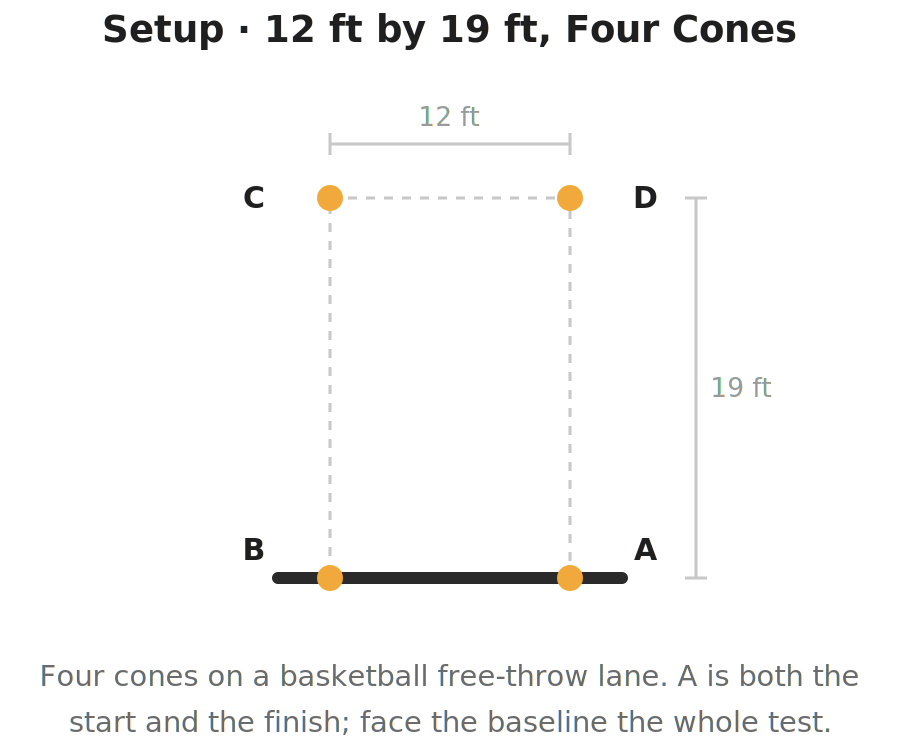
Setup · 12 ft by 19 ft, Four Cones
Set a cone at each corner of a basketball free-throw lane — 12 ft across the baseline, 19 ft deep. A is both the start and the finish. Face the baseline for the entire test; never turn to look where you are going.
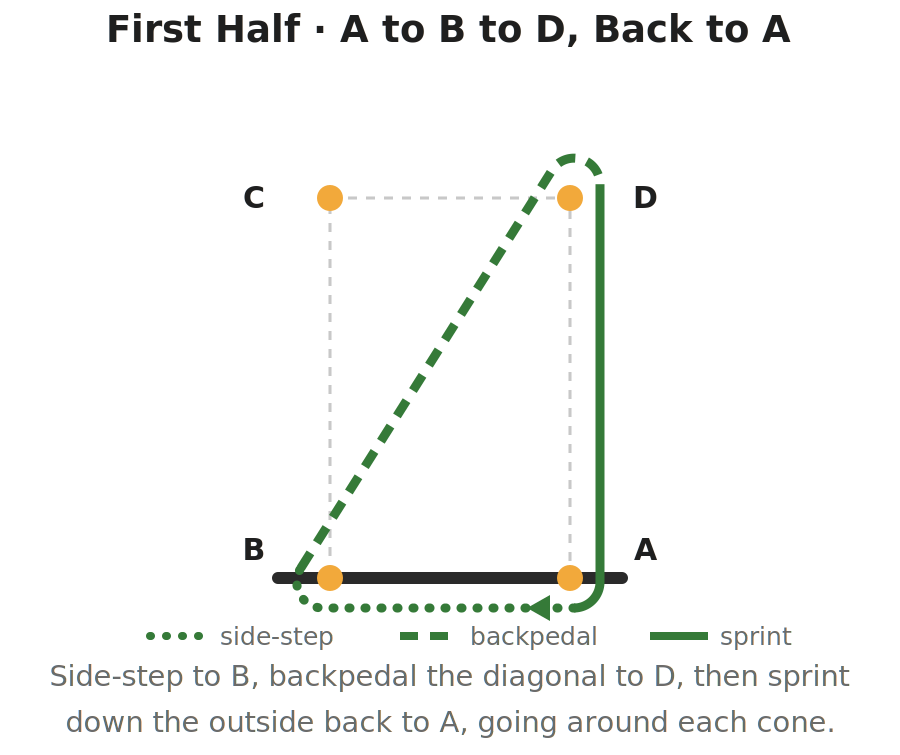
First Half · A to B to D, Back to A
Side-step along the baseline to B. Backpedal the diagonal up to D. Sprint forward down the long side back to A. Skirt the outside of every cone — cutting inside one voids the trial.
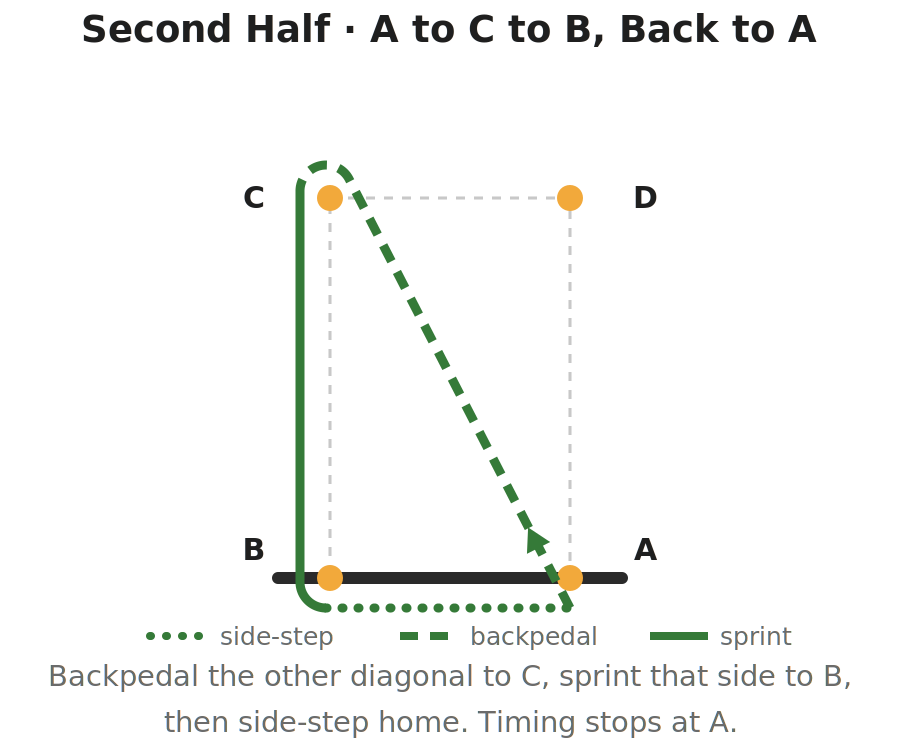
Second Half · A to C to B, Back to A
Straight on from A, backpedal the other diagonal up to C. Sprint down that side to B, then side-step home. Timing stops as you reach A — there is no pause between the halves.
In the diagrams a dotted line is a side-step, a dashed line is a backpedal, and a solid line is a forward sprint. The two halves run without a break — the sprint that finishes the first half hands straight into the backpedal that starts the second. Two rules void a trial: cutting inside a cone instead of going around it, and turning your body to face the direction of travel. Take the best of two or three attempts with full rest, and mind the footing on the backpedals — they are where falls happen.
The Test in Practice
A short clip of the SEMO course being run end to end.
Video is from a third-party channel, not produced by Amatal, and is not the source of the reference times on this page. Use the protocol above as the reference — cone A at the near right, side-step to B, backpedal the diagonal to D, sprint down the side to A, backpedal the other diagonal to C, sprint down that side to B, side-step home. Descriptions of this test vary, so check that any version you copy matches before comparing your time to these ratings.
- T-Test — the other multidirectional test on this site, mixing sprinting, shuffling and backpedaling over a larger course.
- Edgren Side Step Test — isolates the lateral shuffle and counts it against the clock instead of timing a course.
- Illinois Agility Run — all forward running, with weaving instead of backward movement.
How This Calculator Works
This calculator measures your multidirectional change-of-direction agility using the SEMO Agility Test — a field assessment developed at Southeast Missouri State University that, unlike most agility drills, deliberately blends forward sprinting, diagonal backpedalling, and lateral side-stepping into a single short circuit. You enter your time in seconds to complete the course, and the calculator classifies that result against the published SEMO reference norms for your sex.
One thing to keep in mind throughout: for the SEMO test, a lower time is better. Every part of the calculator — the rating bands, the table, the curve — is built around faster being better, the opposite of a reps-based test where more is better.
Step 1: Enter Your Details
The calculator needs just two inputs: your sex and your SEMO time.
- SexSEMO norms are reported separately for men and women because of biological differences in lower-body power, speed, and strength-to-weight ratio. — selects which normative column you are compared against.
- SEMO Time — your total time, in seconds, from the start signal until you return across the start/finish line. This single time is your score.
You may notice there is no age field. That is deliberate, and it is explained in "Why There Is No Age Adjustment" below — in short, the SEMO test simply has no published age-graded norms to stand on.
The Test Protocol
For your result to mean anything against the norms, the course must be run the way the norms were collected. The SEMO test uses four cones at the corners of a rectangle the size of a basketball free-throw lane — 12 × 19 ft (about 3.7 × 5.8 m). Label the near-right corner A (start and finish), the near-left corner B, the far-left corner C, and the far-right corner D. You set up behind the line at A in a sprint-start stance, facing the baseline, and complete the circuit A → B → D → A → C → B → A, always going around the outside of each cone:
- A → B — side-step: shuffle laterally across the near baseline (the 12 ft side).
- B → D — backpedal: run backward along the diagonal to the far right corner.
- D → A — sprint: run forward down the long right side (the 19 ft side).
- A → C — backpedal: run backward along the other diagonal to the far left corner.
- C → B — sprint: run forward down the long left side.
- B → A — side-step: shuffle laterally back across the baseline to finish. Timing stops as you cross the line at A.
A defining feature is that you stay facing forward (toward the baseline) the entire time — you never rotate to face your direction of travel, which is what forces genuine backward and sideways movement. A trial is void if you pass over a cone instead of skirting its outside; form faultsFrom the standard scoring rubric: taking crossover steps during the side-step, or letting your back swing out of square (not perpendicular to the cone line) during the backpedal. include crossing one foot over the other while shuffling or twisting the torso during the backpedal. The fastest of two trials is recorded, to the nearest 0.1 second. Keep surface and footwear consistent between tests.
How Your Rating Is Determined
The SEMO test publishes a five-band rating scale for each sex — Excellent, Above Average, Average, Below Average, and Poor. Because that is already five bands, it maps directly, one-to-one, onto this platform's five-color tier system with nothing split, merged, or invented. The published band names are kept as-is, colored to match the rest of the site:
Excellent = gold · Above Average = blue · Average = green · Below Average = orange · Poor = red
The reference thresholds the calculator uses are the published Kirby norms, applied as a single table for a general adult/athlete population:
Women: Excellent ≤ 12.19s · Above Average ≤ 12.99s · Average ≤ 13.90s · Below Average ≤ 14.49s · Poor > 14.49s
Your time is compared against these cutoffs and you are placed in the fastest band you qualify for — the best band whose time ceiling you match or beat:
- Poor — slower than the typical range for adults and athletes. A clear starting point with substantial room to improve multidirectional speed and footwork.
- Below Average — somewhat slower than the middle of the reference group. Reasonable baseline agility; consistent change-of-direction work tends to move results upward quickly here.
- Average — around the middle of the reference group. Typical of recreationally active adults and general team-sport participants. Note: on this test green marks the literal middle band, not "above average."
- Above Average — quicker than most of the reference group. Reflects solid conditioning and efficient forward, backward, and lateral mechanics.
- Excellent — among the quickest in the reference group. Characteristic of well-trained athletes in sports demanding multidirectional movement.
Reading the Curve: "Where You Fall"
The calculator draws one visual — a curve showing where your time sits among the five published bands. A couple of points on how to read it honestly:
- Faster times sit to the right. The time axis runs so that quicker performances move rightward, which places Excellent on the right and Poor on the left, and the five shaded regions are the published bands. The dashed line and dot mark your time.
- The curve itself is a model, not measured data.A normal (bell) curve centered on the middle of the Average band, with its spread set so the published bands fall in sensible positions. The SEMO norms provide category boundaries, not a full distribution, so the curve is an illustration. The SEMO norms give you category cut points, not a complete population distribution. To draw a smooth curve, the calculator fits a normal distribution to those bands — so the shape is an illustration of where your time falls, not a measured population of SEMO times.
- The percentile read is an estimate. The "~Nth percentile" shown alongside the curve is read off that same modeled curve. It is a reasonable rough guide to the share of people you are quicker than — not an exact population statistic, precisely because the underlying data is banded rather than continuous.
How to Read the Norm Table
The table lists one row for each of the five ratings, with a Male column and a Female column. It is the published Kirby norm table, shown verbatim.
- Excellent and the middle bands show a ceiling. A cell like "≤ 11.49" means you reach that band by matching or beating that time. Faster always counts as better.
- Poor is the exception.Poor has no lower ceiling — it covers every time slower than the Below Average cutoff. The cell shows "≥" followed by that cutoff. Because Poor covers everything slower than the Below Average cutoff, its cell shows a "greater-than-or-equal" value rather than a target to hit.
- Your rating and sex are highlighted. The row for your achieved rating is shaded in that band's color, and the column for your selected sex is emphasized while the other is dimmed.
How Sex Changes Your Score
Sex is the one input that changes the numbers you are measured against. Choosing male or female swaps in an entirely separate set of cutoffs, so an identical time is scored against different benchmarks depending on which column applies. There is no further adjustment beyond that — the same single table is used for every adult, which leads to the next point.
Why There Is No Age Adjustment
Several assessments on this site adjust their standards for age. This one does not, and that is a data-integrity choice rather than an oversight. The SEMO test has only a single published norm table, gathered on a general adult/athlete population (the validation and reference work skews toward college-aged and competitive athletes). There is no published, age-stratified SEMO data to anchor an age curve.
Rather than fabricate per-age thresholds and present modeled numbers as if they were measured, the calculator stays faithful to what was actually published: one table, applied as-is. The practical consequence is worth knowing — if you are considerably older than a young competitive athlete, treat the bands as a fixed external benchmark rather than an age-matched expectation, since they were not built to flex with age.
Why Agility Matters
The SEMO test is a benchmark for planned multidirectional agility — the capacity to accelerate, decelerate, move laterally and backward, and reaccelerate while keeping body control. Its distinguishing value is that it forces all three movement directions within one timed run, which makes it a good fit for court and field sports such as basketball, volleyball, badminton, tennis, and netball, where players constantly move forward, back, and side to side.
Important context: the SEMO test is a pre-planned drill — you know the course in advance. It therefore measures the physical side of agility (how quickly and cleanly you can change direction) rather than reactive agility, which is the ability to read and respond to an unpredictable cue. A great SEMO time reflects strong movement mechanics and lower-body speed across multiple planes, but it is one piece of the broader agility picture, not the whole of it.
Data Sources and Methodology
The norms and protocol in this calculator are built from established testing references:
- Kirby, R.F. (1971). A Simple Test of Agility. Coach and Athlete, 25(6), 30–31 — the original SEMO test description and norms.
- Mackenzie, B. (2005). 101 Performance Evaluation Tests. Electric Word plc — widely cited reproduction of the SEMO protocol and five-band rating scale.
- Davis, B. et al. Physical Education and the Study of Sport — field-testing protocols and interpretation.
- Topend Sports. SEMO Agility Test — procedure reference cross-checked for the cone route and scoring.
A note on the data: every rating boundary in this tool comes straight from the published SEMO norm table — none are modeled. The only modeled element is the illustrative bell curve in "Where You Fall" and the rough percentile read taken from it, both clearly labeled as such.
Limitations and Important Caveats
This calculator provides an estimate, not a clinical measurement. Several factors affect how precisely it reflects your true agility:
- One reference table for everyone. The SEMO norms are a single adult/athlete table with no age stratification, and the reference population skews young and athletic. Read your band as a fixed external benchmark, not an age- or population-matched expectation.
- The curve is modeled. The "Where You Fall" curve is a normal approximation fitted to the published bands; real agility times are mildly skewed, so it is illustrative rather than a measured population.
- Approximate percentile. The percentile is read off that modeled curve rather than a complete distribution, so treat it as a guide, not an exact statistic.
- Setup and surface variability.Cone spacing, the testing surface, footwear, and whether you skirt the outside of each cone all change the time. Standardize them to make retests meaningful. Non-standard setups bias the result. Keep the course, surface, and footwear consistent across tests.
- The backpedal segments carry a fall risk. Backward running is the part people are least practiced at; rehearse it at sub-maximal speed first and keep the area behind you clear.
- Single-test snapshot. Fatigue, warm-up, time of day, and recent training all affect a single trial. For tracking progress, retest under the same conditions every few weeks and take the best of two trials.
- Planned agility only. The SEMO test does not capture reactive agility — your ability to respond to an unpredictable cue.
Disclaimer:
This calculator provides an estimate based on established normative data. Real agility depends on training history, movement mechanics, body proportions, recovery, and individual variation. The SEMO test involves maximal sprinting, hard deceleration, diagonal backpedalling, and rapid lateral movement that place significant stress on the knees, ankles, and hips, with an added fall risk during backward running. Always warm up thoroughly beforehand, keep clear space behind you, and stop immediately if you experience pain, dizziness, or unusual discomfort. This tool is for general informational purposes only and should not be considered medical, fitness, or training advice. Consult a healthcare provider before beginning a new exercise or testing program, especially if you have a pre-existing condition, are over the age of 45, or have been sedentary for an extended period.