
Zig-Zag Test
Change-of-Direction Agility — Little & Williams (2005) Protocol
Read the disclaimer below before attempting this test.
Where You Fall
The Professional Benchmark
How to Run the Zig-Zag Test
Five cones, four 5 m sections, three 100° cuts — 20 m of sprinting against the clock.
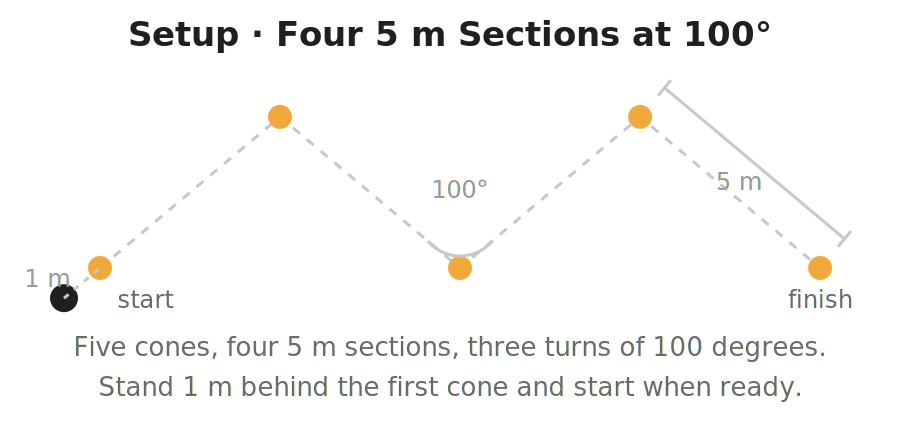
Setup · Four 5 m Sections at 100°
Lay out five cones so that the four sections are each 5 m long and meet at 100° turns — 20 m of running in total. Stand 1 m behind the first cone; that meter is not part of the course.
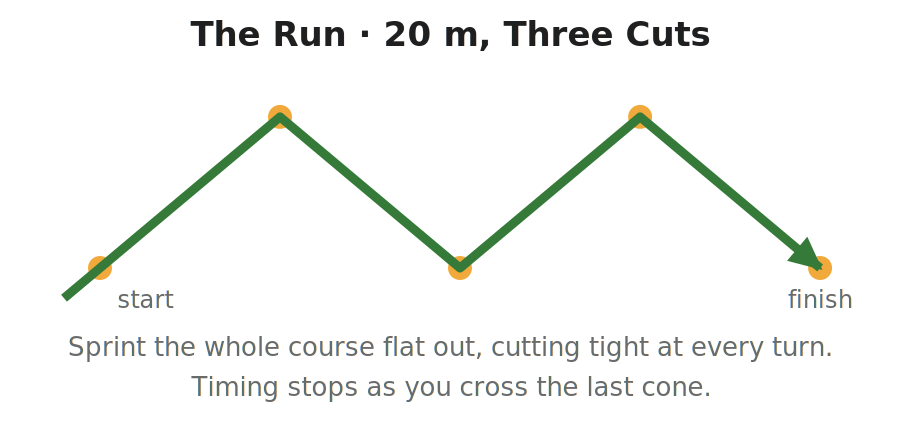
The Run · 20 m, Three Cuts
Start on your own signal and sprint the whole course flat out, cutting as tight as you can at each of the three turns. Timing stops the moment you cross the last cone. Take the best of three trials.
Several unrelated courses go by the name "zig-zag", so the layout above is what the reference times on this page assume: four 5 m sections at 100°, 20 m in total. A rectangular five-cone version and a variant run while dribbling a ball both exist and produce different times — neither is comparable to these figures. Run on a flat, non-slip surface in normal sports shoes, allow full recovery between trials, and keep the surface, footwear and timing method consistent so retests compare.
The Test in Practice
A short clip of the zigzag course being run in the same layout used here.
Video is from a third-party channel, not produced by Amatal, and is not the source of the reference times on this page — those come from Little & Williams (2005). The layout matches the course above, but many drills share the name "zig-zag" without sharing the protocol, so check the specification rather than the name: four 5 m sections, 100° turns, 20 m in total, timed from a standing start 1 m behind the first cone.
- 505 Agility Test — the other soccer change-of-direction test here, isolating a single 180-degree turn.
- Illinois Agility Run — a longer course pairing straight-line speed with weaving, and often run alongside this one.
- T-Test — adds lateral shuffling and backpedaling rather than testing cutting alone.
How This Calculator Works
This calculator measures your change-of-direction agility using the Zig-Zag test as defined by Little and Williams (2005) — a short, sharply angled sprint course used in soccer and team-sport research. You enter your best time in seconds to complete the course, and the calculator places that time against a published professional benchmark, assigns a performance level, and shows where you sit on a performance scale and relative to the professional distribution.
One thing to keep in mind throughout: for the Zig-Zag test, a lower time is better. Every part of the calculator — the levels, the scale, the comparison — is built around faster being better, the opposite of a reps-based test where more is better.
A second, more important thing to understand up front: this test has no general-population, female, or age-graded norms. Unlike a test such as the push-up or sit-and-reach, no one has published reference tables spanning ages and both sexes for the Zig-Zag. The calculator is therefore built around the one solid published reference that exists, and is most useful for tracking your own progressBecause there is no population norm, the most reliable use is repeating the test under identical conditions over time and watching your own time improve. over time. The sections below are explicit about which numbers are measured, which are derived, and which are illustrative.
Step 1: Enter Your Time
The calculator needs a single input: your best Zig-Zag time, in seconds, from the start signal until you cross the finish.
You will notice there is no sex or age field. That is deliberate. The published reference for this protocol comes from male professional soccer players aged 18–36; there is no established female reference and no age-graded data for this specific course. Adding sex or age inputs would imply the calculator can adjust for them — a precision the underlying data does not support. Rather than invent those numbers, the tool leaves them out and is transparent about the population it actually compares you to.
The Test Protocol
For your result to mean anything against the benchmark, the test must be run the same way the benchmark was collected. There are several unrelated courses that all go by the name "Zig-Zag"; this calculator is built for one specific version:
- Course: four 5 m straight sections joined by three turns of 100°, for roughly 20 m total. The geometry forces acceleration, deceleration, and balance control through each cut.
- Start: begin about 1 m behind the start line and set off when ready; timing runs from first movement (or the gate trigger) to crossing the finish.
- Trials: run the course as fast as possible and record the best of two or three trials, with full recovery between them.
- Timing: electronic timing gatesThe professional benchmark was collected with electronic gates. A hand-held stopwatch typically reads a few tenths faster because of reaction-time lag, which would flatter your result against the gate-timed benchmark. are ideal; a stopwatch will read slightly faster, so keep your method consistent.
Because the benchmark is tied to this exact course, results from other "zig-zag" layouts — the rectangular five-cone versions, for example — are not comparable and should not be entered here.
How Your Level Is Determined
The five levels here are benchmark-referenced, not population percentiles. They describe how your time compares to published soccer benchmarks for trained adult males, anchored on two real data points:
- Elite professional reference — 5.34 ± 0.20 s. The mean time of 106 male professional soccer players (English League Divisions 1 & 2, ages 18–36), best of two trials with electronic gates (Little & Williams, 2005).
- Amateur / mixed reference — about 6.1 s. Comparison studies of amateur and student players on comparable courses run measurably slower than the professional sample.
The level thresholds are built from those anchors:
Elite ≤ 5.34s · Superior ≤ 5.74s · Advanced ≤ 6.10s · Intermediate ≤ 6.80s · Low > 6.80s
Here is exactly where each boundary comes from, so nothing is taken on faith:
- Elite (≤ 5.34s) sits on the professional mean — matching or beating the average elite professional.
- Superior (≤ 5.74s) is the professional mean plus two standard deviationsA standard deviation (0.20 s here) measures how tightly the professional times cluster around their mean. Two SDs above the mean still falls within the broad professional range. (5.34 + 2 × 0.20) — still within the professional range.
- Advanced (≤ 6.10s) runs from the professional band down to the amateur/mixed reference.
- Intermediate (≤ 6.80s) covers times around and just past the amateur reference.
- Low (> 6.80s) is everything slower than that. No published data calibrates times this far out, so this band is open-ended.
To be clear about provenance: the Elite and Superior boundaries derive directly from the published professional mean and standard deviation, and the Advanced boundary uses the amateur reference. The 6.80 s Intermediate/Low boundary is illustrative — a reasonable round figure, not a sourced value.
- Low — slower than the amateur reference. Open-ended band below the amateur reference. A clear starting point with substantial room to improve.
- Intermediate — around and just past the amateur reference. In the region of amateur and student players on comparable courses.
- Advanced — between the amateur reference and the professional band. Approaching trained-athlete territory; faster than the typical amateur sample.
- Superior — within the professional range. Within two standard deviations of the professional mean — professional-caliber change-of-direction speed.
- Elite — at or beyond the professional mean. Matches or beats the average elite male professional in the reference sample.
Reading the Two Visuals
The calculator draws two complementary visuals, and they answer different questions.
- Where You Fall is a horizontal performance scale spanning roughly 4.8–8.0 s, shaded into the five levels. Faster times sit on the right, so the gold Elite zone is on the right and the red Low zone on the left. A shaded band marks the professional mean ± one SD5.14–5.54 s — the tight cluster where most of the professional reference sample fell. (5.14–5.54 s), and separate markers show the professional mean, the amateur reference, and your time, so you can see at a glance which benchmarks you fall between.
- The Professional Benchmark is the actual distributionA normal curve built from the published professional mean (5.34 s) and standard deviation (0.20 s) — this is the real reference sample, not a modeled population. of elite professional times, drawn from the published mean and SD. It shows how tightly professional times cluster, and marks where your time falls against that cluster. If your time sits well to the left of the curve, that is expected — anyone outside elite soccer will be slower than a sample of professionals, and the note below the chart reports how many standard deviations out you are.
Why There Is No Agility Age, Percentile, or Age Table
Other agility and fitness calculators on this site report an "agility age," a population percentile, and an age-by-level standards table. This one deliberately does not, and the reason is the same in every case: the data to support them does not exist for this protocol.
- No percentile — there is no published population distribution for the Zig-Zag test, so any "faster than X% of people" figure would be invented.
- No agility age — that calculation requires knowing how typical times change across the lifespan, and no age-graded data exists here.
- No age-by-level table — the reference group is a single age band (18–36) of male professionals; there is nothing to interpolate across ages from.
Reputable testing references make the same point directly: the Zig-Zag has no normative scores, and its results are meaningful chiefly when compared against an individual's own previous attempts. That is why the most valuable thing you can do with this tool is re-test under identical conditions every few weeks and watch your own time fall.
Why Agility Matters
The Zig-Zag is a benchmark for planned change-of-direction ability — the capacity to accelerate, decelerate sharply, cut, and reaccelerate while keeping body control through tight 100° turns. Those qualities underpin performance in court and field sports. In the original study, Little and Williams used it to show that agility, acceleration, and maximum speed are relatively independent qualities in professional players — being fast in a straight line did not reliably predict being quick through the cuts, which is part of why a dedicated change-of-direction test is worth running at all.
Important context: the Zig-Zag is a pre-planned drill — you know the course in advance. It therefore measures the physical side of agility (changing direction quickly) rather than reactive agilityThe ability to read and respond to an unpredictable stimulus, such as an opponent's movement. The Zig-Zag does not measure this., the ability to read and respond to an unpredictable stimulus. A fast Zig-Zag time reflects strong mechanics and lower-body speed, but it is one piece of the broader agility picture, not the whole of it.
Data Sources and Methodology
The benchmark and methods in this calculator are built from published research:
- Little, T., & Williams, A.G. (2005). Specificity of Acceleration, Maximum Speed, and Agility in Professional Soccer Players. Journal of Strength and Conditioning Research, 19(1), 76–78 — the protocol (four 5 m sections at 100°) and the professional reference of 5.34 ± 0.20 s in 106 male professionals.
- Comparison studies of agility tests in soccer (amateur, professional, and student samples) — the basis for the softer amateur/mixed reference of roughly 6.1 s on comparable courses.
- Topend Sports and other field-testing references — note that the Zig-Zag test has no normative scores and is best used for tracking individual progress over time.
A note on the boundaries: the Elite and Superior thresholds come directly from the professional mean and standard deviation; the Advanced threshold uses the amateur reference; and the 6.80 s boundary between Intermediate and Low is an illustrative round figure, clearly labeled as such rather than a measured value.
Limitations and Important Caveats
This calculator provides a benchmark comparison, not a clinical measurement or a population ranking. Several things shape how to read it:
- Single, specific population. The benchmark is male professional soccer players aged 18–36. Female and non-soccer reference data for this protocol are not established, so the comparison is to that group regardless of who you are.
- No age grading. The reference is a single young-adult age band; the tool does not and cannot adjust for age.
- One illustrative boundary. The Intermediate/Low cut at 6.80 s is not sourced; treat the slowest band as approximate.
- Setup, surface, and timing variability.Cone placement, turn angles, surface, footwear, and stopwatch-versus-gate timing all change the result. Standardize them to make retests meaningful. Non-standard setups bias the result; keep course, surface, footwear, and timing method consistent across tests.
- Protocol variants are not comparable. Only the four-section, 100° Little & Williams course belongs here.
- Single-test snapshot. Fatigue, warm-up, time of day, and recent training all affect one trial. For tracking, retest under the same conditions and take the best of two or three.
- Planned agility only. The Zig-Zag does not capture reactive agility — your ability to respond to an unpredictable cue.
Disclaimer:
This calculator provides a benchmark comparison based on published professional reference data. Real agility depends on training history, movement mechanics, body proportions, recovery, and individual variation. The Zig-Zag course involves maximal acceleration, hard deceleration, and rapid 100° changes of direction that place significant stress on the knees, ankles, and hips. Always warm up thoroughly beforehand and stop immediately if you experience pain, dizziness, or unusual discomfort. This tool is for general informational purposes only and should not be considered medical, fitness, or training advice. Consult a healthcare provider before beginning a new exercise or testing program, especially if you have a pre-existing condition, are over the age of 45, or have been sedentary for an extended period.