
4×10m Shuttle Run
Speed–Agility Test · ACSM Classification · Ages 5–18
Read the disclaimer below before attempting this test.
4×10m Standards by Age
Standards Across Age
Where You Fall in Your Age Group
How to Run the 4x10m Shuttle
Two lines 10 meters apart, three sponges, four legs. Best of two trials is the score.
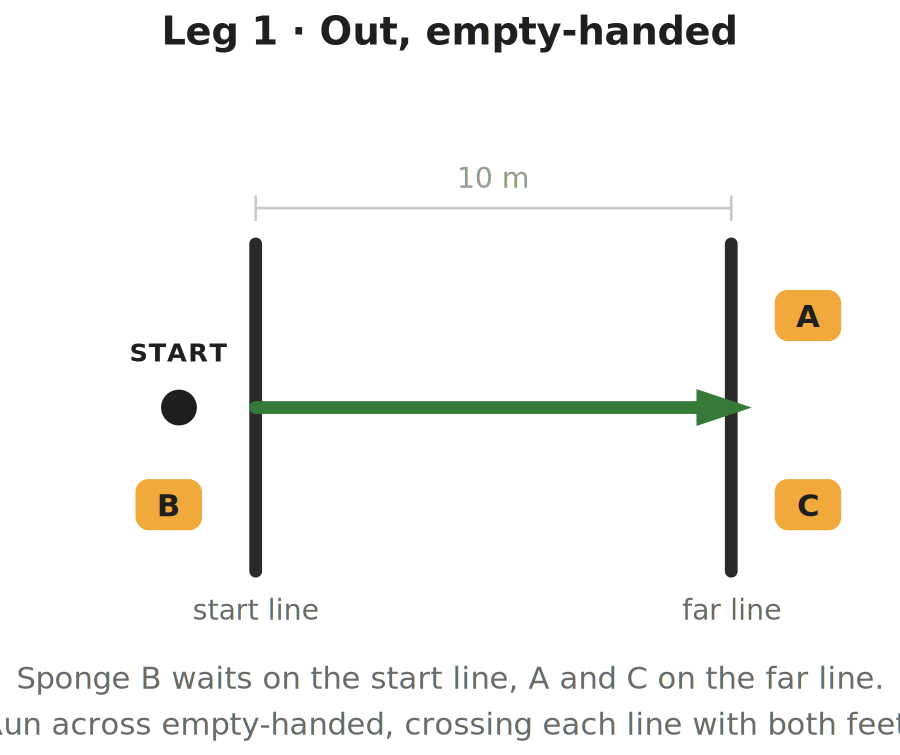
Leg 1 · Out, empty-handed
Start behind the line. Sponge B sits on the start line; A and C sit on the far line. Run across empty-handed, crossing each line with both feet.
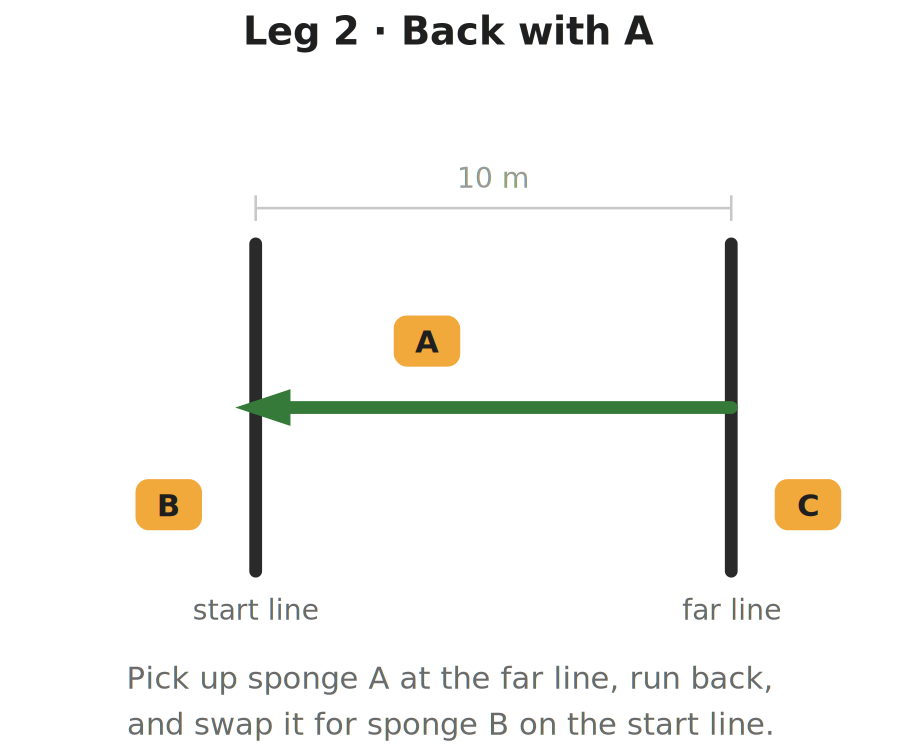
Leg 2 · Back with A
Pick up sponge A at the far line, run back, and swap it for sponge B on the start line. Set A down as you take B.
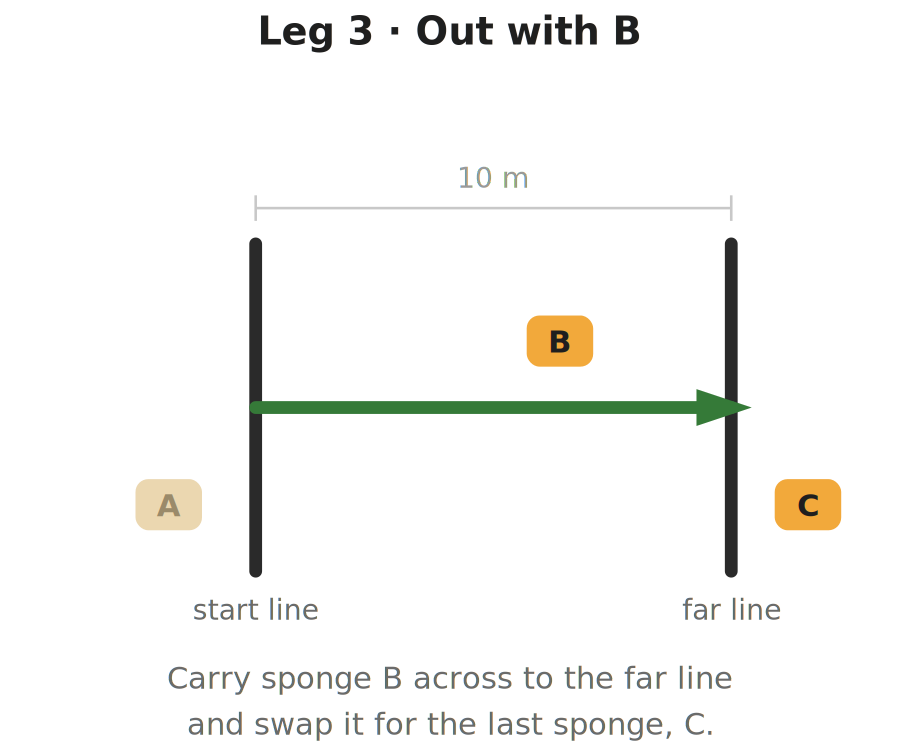
Leg 3 · Out with B
Carry sponge B across to the far line and swap it for the last sponge, C. Three of the four legs are now done.
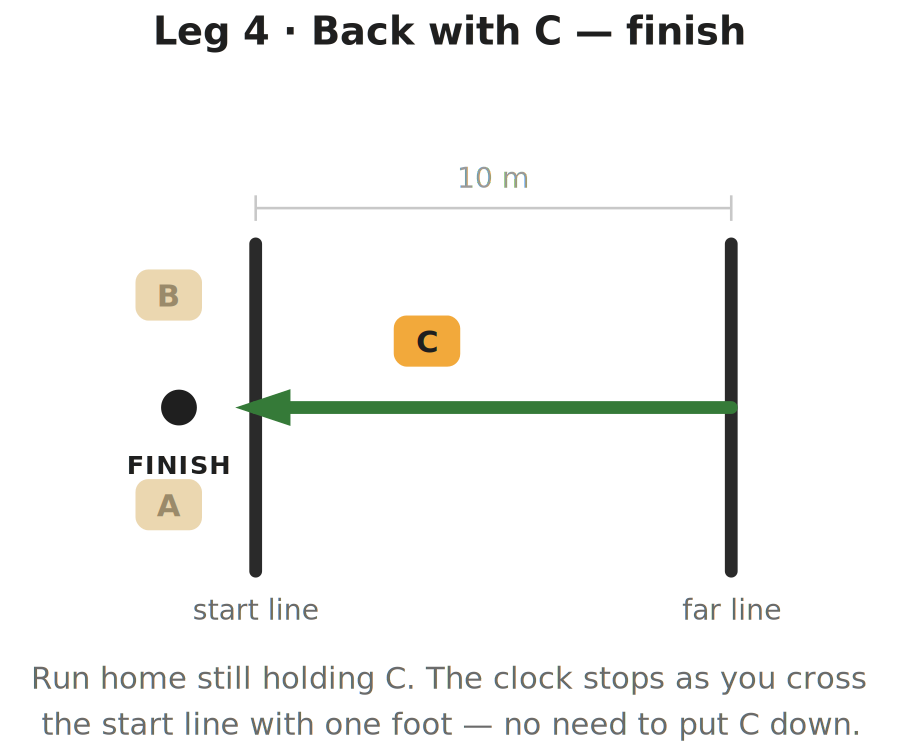
Leg 4 · Back with C
Run home still holding C. The clock stops as you cross the start line with one foot — there is no need to put the sponge down.
Run on a flat, non-slip surface in normal sports shoes. Two trials are usually taken with the better time recorded, so allow a full rest in between — and keep the surface, footwear, and timing method consistent so retests are comparable.
The Test in Practice
The ALPHA project’s own demonstration: line setup, sponge exchanges, and timing.
Video is from the ALPHA-FIT project, not produced by Amatal. It shows the same protocol the norms on this page are drawn from — two lines 10 meters apart, both-feet crossings, and a one-foot finish with the last sponge still in hand.
- 505 Agility Test — isolates a single 180° turn, without the sprint length.
- Illinois Agility Run — a longer course adding weaving to the turns.
- 3-Cone Drill — the combine change-of-direction test, scored against NFL athletes.
How This Calculator Works
This calculator measures change-of-direction agility using the 4×10m shuttle run — the speed-and-agility (motor fitness) test from the ALPHA health-related fitness battery for children and adolescents. You enter the total time in seconds to complete the course, and the calculator classifies the result against published European youth norms, then reports a category, an Agility Age, and an estimated percentile for that age and sex.
One thing to keep in mind throughout: for this test, a lower time is better. Every part of the calculator — the tiers, the table, the charts, and the percentile — is built around faster being better, which is the opposite of a reps-based test where more is better.
Step 1: Enter Your Details
The calculator needs three inputs: sex, age, and 4×10m time.
- SexNorms are reported separately for boys and girls because lower-body speed, power, and coordination develop differently across childhood and adolescence. — selects which normative table the result is compared against.
- Age (5–18)Outside this range the calculator will not score a result — there are no validated 4×10m norms below age 5 or for adults. — determines the standards expected at that stage of development.
- 4×10m Time — the total time, in seconds, to complete the full course. This single time is the score; there is no separate technique setting.
The Test Protocol
For results that match the norms, the test must be run the way the norms were collected — the standard ALPHA procedure with two lines and three sponges:
- Setup: Draw two parallel lines 10 m apart. Place one sponge on the start line and two sponges on the far line.
- Start: The child stands behind the start line, one foot just behind it, with no sponge in hand.
- Leg 1 & 2: On the signal, sprint to the far line, pick up a sponge, and run back, crossing the start line with both feet. Swap that sponge for the one waiting on the start line.
- Leg 3 & 4: Sprint back to the far line, swap that sponge for the last one there, and run back across the start line as fast as possible.
- Score: Timing stops as the child crosses the start line with one foot, still holding the last sponge — there is no need to set it down. Total distance is four 10 m lengths — 40 m.
Each direction change forces a hard decelerate-turn-reaccelerate, which is what makes this a motor-fitness rather than a pure-sprint test. Two trials are usually run with the better time recorded. Equipment is simple — tape, three sponges, and a stopwatch — but surface and footwear should be kept consistent between tests, and steady encouragement helps ensure a maximal effort.
How Your Category Is Determined
The calculator places each result into one of six categories using the widely recognized ACSM / Cooper Institute percentile classification. An important distinction underpins this: the percentile data is the European youth 4×10m reference (described below); only the cut-point scheme — where the category lines fall on the percentile scale — comes from ACSM. The six bands are:
Poor < P20 · Fair P20–P40 · Average P40–P60 · Good P60–P80 · Excellent P80–P95 · Superior P95+
Every boundary is taken directly from a published percentile — nothing is averaged or invented. The one practical adjustment: ACSM's top cut is the 95th percentile, but the source table publishes the 90th and 97th percentiles and not the 95th, so the calculator uses P97 for the top boundary (the nearest published value, slightly stricter than P95). The effective published cuts are therefore P20 / P40 / P60 / P80 / P97.
Because standards change with age, the tier times differ for every age. As an illustration, the cut-offs at age 13 are:
Girls (age 13): Superior ≤ 10.40s · Excellent ≤ 11.90s · Good ≤ 12.50s · Average ≤ 13.10s · Fair ≤ 13.90s · Poor > 13.90s
Your time is compared against the cut-off for each tier at your age and sex, and you are placed in the highest (fastest) tier you qualify for — the best tier whose time ceiling you match or beat:
- Poor — below the 20th percentile. Slower than about four in five peers. A clear starting point with plenty of room to grow through play, sport, and practice.
- Fair — 20th–40th percentile. A little below the middle of the age group.
- Average — 40th–60th percentile. Right around the typical result for the age and sex.
- Good — 60th–80th percentile. Above average for the age group — solid speed and coordination.
- Excellent — 80th–97th percentile. Well above average, among the quicker performers in the demographic.
- Superior — 97th percentile and above. Among the very fastest in the age group.
The Age Standards
Unlike adult agility tests, this calculator is not built on a single young-adult anchor with a modeled decline. The source provides a full set of published percentiles for every year of age from 5 to 18, separately for boys and girls. Change-of-direction speed improves through childhood and adolescence, so — opposite to an adult test — the standards get faster (harder) as age increases, not easier.
For an age between two whole years (say 11.5), the calculator interpolatesA straight-line blend between the published values at the two nearest whole ages — e.g. halfway between the age-11 and age-12 percentiles. smoothly between the two nearest published ages:
One honest note about the source itself: the published reference is a harmonisation of existing European youth data (drawing on the IDEFICS study for younger children and the HELENA study for adolescents), in which the authors linearly interpolated to close a reference gap of roughly ages 10 to 13. So the per-age numbers are genuine published reference values, but a portion of the mid-childhood range was filled in by the source authors' own interpolation rather than measured directly at every age.
Reading the Two Charts
The calculator draws two complementary visuals that answer different questions.
- Standards Across Age plots average speedSpeed = the 40 m course distance ÷ your time, in meters per second. It is the average pace over the whole course, not a top speed. rather than raw time. Time is converted to speed (40 m ÷ your time) for one reason: so that a faster performance sits higher on the chart, putting Superior at the top and Poor at the bottom. The six shaded bands are the tiers at every age; the dot marks your age and speed; the band the dot sits in is your level. The bands slope gently upward with age, because older children are expected to be faster. The legend runs lowest on the left to highest on the right (Poor → Superior), and the tooltip shows both your speed and your real time.
- Where You Fall in Your Age Group is a modeled distributionA normal (bell) curve anchored to the published median and the 25th/75th-percentile times for your exact age and sex. Real times are mildly skewed, so the curve is an illustrative approximation, not a measured population. of 4×10m times for your exact age and sex, shaded into the six tiers, with a dashed line and dot marking where you fall. Because the time axis is reversed, faster times sit on the right, so the tiers run Poor → Superior from left to right — matching the legend above it.
How to Read the Standards Table
The standards table lists one row for every year of age from 5 to 18, and one column for each of the six levels, running Poor → Superior from left to right. The header labels are color-coded to match the chart bands — on a phone the headers shorten to short codes (P · F · Av · G · E · S); tap any header to see its full name.
- Each cell is a single number — the time ceiling. It shows the slowest time still allowed for that level at that age. If your time equals or beats it (you are that fast or faster), you have reached that level.
- The Poor column is the exception.Poor has no ceiling — it covers every time slower than the Fair cut-off. The cell shows ">" followed by that cut-off. Because Poor covers everything slower than the Fair cut-off, its cell shows a "greater-than" value rather than a target you aim to hit.
- Your row and level are highlighted. The row closest to your age is shaded, and within it, the cell for your achieved level is filled with that tier's color.
Agility Age
Your Agility AgeThe age at which your time would be considered typical (around-median) performance. Conceptually similar to a "fitness age." is the age at which your time would be average. Because children get faster with age, the direction is intuitive: a time faster than typical for your actual age matches an older age-equivalent (ahead of your age group), while a slower time matches a younger one.
The calculator scans the per-age model for the age whose median performance equals your time, giving an intuitive single-number summary of where your change-of-direction speed sits on the development curve.
Percentile Estimate
The percentile estimates the share of peers in your age-and-sex group you are faster than. Unlike a calculator that only has category boundaries, this one is built on a full published percentile curve, so the estimate is read directly from the real distribution rather than inferred from tier cut-offs.
This makes the percentile a faithful reflection of the reference data — though, like any norm-based estimate, it still depends on a clean, standardized test.
How Age and Sex Change Your Score
These two inputs do not just describe the child — each one directly changes the numbers the result is measured against:
- Age changes the standards. The calculator recomputes the time cut-off for every tier at the exact age. Because children are expected to get faster as they grow, the same time is judged against tougher cut-offs at older ages — so an identical time can place higher at age 7 than at age 15. This is why the whole table and chart shift across age.
- Sex selects a different table. Choosing boy or girl swaps in an entirely separate set of normative values, so the same time is scored against different benchmarks depending on which table applies.
Why Agility Matters
The 4×10m shuttle run is a benchmark for planned change-of-direction ability — accelerating, decelerating, turning, and re-accelerating while keeping body control. In children and adolescents it reflects motor coordination, leg speed, and power together, and it is one of the most widely used field measures of speed-agility in European youth fitness surveillance. Better motor fitness in youth is associated with more active, confident movement habits.
Important context: this is a pre-planned drill — the course is known in advance. It therefore measures the physical side of agility (how quickly direction can be changed) rather than reactive agility, the ability to read and respond to an unpredictable stimulus. A fast time reflects strong movement mechanics and lower-body speed, but it is one piece of the broader agility picture, not the whole of it.
Data Sources and Methodology
The norms and methods in this calculator are built from established references:
- Kolimechkov, S., Petrov, L., & Alexandrova, A. (2019). ALPHA-FIT Test Battery Norms for Children and Adolescents from 5 to 18 Years of Age Obtained by a Linear Interpolation of Existing European Physical Fitness References. European Journal of Physical Education and Sport Science, 5(4). Licensed CC BY 4.0 — the 4×10m percentile tables used here.
- Ruiz, J.R., et al. (2011). Field-based fitness assessment in young people: the ALPHA health-related fitness test battery for children and adolescents. British Journal of Sports Medicine — the test battery and 4×10m protocol.
- IDEFICS and HELENA studies — the underlying European reference samples the percentile values were harmonised from (younger children and adolescents, respectively).
- ACSM's Guidelines for Exercise Testing and Prescription / Cooper Institute. Fitness category percentile classification (Poor, Fair, Average, Good, Excellent, Superior) — the six-tier cut-point scheme applied to the percentile data.
A note on the scheme: ACSM's own normative tables are derived from adults, so only the classification convention — the percentile locations of the category boundaries — is borrowed; it is applied to the European youth percentile data, which is what the child is actually compared against. The top boundary uses the published P97 in place of ACSM's P95, since the source does not publish a 95th-percentile column.
Limitations and Important Caveats
This calculator provides an estimate, not a clinical measurement. Several factors affect how precisely it reflects true agility:
- Youth only (ages 5–18). There are no defensible adult percentile norms for this test, so the calculator does not score adults.
- The source is a harmonisation study. The percentiles combine existing European datasets, and a reference gap of roughly ages 10–13 was filled by the source authors' own linear interpolation rather than measured directly at every age.
- Borrowed cut-point scheme.The ACSM bands were developed on adult fitness data; here only the percentile boundaries are reused, applied to youth data. The top cut uses P97 rather than P95. The category lines follow the ACSM convention, with P97 standing in for the unpublished P95.
- Setup and surface variability.Line spacing, the testing surface, footwear, and whether sponges are properly exchanged all change the time. Standardize them to make retests meaningful. Non-standard setups bias the result. Keep the course, surface, and footwear consistent across tests.
- The speed chart shows average pace. Standards Across Age plots average speed over the full 40 m course, not top speed at any instant.
- The distribution curve is modeled. The age-group bell curve is a normal approximation anchored to the published median and quartile times; real times are slightly skewed, so it is illustrative rather than an exact population.
- Single-test snapshot. Warm-up, surface, footwear, and effort all affect a single trial. For tracking progress, retest under the same conditions and take the better of two trials.
- Planned agility only. The test does not capture reactive agility — the ability to respond to an unpredictable cue.
Disclaimer:
This calculator provides an estimate based on published European youth normative data and a recognized classification scheme. Real agility depends on growth, training history, movement mechanics, body proportions, and individual variation. The 4×10m shuttle run involves maximal sprinting, hard deceleration, and rapid changes of direction that place stress on the knees, ankles, and hips. The child should warm up thoroughly beforehand, perform the test on a safe non-slip surface in suitable footwear, ideally under adult supervision, and stop immediately on any pain, dizziness, or unusual discomfort. This tool is for general informational purposes only and is not medical, fitness, or training advice. Consult a healthcare provider before beginning a new exercise or testing program, especially where any pre-existing condition exists.