
3-Cone L Drill
L-Drill · Change-of-Direction Agility
Scored against NFL Combine athletes by position. Combine data is effectively all-male. Lower time = better.
Read the disclaimer below before attempting this drill.
Tier Standards by Position
Where You Fall in Your Position
How to Run the 3-Cone Drill
Three cones five yards apart in an L. Six five-yard legs, roughly 30 yards in total.
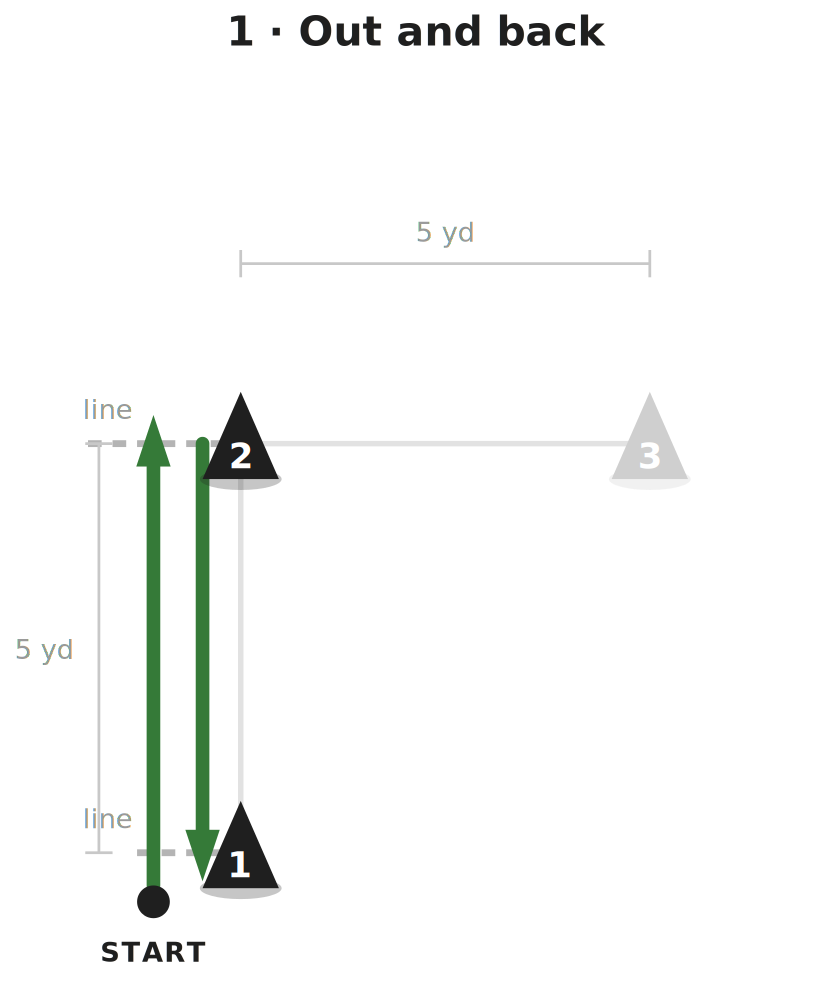
Step 1 · Out and back
Set up in a three-point stance outside cone 1, on the side away from cone 3, one hand on the ground. Sprint to cone 2 and touch the line, then reverse and sprint back to cone 1 and touch the line again. Use the same hand for both touches and stay outside the cones the whole way.
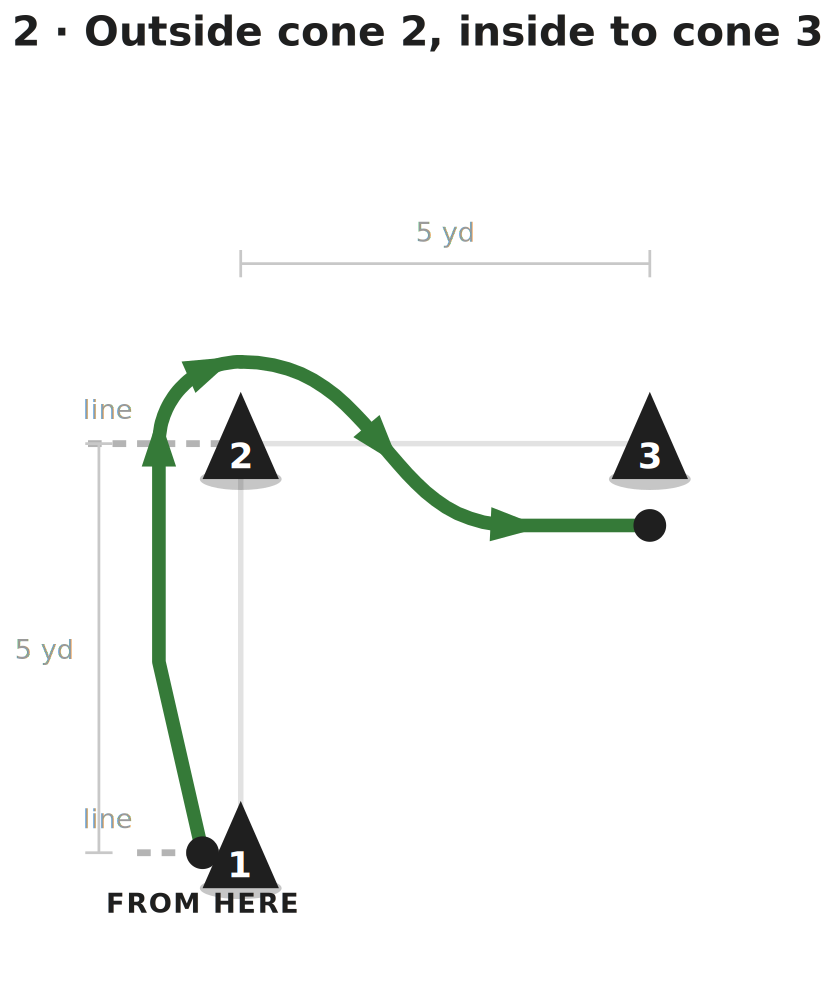
Step 2 · Outside cone 2, inside to cone 3
Sprint back toward cone 2 and run around the outside of it rather than touching it this time, then cut across to the inside and carry on to cone 3. This is where the clock starts getting away from you — the turn should be tight, not rounded off.
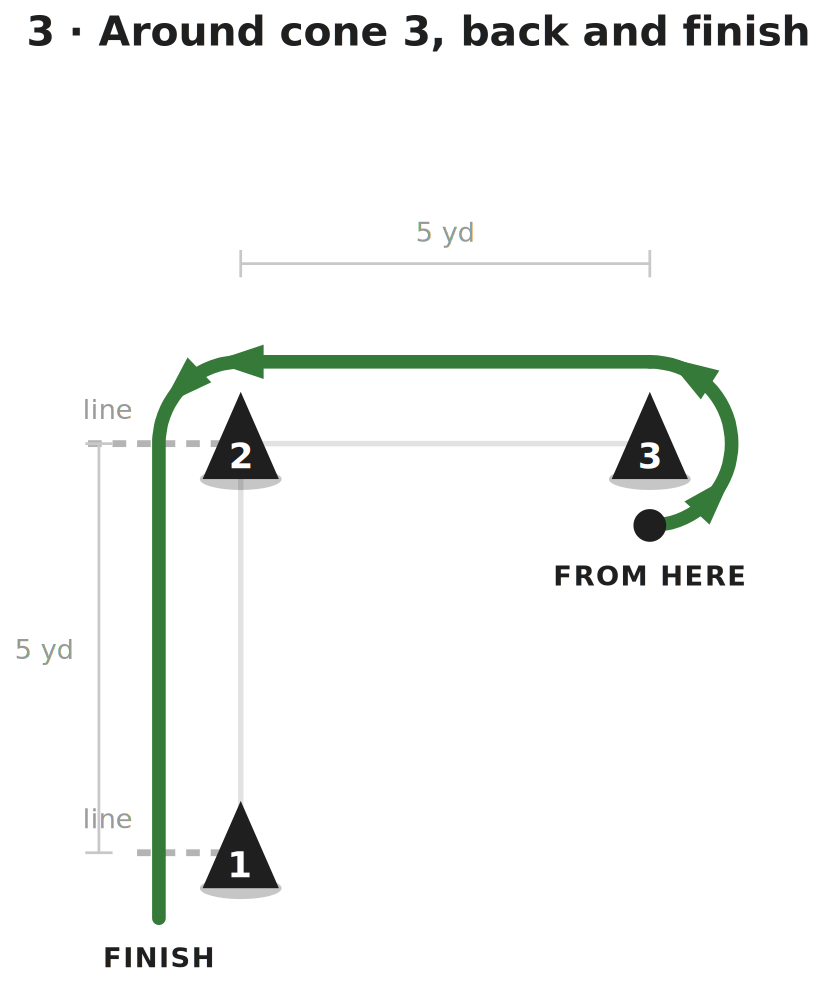
Step 3 · Around cone 3 and finish
Circle cone 3 from the inside to the outside, then come back around the outside of cone 2 and sprint through cone 1. Timing stops as you pass it, and you finish on the side you started from. Six five-yard legs, about 30 yards in total.
Going wide on the turns, failing to touch the lines, drifting inside the cone line, or cutting the figure-eight short all distort the time. Keep the surface, footwear, and timing method consistent between tests.
The Drill in Practice
Cone setup, the out-and-back, and the path around cones 2 and 3 at speed.
Video is external and not produced by Amatal. Follow the written protocol above where the two differ — in particular, cone 3 is entered from the inside and circled inside-to-outside. Times on this page are scored against combine data collected under the standard setup.
- 5-10-5 Shuttle — the other NFL Combine agility test, measuring lateral burst over a 20-yard lane.
- T-Test — adds lateral shuffling and backpedaling to forward sprinting for a multi-directional score.
- Illinois Agility Run — a longer cone course pairing straight-line speed with tight weaving.
How This Calculator Works
This calculator measures your change-of-direction agility using the 3-Cone Drill, also called the L-Drill — the agility test made famous by the NFL Scouting Combine. You select your position and enter your total time in seconds to complete the course. The calculator then compares your result against the real distribution of combine times for that position and reports your tier, your percentile, and a position equivalent.
One thing to keep in mind throughout: for the 3-Cone Drill, a lower time is better. Every part of the calculator — the tiers, the table, the bell curve, the percentile — is built around faster being better, which is the opposite of a reps-based test where more is better.
What This Scale Is — and Isn't
Unlike a general-population fitness test, the 3-Cone Drill has no broad reference norms. It is overwhelmingly a combine test, so essentially all documented data comes from draft-eligible NFL prospects — among the most explosive athletes on the planet. This calculator is built honestly on that data, which means its scope is specific:
- It is an elite benchmark. The average combine time is already elite by general-population standards. A typical recreational athlete will land in the lower tiers or below the bottom of the scale — and that is the data being honest, not an error. There is simply no published general-population 3-Cone data to extend the scale downward.
- It is effectively male. The NFL Combine is essentially all-male, and no comparable female 3-Cone norms exist. The comparison group is therefore male combine athletes. There is intentionally no sex selector.
- Position is everything. Body size and role drive enormous variation in this test — far more than age does in most fitness tests. A great corner and a great tackle can differ by more than a full second and both be elite. Choosing the right position is the single most important input.
Read this way, the calculator answers a precise question: "How would my 3-Cone time rank among combine athletes at my position?" — not "how fit am I in general."
Step 1: Enter Your Details
The calculator needs two inputs: your position and your 3-Cone time.
- PositionSelects which combine distribution you are compared against. Each position has its own mean and spread, so the same time scores very differently across positions. — selects the combine distribution your time is measured against. This is the most consequential choice you make.
- 3-Cone Time — your total time, in seconds, from the start until you finish the course. This single time is your score; there is no separate technique setting.
The calculator covers the seven skill and agility positions where the drill is most meaningful and best sampled: cornerback, wide receiver, safety, running back, quarterback, off-ball linebacker, and tight end. The big-bodied line positions are intentionally excluded — they run the drill far less often, producing thin, self-selected samples that would not support honest tiers.
The Test Protocol
For results that match the norms, the test must be performed the standard way. The 3-Cone Drill uses three cones placed five yards apart in an "L" shape (a right angle):
- Cone setup: Cone 1 is the start. Cone 2 sits 5 yards from Cone 1. Cone 3 sits 5 yards from Cone 2 at a right angle, forming the corner of the L.
- Start: Set up in a three-point stance outside Cone 1, on the side away from Cone 3, with one hand on the ground. All three cones stay on the same side of you for the whole drill.
- Out and back: Sprint to Cone 2 and touch the line, then reverse and sprint back to Cone 1 and touch the line again. Stay outside the cones the whole way — you finish this phase where the next one begins. Use the same hand for both touches.
- Into the L: Sprint back toward Cone 2, but this time run around the outside of it and continue to Cone 3.
- The weave: Cut inside Cone 3 and circle it from the inside to the outside, then come back around the outside of Cone 2 in a figure-eight path.
- Finish: Sprint through Cone 1, finishing on the side you started from. Timing stops as you pass it. The full course is roughly 30 yards.
Going wide on the turns, failing to touch the lines, drifting inside the cone line, or cutting the figure-eight short all distort the time. Equipment is simple — three cones, a measured surface, and a stopwatch — but surface, footwear, and timing method should be kept consistent between tests. Combine times are hand-timed or laser-timed at a high standard; a stopwatch in the field will read slightly differently, so treat your own results as internally consistent rather than directly combine-comparable to the hundredth of a second.
How Your Tier Is Determined
This is where the calculator's data integrity matters most. Each position carries its actual combine distribution — a measured mean, standard deviation, and sample size drawn from combine history. Nothing is invented or interpolated; every threshold is a percentile of a real distribution.
| Position | Mean (s) | Std. Dev. (s) | Sample (N) |
|---|---|---|---|
| Cornerback | 6.94 | 0.197 | 270 |
| Wide Receiver | 6.96 | 0.209 | 558 |
| Safety | 6.99 | 0.212 | 162 |
| Running Back | 7.08 | 0.210 | 229 |
| Quarterback | 7.11 | 0.195 | 161 |
| Linebacker (off-ball) | 7.13 | 0.231 | 188 |
| Tight End | 7.17 | 0.220 | 193 |
Your time is converted to a z-scorez = (your time − position mean) ÷ position standard deviation. It expresses how many standard deviations faster or slower than the position average you are. for your position, and the five tiers are defined as percentile bands on that distribution. Because lower is better, faster times fall to the left of the mean:
Elite ≥ 95th · Superior 80th–95th · Advanced 50th–80th · Intermediate 20th–50th · Low < 20th
Each band maps to a fixed z-cutoff (95th ≈ −1.64, 80th ≈ −0.84, 50th = mean, 20th ≈ +0.84), so the exact time ceilings differ position by position while the scheme stays the same everywhere. You are placed in the highest (fastest) tier you qualify for:
- Low — below the 20th percentile for the position. Slower than roughly four out of five combine athletes at this position. Note that this is still measured against elite athletes.
- Intermediate — 20th to 50th percentile. Below the position median but within the normal combine range.
- Advanced — 50th to 80th percentile. Above the position median — a solid combine result for the position.
- Superior — 80th to 95th percentile. Well above average for the position; among the quicker athletes in the group.
- Elite — 95th percentile or faster. Among the very fastest combine athletes at this position — approaching record territory.
Position Comparison (Percentile)
The percentile estimates the share of combine athletes at your position you are faster than. Unlike tests that only publish category boundaries, here the full distribution is known, so the percentile is computed directly from the normal distributionpercentile = (1 − Φ(z)) × 100, where Φ is the standard normal cumulative distribution. A faster (lower) time yields a higher percentile. of your position's mean and standard deviation — a true z-score percentile, not an interpolation between tiers.
One honest caveat: real 3-Cone times are mildly right-skewed (a few very slow outliers), while the calculation assumes a clean bell curve. The fit is good through the middle of the range, so percentiles near the tiers are reliable; readings in the extreme tails are close approximations rather than exact figures.
Position Equivalent
Your Position EquivalentThe position whose average 3-Cone time is closest to yours — the position-based analog of a "fitness age." is the position your time would be roughly average for. Because each position has a different mean, the same time can be unremarkable for one role and standout for another.
For example, a 7.17-second drill sits near the bottom of the range for a cornerback (mean 6.94s) but lands right on the average for a tight end (mean 7.17s). The card gives you an intuitive cross-position read on where your agility profile fits, independent of the position you selected.
Reading the Bell Curve
The "Where You Fall in Your Position" chart is a normal curve fitted to your selected position's actual combine mean and standard deviation, shaded into the five tiers, with a dashed line and dot marking where you fall. Slower times are on the left and faster times on the right, so the tiers run Low → Elite across the curve from left to right. The red Low region and gold Elite region are deliberately sized to reflect that Low spans the bottom fifth of the position while Elite is only the top few percent. The tooltip shows your time, tier, and percentile together.
How to Read the Standards Table
The standards table lists one row for every position and one column for each of the five tiers, running Low → Elite from left to right. The header labels are color-coded to match the chart bands — on a phone the headers shorten to single letters (L · I · A · S · E); tap any header to see its full name.
- Each cell is a single number — the time ceiling. It shows the slowest time still allowed for that tier at that position. If your time equals or beats it, you have reached that tier.
- The Low column is the exception.Low has no ceiling — it covers every time slower than the Intermediate cutoff. The cell shows ">" followed by that cutoff. Because Low covers everything slower than the Intermediate cutoff, its cell shows a "greater-than" value rather than a target you aim to hit.
- Your position and tier are highlighted. Your position's row is shaded, and within it, the cell for your achieved tier is filled with that tier's color. Reading down a column shows how the same standard shifts across positions — Elite for a tight end is a far more forgiving time than Elite for a cornerback.
How Position Changes Your Score
Position is not just a label — it swaps in an entirely different distribution to measure you against:
- The mean shifts. Faster positions (corner, receiver, safety) have lower averages, so the same time scores lower against them; slower positions (tight end, linebacker) have higher averages, so the same time scores higher. A 7.00-second drill is below the median for a cornerback but comfortably above it for a tight end.
- The spread shifts too. Each position has its own standard deviation, so even two positions with similar averages can grade the same time slightly differently depending on how tightly their athletes cluster.
Why Agility Matters
The 3-Cone Drill is a benchmark for planned change-of-direction ability — the capacity to accelerate, decelerate, bend tightly around an obstacle, and reaccelerate while keeping body control. It is especially prized in evaluating pass rushers, who must maintain speed while bending around offensive linemen, as well as slot receivers and defensive backs who live in tight spaces. A strong 3-Cone time reflects efficient, low-hipped cornering and short-area burst.
Important context: the 3-Cone is a pre-planned drill — you know the course in advance. It therefore measures the physical side of agility (the ability to change direction quickly) rather than reactive agility, which is the ability to read and respond to an unpredictable stimulus. A great 3-Cone time reflects strong movement mechanics and short-area quickness, but it is one piece of the broader agility picture, not the whole of it.
Data Sources and Methodology
The norms and methods in this calculator are built from combine measurement data and established references:
- MockDraftable (Marcus Armstrong). Position Aggregate Statistics. Per-position mean, standard deviation, and sample size for the 3-Cone Drill, pooled across NFL Combine history — the source of every tier boundary and percentile in this tool.
- NFL Scouting Combine. The drill's primary testing context and the population the norms describe.
- Brocato, C. O. The scout credited with devising the three-cone (L) drill as a measure of agility and bend for player evaluation.
- Combine reference points. Documented extremes — such as a 6.28-second record by a cornerback and a 6.42-second mark by a wide receiver — were used to sanity-check that the fastest tier aligns with real elite performances.
A note on the method: every position's tier ceilings and percentiles are derived directly from its measured mean and standard deviation. The only modeling assumption is that times within a position follow an approximately normal distribution — a reasonable, clearly labeled simplification that is accurate through the working range and slightly approximate in the extreme tails.
Limitations and Important Caveats
This calculator provides an estimate, not a clinical measurement. Several factors affect how precisely it reflects your true agility:
- Elite, not general-population. The comparison group is combine athletes. The scale does not extend to untrained or recreational times because no published data exists there — so non-athletes should expect to sit at or below the bottom tier.
- Effectively male data. The combine population is essentially all-male; there are no comparable female norms, so a female user has no native comparison group here.
- Self-selection bias.Players choose whether to run the 3-Cone, and more agile athletes opt in more often, which can pull a position's average slightly faster than its true talent pool. Combine 3-Cone participation is voluntary and skews toward the more agile athletes, which can bias position means slightly fast.
- Position dominates. Selecting the wrong position changes your result more than almost any other factor. Pick the position that matches how you actually move.
- Normal approximation. Percentiles and the bell curve assume a normal distribution; real times are mildly right-skewed, so extreme-tail readings are approximate.
- Timing and setup variability. Cone spacing, surface, footwear, whether you touch the lines, and hand-timing versus electronic timing all shift the result. Keep them consistent so retests are meaningful.
- Single-test snapshot. Fatigue, warm-up, time of day, and recent training all affect a single trial. For tracking progress, retest under the same conditions every few weeks and take the best of two or three trials.
- Planned agility only. The 3-Cone does not capture reactive agility — your ability to respond to an unpredictable cue.
Disclaimer:
This calculator provides an estimate based on NFL Combine performance data and a normal-distribution model. Real agility depends on training history, movement mechanics, body proportions, recovery, and individual variation. The 3-Cone Drill involves maximal acceleration, hard deceleration, and rapid changes of direction that place significant stress on the knees, ankles, and hips. Always warm up thoroughly beforehand and stop immediately if you experience pain, dizziness, or unusual discomfort. This tool is for general informational purposes only and should not be considered medical, fitness, or training advice. Consult a healthcare provider before beginning a new exercise or testing program, especially if you have a pre-existing condition, are over the age of 45, or have been sedentary for an extended period.