
Illinois Agility Test
Change-of-Direction Agility Assessment
Read the disclaimer below before attempting this test.
Illinois Agility Test Standards
Where You Fall
Modeled Distribution
How to Run the Illinois Agility Test
Eight cones, three continuous phases, about 60 meters of sprinting, weaving and turning against the clock.
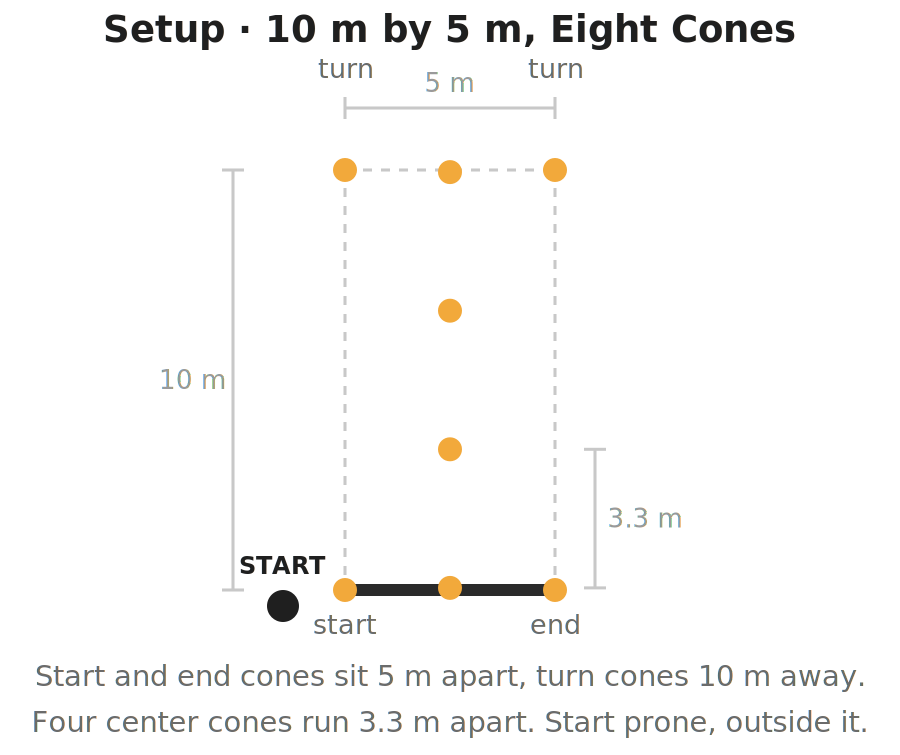
Setup · 10 m by 5 m, Eight Cones
Mark a 10 m × 5 m area. Put a start and an end cone 5 m apart at the near end, two turning cones facing them 10 m away, and four cones down the middle 3.3 m apart. Start face down, hands by your shoulders, just outside the start cone.
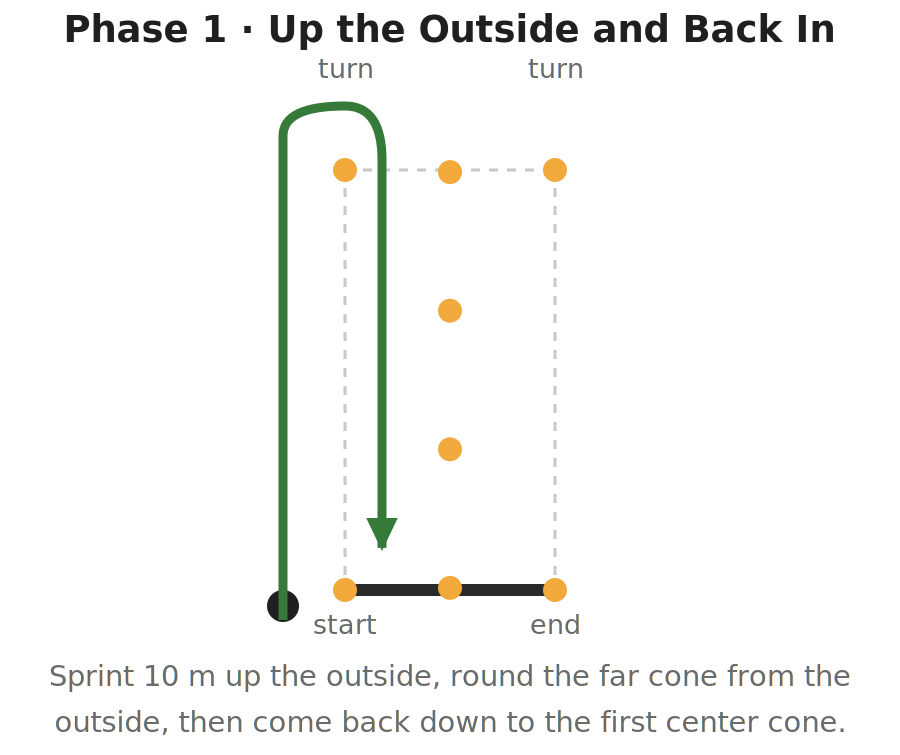
Phase 1 · Up the Outside and Back In
Get to your feet and sprint 10 m up the outside. Curve around the far cone from the outside and come back down 10 m, finishing at the first center cone — where the weave begins.
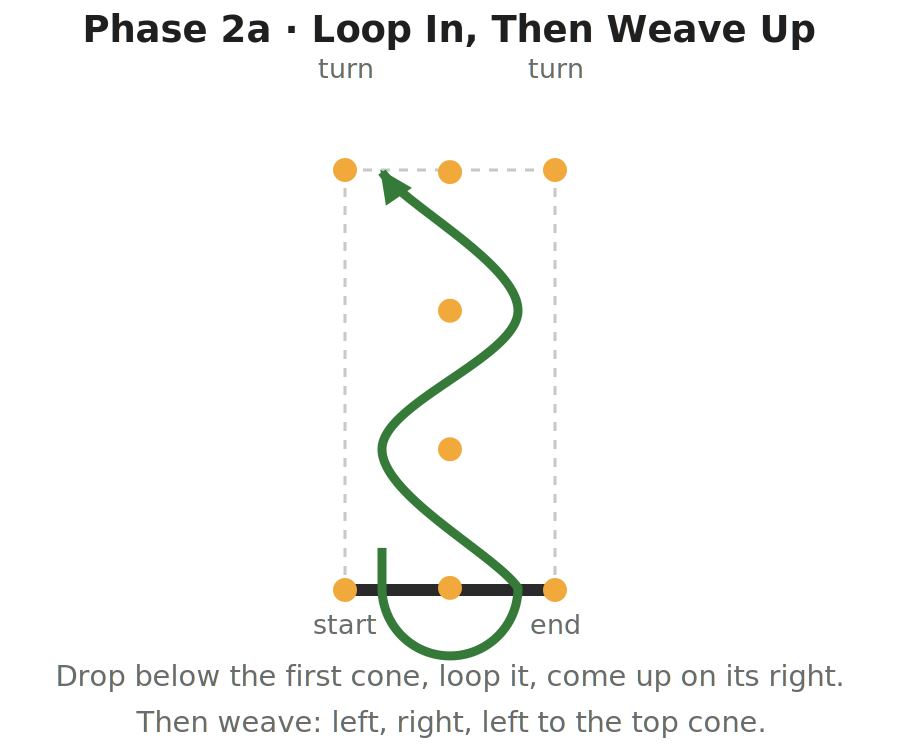
Phase 2a · Loop In, Then Weave Up
Loop around the first center cone, then slalom up the line of four, passing each one on the opposite side to the last. The loop at the bottom is what sets which side you start on.
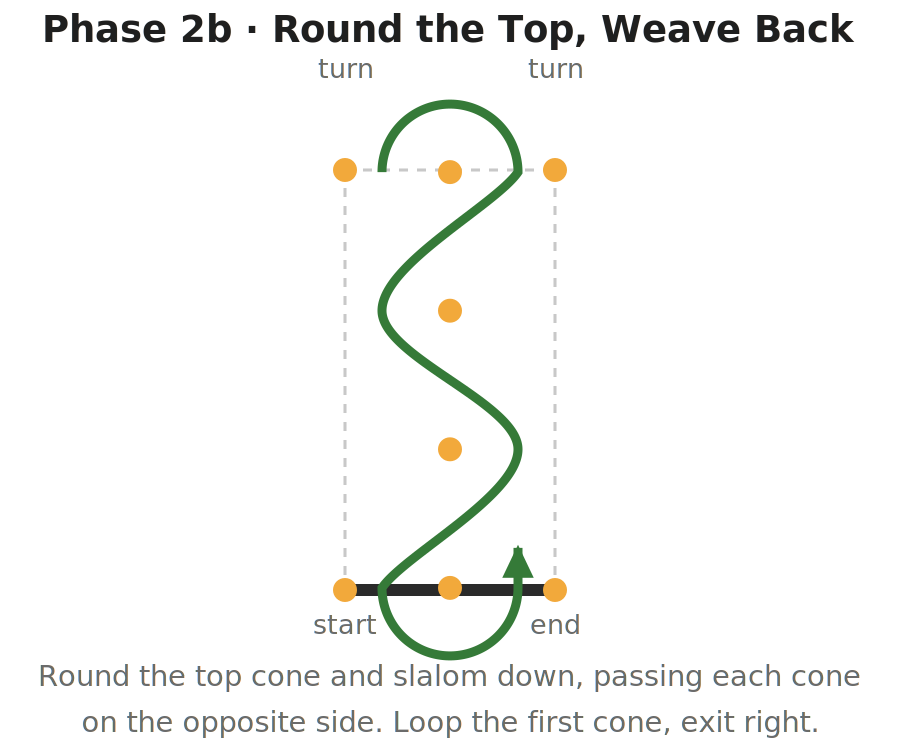
Phase 2b · Round the Top, Weave Back
Curve around the top cone and slalom back down, taking every cone on the opposite side from the way up. Loop the first center cone again on your way out. Knocking a cone over voids the trial.
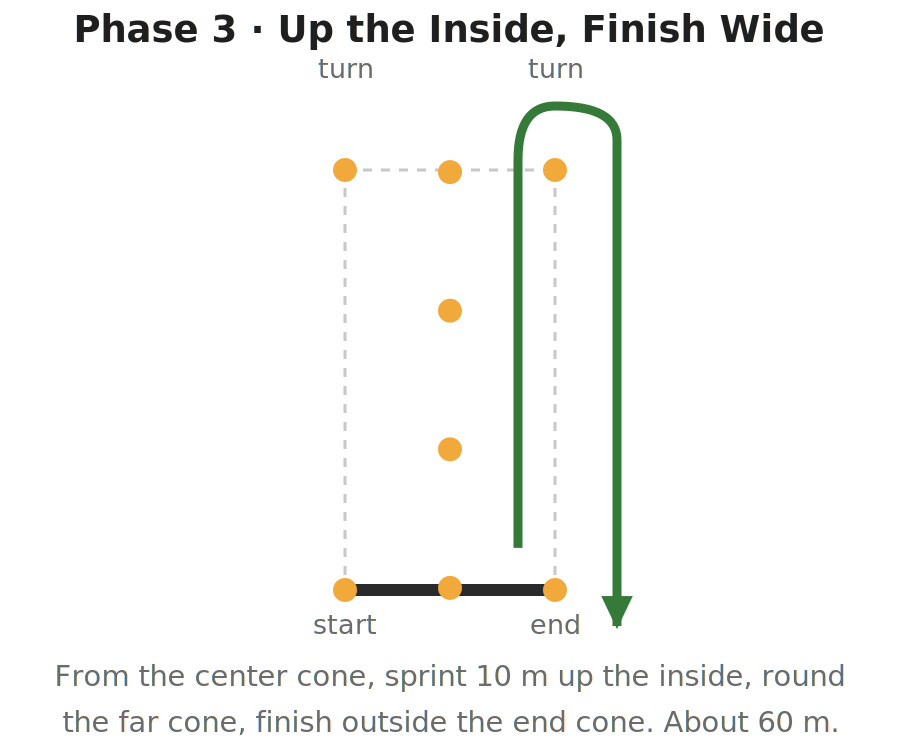
Phase 3 · Up the Inside, Finish Wide
From that same center cone, sprint 10 m up the inside, curve around the far cone, and come back down 10 m on the outside. Timing stops as you pass the end cone — about 60 m all told.
The three phases run without a break — each one finishes where the next begins, so there is no pause at the center cone. Walk the route once and run it at submaximal speed before recording anything, because a wrong turn or a knocked cone voids the trial. Take the best of two or three attempts with full rest between them, and keep the surface and footwear consistent, since both noticeably change the time.
The Test in Practice
A police recruiting demonstration of the course, run end to end at full speed.
Video is from a police recruiting unit, not produced by Amatal. It demonstrates the department's own entry standard rather than the reference table on this page, so use it for the shape of the course and not for the time. One detail it does settle: the turns are run around the far cones. Where a version uses a line instead of a cone at the turnaround, times come out faster and are not comparable to these ratings.
- T-Test — a shorter multi-directional course, and the test most often benchmarked alongside this one.
- Edgren Side Step Test — drops the running entirely and counts lateral shuffles against the clock.
- 505 Agility Test — isolates a single 180-degree turn, scoring each leg separately for left-right symmetry.
How This Calculator Works
This calculator measures your change-of-direction agility using the Illinois Agility Test — one of the most widely used field assessments of running agility, combining acceleration, hard deceleration, tight turning, and weaving. You enter your total time in seconds to complete the course, and the calculator classifies your result against the published Illinois norms, returning your rating on the original five-band scale.
One thing to keep in mind throughout: for this test, a lower time is better. Every part of the calculator — the rating bands, the table, the strip, the distribution — is built around faster being better, which is the opposite of a reps-based test where more is better.
It is worth being clear up front about what this calculator does not do. The published Illinois norms are a single standard for one reference group (see below), not a set of age-by-age tables. So — unlike some other assessments on this platform — this tool deliberately does not compute an age-adjusted score, an "agility age," or a precise percentile. None of those are supported by the source data, and inventing them would misrepresent how solid the numbers are. What you get instead is honest: your rating, the published table, and a clear picture of where your time falls.
Step 1: Enter Your Details
The calculator needs your sex and your time. Age is optional.
- SexThe Illinois norms are reported separately for males and females, reflecting differences in sprint speed and change-of-direction performance. — selects which column of the normative table you are compared against.
- Age (optional) — does not change your rating. It is used only to show a relevance note: whether you sit inside the 16–19 reference group the norms were built for, or outside it (where the table is still a useful benchmark, just not age-adjusted).
- Test Time — your total time, in seconds, from the "Go" signal until you cross the finish line. This single time is your score.
The Test Protocol
For your result to match the norms, the test must be run the way the norms were collected. The Illinois course is a rectangle 10 meters long and 5 meters wide, marked with eight cones:
- Course setup: Four cones mark the corners — the start and end cones 5 m apart at the near end, and two turning cones facing them 10 m away. Four more cones run down the center line in a straight row, spaced 3.3 meters apart, for the weaving section. (In imperial terms the course is sometimes laid out as roughly 30 ft × 15 ft.)
- Start: Lie face down (prone) with your head at the start line and hands by your shoulders. On the "Go" command, the clock starts and you get up as fast as possible.
- Run the course: Three continuous phases, each ending where the next begins. One: from outside the start cone, sprint 10 m up the outside, round the far cone from the outside, and come back down to the first center cone. Two: loop around that first center cone, weave up the line of four, round the top one, and slalom back down — taking every cone on the opposite side from the way up — then loop the first cone again on your way out. Three: from that same center cone, sprint 10 m up the inside, round the far cone, and finish outside the end cone.
- Finish: Timing stops as you cross the finish line. Total distance covered is roughly 60 meters, and a trial typically takes 15–25 seconds.
A trial is void if you knock over a cone or fail to follow the prescribed path. Equipment is simple — eight cones, a measured surface, and a stopwatch (or timing gates) — but the surface and footwear should be kept consistent between tests, since both noticeably affect the time. Athletes usually run several trials with full rest and keep the fastest.
How Your Rating Is Determined
The Illinois Agility Test has its own published five-band rating scale, and this calculator keeps those bands and their original names exactly as published rather than reshaping them into the tier labels used elsewhere on the platform. That is a deliberate choice: the bands and their cut points come straight from the source, so the most faithful thing to do is present them unchanged.
Excellent · Above Average · Average · Below Average · Poor
The colors run gold → red by position (gold for the fastest band down to red for the slowest), borrowing the platform's existing palette so the rating reads at a glance. The published time cut points are:
Female (seconds): Excellent < 17.0 · Above Average 17.0–17.9 · Average 18.0–21.7 · Below Average 21.8–23.0 · Poor > 23.0
Your time is checked against these ranges and you are placed in the fastest band you qualify for — the best rating whose time window your result falls into. Note that these are qualitative rating bands, not percentile-defined cut points; the source describes them as performance ratings, and this calculator does not attach a population percentile to them.
One Standard, Not an Age Curve
The published Illinois norms describe one reference group: national-level 16–19 year oldsFrom Davis et al. (2000), Physical Education and the Study of Sport, reproducing norms originating with Getchell (1979). The stated target group is national-standard 16–19 year olds.. They are a single fixed standard, not a set of thresholds that shift by age.
Because of that, this calculator applies the same cut points to everyone and does not pretend to scale them across the lifespan. There is no published age-by-age Illinois table to interpolate from, so building a smooth age curve would mean inventing numbers — exactly the kind of fabricated precision this platform avoids. Age stays optional and informational:
So if you are well outside the 16–19 window, treat your rating as a sensible benchmark against a young-adult standard rather than as a precise verdict for your exact age.
Reading the Visuals
The calculator shows three things below your result, and they answer different questions.
- Illinois Agility Test Standards is the published table itself — every band, for both sexes, exactly as sourced. Your sex column and your rating row are highlighted so you can see where you land and what the next band up requires.
- Where You Fall draws the five rating bands along the time axis for your sex, with a marker on your result. It runs Poor → Excellent from left to rightThe axis is reversed so that faster times sit on the right. Slower (worse) times are on the left, faster (better) times on the right., so faster is to the right. The bands are drawn straight from the published cut points — nothing modeled. You will notice the Average band for females is very wide (18.0–21.7 s); that breadth is a genuine feature of the original table, not a glitch.
- Modeled Distribution is the one illustrative element. It is a normal (bell) curveA smooth curve centered on the rating bands, included for visual continuity with other tools. The source gives rating bands, not a measured population distribution, so this is an approximation only. centered on the bands and shaded into the five colors, with a marker for your time. It is clearly labeled as a visual aid — the source does not provide a population distribution, so this curve is not measured data and carries no percentile claim. It is the first thing to ignore if you want only the published figures, and easy to remove entirely.
How to Read the Standards Table
The table has one row per rating band and one column per sex, with the bands running Excellent → Poor from top to bottom. The rating names are color-coded to match the strip and distribution.
- Each cell is a time range, not a single number. Unlike a ceiling-style table, the Illinois bands are published as ranges (for example, male Average is 16.2–18.1 s), and the table shows them that way.
- Your column and rating are highlighted. The column for your selected sex is shaded, and within it the cell for your achieved band is filled with that band's color.
How Age and Sex Change Your Result
These two inputs play very different roles here:
- Sex selects the table. Choosing male or female swaps in a separate set of published cut points, so the same time is scored against different benchmarks depending on which column applies.
- Age does not change your rating. Because the norms are a single 16–19 standard, your band is the same regardless of the age you enter. Age only drives the relevance note described above. This is intentional — it keeps the result honest rather than implying an age adjustment the data cannot support.
Why Agility Matters
The Illinois Agility Test is a benchmark for planned change-of-direction ability — the capacity to accelerate from a standstill, sprint, decelerate, turn sharply, and weave while keeping body control. Those qualities underpin performance in court and field sports such as soccer, rugby, basketball, and field hockey, and in tactical occupations. Developed by Getchell in 1979, it remains popular because it is quick, needs little equipment, and has good test-retest reliability when administered consistently.
Important context: the Illinois test is a pre-planned drill — you know the course in advance. It therefore measures the physical side of agility (how fast you can change direction) rather than reactive agility, the ability to read and respond to an unpredictable stimulus. Research also suggests Illinois performance correlates more strongly with straight-line speed than with leg power, so a fast time reflects strong sprint mechanics and turning ability, but it is one piece of the broader agility picture, not the whole of it.
Data Sources and Methodology
The norms and protocol in this calculator are drawn from established testing references:
- Getchell, B. (1979). Physical Fitness: A Way of Life. 2nd ed. New York: John Wiley & Sons — the origin of the test and its norms.
- Davis, B. et al. (2000). Physical Education and the Study of Sport. — the published rating table used here, for national-level 16–19 year olds.
- Topend Sports. Illinois Agility Test & Norms. — widely cited reproduction of the protocol and rating scale.
- Roozen, M. (2004). Illinois Agility Test. NSCA's Performance Training Journal, 3(5), 5–6 — protocol and interpretation.
A note on faithfulness: the rating bands, their names, and their cut points are reproduced from the source without modification. The reference group is national-level 16–19 year olds, so the standard is not age-adjusted. The only modeled element in the tool is the illustrative distribution curve, which is labeled as such and asserts no measured percentile.
Limitations and Important Caveats
This calculator provides an estimate, not a clinical measurement. Several factors affect how precisely it reflects your true agility:
- One reference group. The norms describe national-level 16–19 year olds. For anyone outside that range the rating is a benchmark against a young-adult standard, not an age-specific result.
- Coarse, qualitative bands. The bands are broad rating categories rather than fine percentile cut points — most strikingly the female Average band (18.0–21.7 s), which spans nearly four seconds. Two quite different times can share a rating.
- Setup and surface variability.Cone spacing, the testing surface, footwear, and turning technique all change the time. Standardize them to make retests meaningful. Non-standard setups bias the result. Keep the course, surface, and footwear consistent across tests.
- Timing method matters. Manual stopwatch timing carries roughly ±0.2 s of error; electronic timing gates are far more precise. Compare like with like.
- The distribution curve is modeled. It is a normal approximation centered on the rating bands, included for illustration only — not a measured population, and not a source of percentiles.
- Single-test snapshot. Fatigue, warm-up, time of day, and recent training all affect a single trial. For tracking progress, retest under the same conditions every few weeks and take the best of two or three trials.
- Planned agility only. The test does not capture reactive agility — your ability to respond to an unpredictable cue — and does not distinguish left- from right-turning ability.
Disclaimer:
This calculator provides an estimate based on established normative data. Real agility depends on training history, movement mechanics, body proportions, recovery, and individual variation. The Illinois Agility Test begins from a face-down position and involves an explosive get-up, maximal sprinting, hard deceleration, and repeated sharp turns that place significant stress on the knees, ankles, hips, and lower back. Always warm up thoroughly beforehand and stop immediately if you experience pain, dizziness, or unusual discomfort. This tool is for general informational purposes only and should not be considered medical, fitness, or training advice. Consult a healthcare provider before beginning a new exercise or testing program, especially if you have a pre-existing condition, are over the age of 45, or have been sedentary for an extended period.